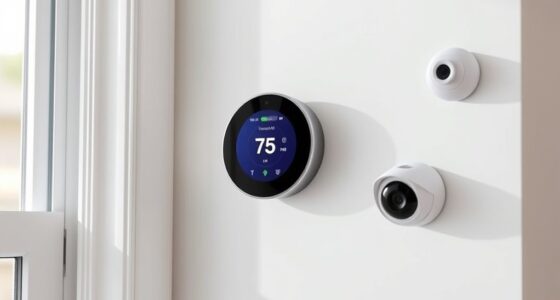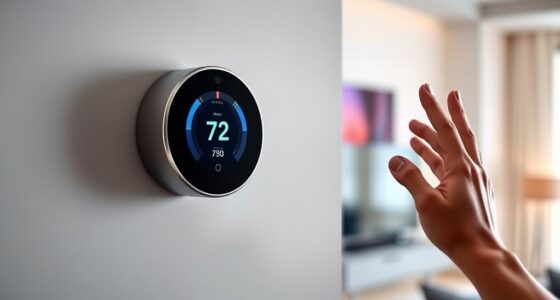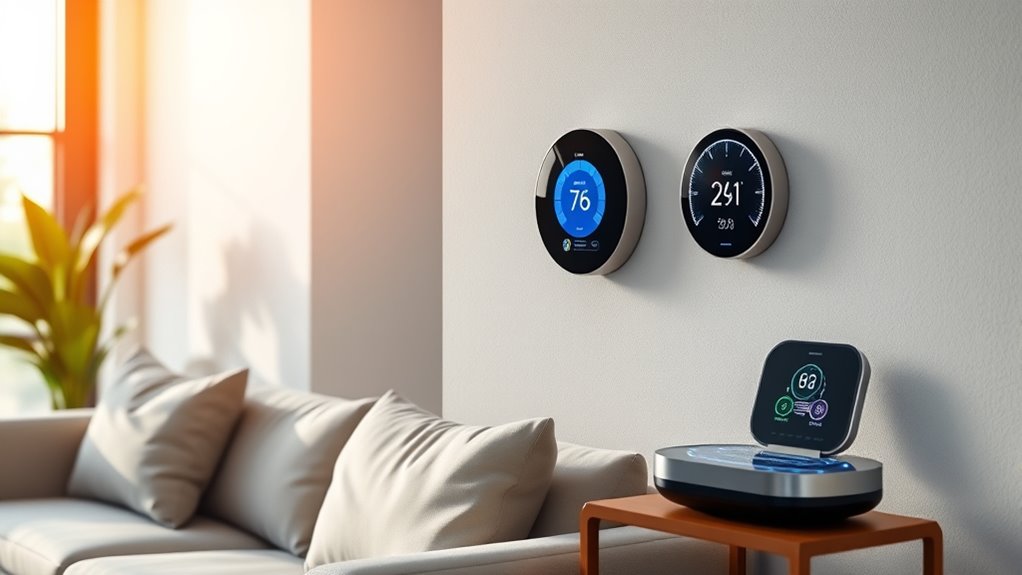

Integrating smart thermostats with learning AI hubs lets you automate your home’s climate control for maximum comfort and savings. The system analyzes your routines, occupancy, and weather conditions to customize heating and cooling schedules automatically. It learns from your preferences over time and makes preemptive adjustments, reducing energy waste. You can control everything remotely via apps or voice commands. Keep exploring to discover how this smart setup can create a more efficient and personalized home environment.
Key Takeaways
- Smart thermostats can connect seamlessly with AI hubs to enable automated, adaptive climate control based on user behavior and environmental data.
- Integration allows AI hubs to analyze routines, occupancy patterns, and weather for optimized heating and cooling schedules.
- AI hubs continuously learn from user preferences and adjust thermostat settings for personalized comfort and energy savings.
- Remote management via smartphone apps or voice commands enhances user control and system responsiveness.
- Combining these technologies improves energy efficiency, reduces costs, and promotes sustainable home climate management.

Smart thermostats with learning AI hubs are transforming how you control indoor temperatures, making your home more comfortable and energy-efficient. These devices are designed to adapt to your habits and preferences, creating a tailored environment that balances comfort with savings. By leveraging advanced AI, they analyze your daily routines, occupancy patterns, and even local weather conditions to optimize heating and cooling schedules automatically. This means you no longer need to manually adjust settings throughout the day or worry about wasting energy when you’re away. Instead, the system learns from your behavior, adjusting itself to maintain the perfect temperature at the right times, which considerably boosts energy efficiency. This reduces your utility bills and minimizes environmental impact, all while keeping your home cozy when you’re there.
Smart AI thermostats learn your habits to optimize comfort and energy savings effortlessly.
User personalization is at the core of these smart systems. As you interact with your AI hub, it gathers data to better understand your preferences—such as preferred room temperatures, wake-up times, and bedtime settings. Over time, it refines its adjustments, providing a customized climate that feels just right. Because the AI learns your habits, it can preemptively change the temperature before you arrive home or when you wake up, ensuring you always wake up to a warm house or come back to a comfortably cooled space. This level of personalization also extends to integrating with other smart devices in your home, such as lights or blinds, to create a seamless environment that responds intuitively to your routines.
Integration with learning AI hubs makes it easier to manage your home’s climate remotely through smartphone apps or voice commands. You can check current temperatures, tweak settings, or override schedules without being physically present. This flexibility allows you to fine-tune your system for maximum comfort and efficiency, whether you’re at work, on vacation, or just relaxing at home. The AI hub continually updates its algorithms based on new data, ensuring that your home adapts to changing seasons, occupancy, and even unexpected weather shifts. This dynamic adjustment helps prevent energy waste and keeps your home comfortable year-round. Additionally, the system can incorporate data analysis to further refine its performance and predict future temperature needs.
Ultimately, combining smart thermostats with learning AI hubs offers a smarter, more personalized way to manage your indoor climate. It saves energy, reduces costs, and creates a home environment that adapts to your lifestyle seamlessly. By trusting the AI to learn and adjust, you can enjoy greater convenience, improved comfort, and a more sustainable way to maintain your ideal indoor temperature.
Frequently Asked Questions
How Secure Are Smart Thermostats Connected to AI Hubs?
Smart thermostats connected to AI hubs are generally secure, but you should stay aware of privacy concerns and hacking risks. Manufacturers implement encryption and security protocols, but vulnerabilities can still exist. You can reduce risks by regularly updating firmware, using strong passwords, and enabling two-factor authentication. Staying informed about security features helps protect your device and personal data, ensuring your smart thermostat remains a safe part of your smart home.
Can Smart Thermostats Work With Non-Ai Compatible Hubs?
Yes, smart thermostats can work with non-AI compatible hubs, but device compatibility varies. You might need a hub that supports standard protocols like Z-Wave or Zigbee to guarantee smooth integration. Keep in mind, using non-AI hubs restricts user customization and automation options. If you want more advanced features, consider upgrading to an AI-compatible hub, which offers smarter control and personalized settings tailored to your preferences.
What Is the Energy Savings Potential of Integrated Systems?
Imagine a household that installs an integrated smart thermostat with a learning AI hub. You could see up to 20-30% energy savings, boosting energy efficiency and reducing costs. These systems adapt to your routines, optimize heating and cooling, and prevent energy waste. As a result, you benefit from significant cost reduction over time, making your home more sustainable and economical while contributing to overall energy conservation efforts.
How Do Learning AI Hubs Adapt to User Behavior Over Time?
Learning AI hubs adapt to your behavior patterns over time by analyzing your daily routines and preferences. They use adaptive algorithms to identify when you’re home or away, adjusting temperature settings accordingly. As you change your habits, the system learns and refines its responses, ensuring ideal comfort and energy efficiency. This continuous learning process allows the hub to personalize your environment, saving energy without sacrificing comfort.
Are There Compatibility Issues With Existing Home Automation Systems?
A stitch in time saves nine, and compatibility issues can be tricky. You might face device interoperability challenges with existing home automation systems, especially if hardware or software isn’t up-to-date. Keep your software updated regularly, and check if your smart thermostat works seamlessly with your AI hub. Sometimes, you may need additional adapters or firmware updates to guarantee everything communicates smoothly, avoiding headaches down the line.
Conclusion
So, now you can sit back and let your smart thermostat learn your every move—because who doesn’t want a device that judges your temperature preferences with the subtlety of a overbearing roommate? Soon, your AI hub will predict when you’re cold, hot, or just too lazy to adjust manually. Just remember, in the quest for perfect comfort, you might end up giving up control altogether—after all, who needs free will when you have a thermostat that knows better?