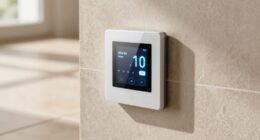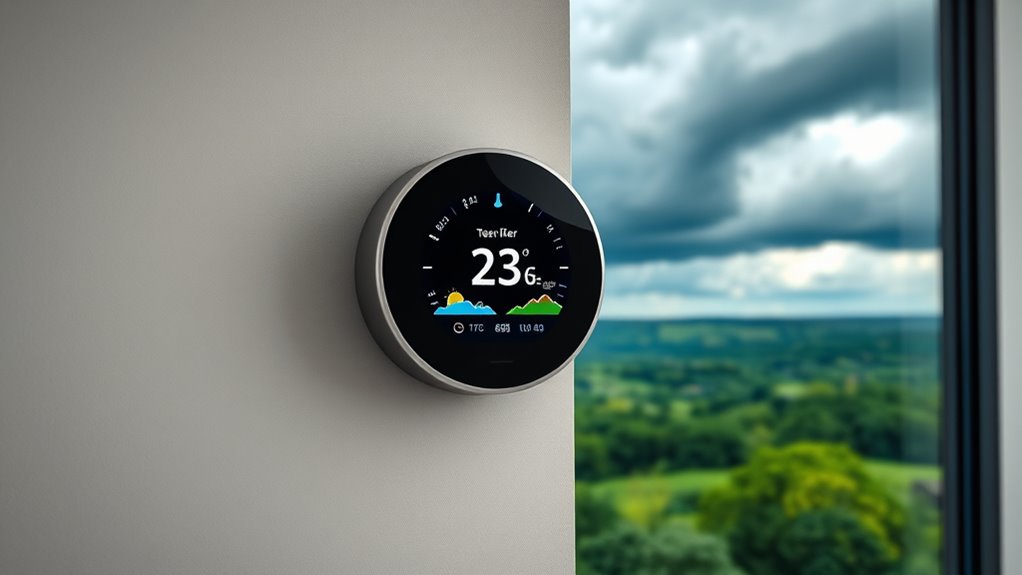
Smart thermostats connect to Wi-Fi to access real-time weather forecast data, including temperature, humidity, and wind conditions. They analyze this information through algorithms that consider your home’s specific characteristics and local climate patterns. Based on forecasted changes, they automatically adjust heating or cooling to improve comfort and save energy. Accurate weather insights help your thermostat make smarter decisions, ensuring you stay comfortable regardless of outdoor weather shifts. Continue to explore how this technology works to get the full picture.
Key Takeaways
- Smart thermostats connect to weather forecast services via Wi-Fi to access real-time weather data.
- Forecast information includes temperature, humidity, wind speed, and precipitation predictions.
- Data is processed through algorithms that analyze local climate patterns and forecast accuracy.
- Thermostats adjust heating, cooling, and humidity settings proactively based on forecasted conditions.
- Integration enables energy-efficient, comfortable indoor environments by anticipating outdoor weather changes.
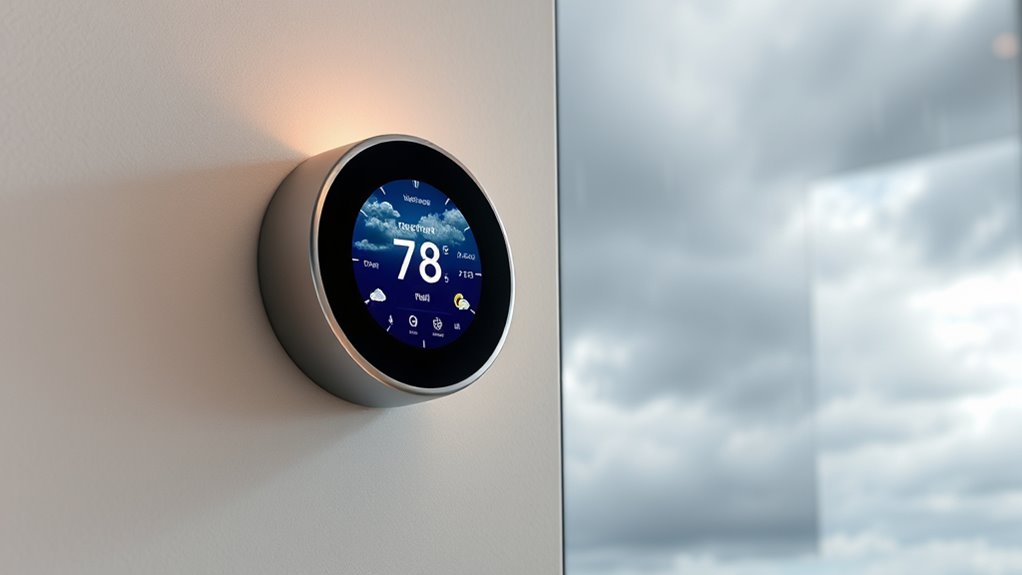
Integrating weather forecasts into thermostats allows you to optimize your home’s comfort and energy efficiency automatically. When your thermostat taps into real-time weather data, it can adjust settings proactively, ensuring your indoor environment remains comfortable without you having to lift a finger. This integration relies heavily on understanding climate patterns, which influence how weather information is gathered and interpreted. Climate patterns help forecast providers predict temperature fluctuations, humidity levels, and other atmospheric conditions, making the data more relevant to your location. As a result, the forecast accuracy improves, allowing your thermostat to make smarter decisions about heating and cooling. The better the forecast accuracy, the more precisely your system can prepare for upcoming weather changes, reducing unnecessary energy consumption and maintaining a consistent indoor climate.
Integrating weather forecasts with thermostats enhances comfort and efficiency by leveraging climate patterns for smarter heating and cooling decisions.
Your smart thermostat connects to weather services via Wi-Fi, pulling in forecast data that includes temperature predictions, precipitation likelihood, wind speeds, and other pertinent information. This data is then processed through algorithms designed to analyze local climate patterns, giving your thermostat a clear picture of upcoming conditions. For example, if a cold front is predicted to arrive overnight, your thermostat can pre-heat your home in advance, so you wake up to a warm environment without wasting energy throughout the day. Likewise, if a heatwave is forecasted, it can pre-cool your space during off-peak hours, saving you money on energy bills. This proactive approach hinges on the forecast accuracy, which is constantly improving as weather models become more sophisticated and data sources expand. Understanding climate patterns is essential for making these predictions more reliable and tailored to your specific environment.
The integration process isn’t just about receiving weather updates; it involves smart decision-making algorithms that interpret the forecast data relative to your home’s specific characteristics. These algorithms adjust your HVAC system’s operation based on anticipated weather changes, ensuring comfort while minimizing energy waste. For example, if the forecast predicts high outdoor temperatures during the day, your thermostat might lower cooling efforts early in the morning or adjust ventilation accordingly. Conversely, if rain or humidity is expected, it can modify humidity controls to prevent mold growth and maintain indoor air quality. The key is that your thermostat uses forecast accuracy to inform these adjustments, making your home more energy-efficient and comfortable.
Ultimately, weather forecast integration transforms your thermostat into a proactive system that anticipates weather impacts rather than reacting to them. By leveraging accurate climate pattern predictions, it ensures your home remains comfortable, even when outdoor conditions shift unexpectedly. This seamless coordination between weather data and your HVAC system not only enhances your living environment but also helps you save money and reduce your ecological footprint. As forecast technology continues to evolve, so will your thermostat’s ability to optimize your home’s climate with even greater precision and reliability.
Frequently Asked Questions
How Accurate Are Weather Forecasts Used by Smart Thermostats?
Weather forecasts used by smart thermostats are generally quite accurate, thanks to advanced forecast accuracy and reliable data sources like national weather services and local sensors. You can trust that these forecasts provide precise predictions for your area, helping your thermostat adjust efficiently. While no forecast is perfect, the integration of high-quality data sources guarantees you get timely, accurate weather info to optimize your home’s comfort and energy savings.
Can Weather Forecast Data Be Customized for Specific Locations?
Think of your smart thermostat as a seasoned sailor steering by stars. It can be customized with location-specific data, like a sailor adjusting course based on unique currents. By tapping into trusted weather data sources, your device considers your exact area. This way, it anticipates local weather shifts, ensuring your home stays perfectly comfortable, no matter if the forecast calls for rain, sun, or snow in your specific neighborhood.
How Often Do Smart Thermostats Update Weather Information?
Your smart thermostat updates weather information typically every 15 minutes to an hour, depending on its settings and data refresh rate. It uses temperature sensors and online weather data to adjust your home’s climate proactively. You can often customize update frequency through the app or settings, ensuring your thermostat stays informed with recent weather forecasts. This frequent data refresh helps maintain comfort and energy efficiency in your home.
Do Weather Forecast Integrations Work During Severe Weather Events?
During severe weather events, weather forecast integrations act like vigilant sentinels, alerting you with real-time hazard detection and severe weather alerts. They continue to work, adjusting your thermostat based on evolving conditions, much like a guardian watching over your comfort. While data might sometimes lag, most smart thermostats endeavor to provide the latest updates, helping you stay safe and comfortable even when nature throws its fiercest storms your way.
Are There Any Privacy Concerns With Weather Data Collection?
You might worry about privacy when your smart thermostat collects weather data, but manufacturers prioritize data privacy and limit data sharing. They typically anonymize information and only share necessary data with trusted sources to improve forecasts. Still, it’s smart to review privacy policies and settings to guarantee your data isn’t exposed or used without your consent. Being informed helps you enjoy smart features without compromising your privacy.
Conclusion
By integrating weather forecasts, your smart thermostat stays one step ahead, adjusting your home’s temperature efficiently. This seamless connection helps you save energy and stay comfortable no matter what the weather brings. It’s like having a weather wizard on your side, turning the unpredictable into something manageable. When it comes to smart technology, understanding how it works is key—after all, knowledge is power, especially when it keeps your home cozy and your bills in check.