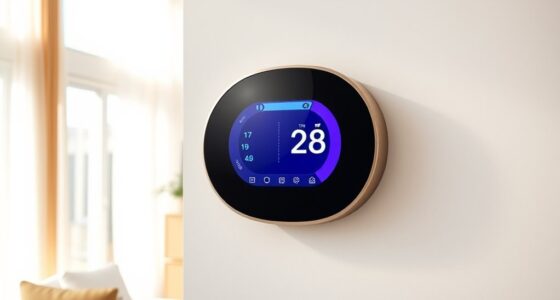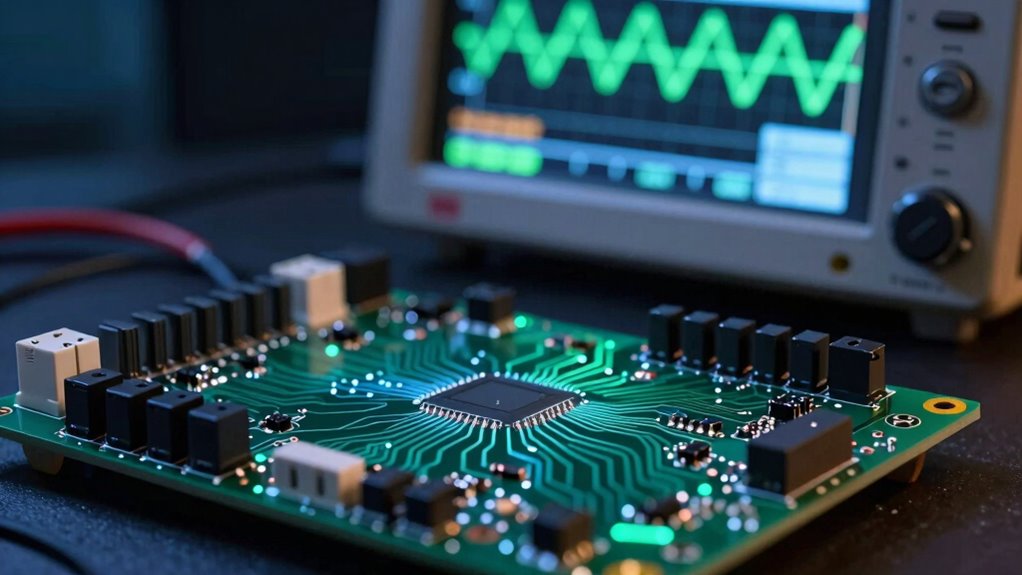

Circuit-level monitoring might sound nerdy, but it saves tons of money by catching issues early before they turn into costly failures. It helps you track voltage, current, and temperature in real time, often wirelessly, making maintenance easier and faster. By using energy-efficient sensors, you guarantee system reliability with minimal added power use. If you want to see how these technical tools can boost your efficiency and cut costs, keep exploring the benefits they offer.
Key Takeaways
- Continuous monitoring prevents costly system failures through early detection of issues like overheating or voltage spikes.
- Wireless, energy-efficient sensors enable real-time alerts, reducing manual inspections and maintenance costs.
- Predictive maintenance based on data analysis minimizes downtime and emergency repair expenses.
- Proactive system management extends equipment lifespan, leading to significant long-term savings.
- Technical monitoring transforms into strategic savings by optimizing system performance and resource utilization.
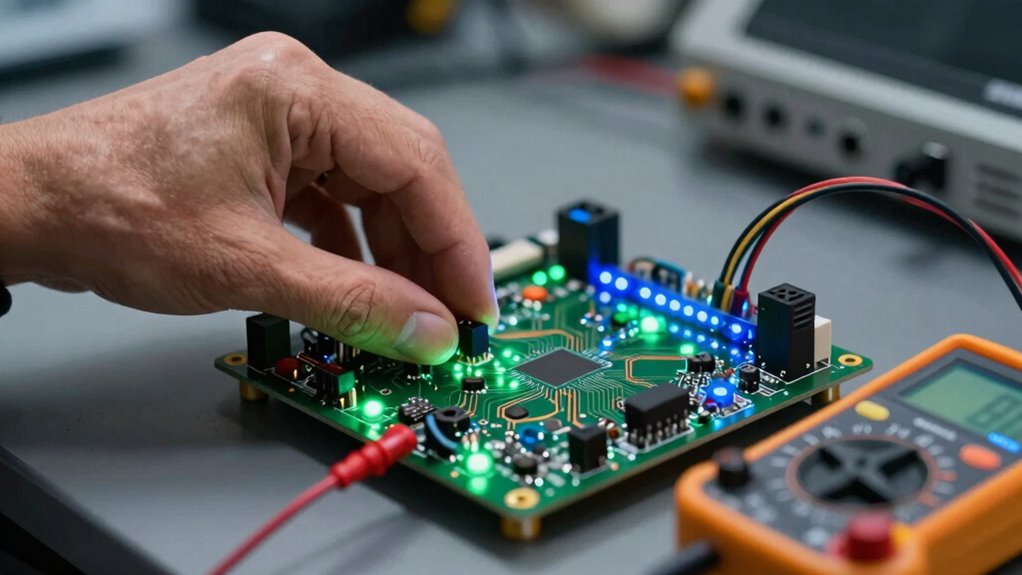
Have you ever wondered how critical system components stay reliable and efficient? It’s not just about robust hardware or clever design—it’s also about continuous monitoring at the circuit level. This process might sound nerdy, but it plays an essential role in keeping systems running smoothly and saving money in the long run. When you think of circuit-level monitoring, envision a network of sensors and data points that track voltage, current, temperature, and other crucial parameters in real time. These tiny, often invisible, checks provide a detailed picture of how your system operates, revealing issues before they escalate into costly failures. Implementing real-time data collection enhances the effectiveness of these systems by allowing immediate responses to anomalies. Wireless integration is a game-changer here. Instead of deploying cumbersome wires or manual inspections, you can connect monitoring devices wirelessly. This approach simplifies installation and allows you to gather data from hard-to-reach places without disrupting your system’s operation. Wireless integration also means you can receive alerts instantly if something’s amiss—say, an unexpected spike in power consumption or overheating components. This proactive insight helps you address problems early, preventing system downtime and avoiding expensive repairs or replacements. Power consumption is a crucial factor in circuit-level monitoring. You need sensors and monitoring devices that are energy-efficient; otherwise, they might add unnecessary load or drain your system’s power resources. Modern monitoring solutions are designed to be low-power, ensuring they don’t interfere with the normal operation of your devices. By keeping power consumption in check, you extend the lifespan of your sensors and reduce operational costs. Plus, low-power devices are especially advantageous in remote or embedded systems, where power availability is limited. Understanding system reliability and integrating it into your monitoring strategies can significantly enhance system longevity and performance. Additionally, predictive maintenance relies heavily on continuous data analysis to forecast potential failures before they happen, further reducing costs. Incorporating advanced sensors can also lead to more comprehensive data collection, enabling better detection of subtle issues. The real value of circuit-level monitoring becomes clear when you see how it impacts your bottom line. Instead of waiting for a failure to happen, you get real-time data that enables predictive maintenance. This means you can schedule repairs before a breakdown occurs, minimizing downtime and reducing emergency repair costs. Over time, these savings can be substantial, especially in large, complex systems where failures can cost thousands of dollars per incident. Additionally, continuous monitoring improves system efficiency—by identifying inefficiencies, you can optimize power usage and extend equipment lifespan, further saving money and resources. Incorporating advanced sensors enhances the accuracy and scope of monitoring, enabling even better preventive measures. In essence, what seems like a nerdy technical gadget becomes a strategic tool. It’s about smarter management, reducing waste, and preventing expensive surprises. Circuit-level monitoring, with its wireless integration and attention to power consumption, transforms complex systems into reliable, cost-effective assets—proving that sometimes, the nerdy stuff really does save the most money.

Smart Home Energy Monitor with 16 50A Circuit Level Sensors, Real-Time Power Usage & Electricity Cost Tracking, Ideal for Rental Homes & Shared Apartments, App History, Compatible with Home Assistant
- Easy Installation: Clamp-on sensors for most circuit panels
- Real-Time Power Monitoring: Track power usage anytime, anywhere
- Electricity Cost Tracking: Monitor costs and energy consumption
As an affiliate, we earn on qualifying purchases.
As an affiliate, we earn on qualifying purchases.
Frequently Asked Questions
How Does Circuit-Level Monitoring Differ From Traditional Energy Meters?
Circuit-level monitoring differs from traditional energy meters by providing detailed insights into your electrical system’s power quality and energy usage at a granular level. You can identify inefficiencies, prevent outages, and optimize energy conservation efforts more effectively. Unlike basic meters, circuit-level monitoring helps you catch issues early, saving money in the long run by reducing waste and ensuring your system runs smoothly and efficiently.
What Types of Faults Can Circuit-Level Monitoring Detect Early?
Ever wonder how you can catch issues before they become costly? Circuit-level monitoring detects early faults like overloads, short circuits, and insulation failures through fault detection and anomaly identification. By continuously analyzing electrical patterns, it spots irregularities sooner than traditional meters. This proactive approach helps prevent equipment damage, reduces downtime, and saves money. Wouldn’t you prefer to address problems early rather than after costly failures occur?
Is Circuit-Level Monitoring Suitable for Small-Scale Facilities?
Yes, circuit-level monitoring is suitable for small-scale facilities because it’s cost-effective and provides detailed insights into your electrical system. By detecting faults early, you can prevent costly outages and equipment damage. It’s a smart investment, especially for smaller setups that need efficient, proactive maintenance without overspending. With this monitoring, you gain better control and can address issues promptly, saving money and ensuring smooth operations.
What Is the Typical Cost of Implementing Circuit-Level Monitoring Systems?
You’ll typically spend between $10,000 and $50,000 to implement a circuit-level monitoring system, depending on your facility size and complexity. While the cost comparison might seem steep initially, it’s worth noting that installation challenges are often outweighed by long-term savings. Plus, early detection of issues can reduce downtime by up to 70%, making the investment a smart move for your facility’s efficiency and bottom line.
How Does Circuit-Level Data Integrate With Existing Building Management Systems?
You can seamlessly integrate circuit-level data with your existing building management systems through sensor calibration and data integration. By calibrating sensors accurately, you guarantee data precision, which allows your BMS to interpret circuit-level insights effectively. These systems typically support standard communication protocols like BACnet or Modbus, enabling smooth data flow. This integration helps optimize energy use, identify issues early, and ultimately save money by making informed, real-time decisions.

Haosie 1pcs Split Core Current, PZCT-02 Current Sensor, Split Core Current Transformer Coil Sensor for 100A Amp Energy Meter
- Enclosed for durability: Good mechanical and environmental resistance
- Snap joint design: Easily attaches to cables with nylon ties
- Simple installation: Built-in coil, lightweight, no power cut needed
As an affiliate, we earn on qualifying purchases.
As an affiliate, we earn on qualifying purchases.
Conclusion
By implementing circuit-level monitoring, you can catch issues early and prevent costly failures. Imagine a manufacturing plant detecting a tiny voltage fluctuation before it causes a machine breakdown—saving thousands in repairs and downtime. Don’t overlook the nerdy-sounding tech; it’s your secret weapon for saving money and boosting reliability. Embrace circuit-level monitoring today, and turn small insights into big savings for your operations.
Advanced Engine Electronics & Diagnostics: ECUs, Sensors, Predictive Maintenance, and the Future of Automotive Tuning (Future of Automotive Engineering Series Book 6)
As an affiliate, we earn on qualifying purchases.
As an affiliate, we earn on qualifying purchases.
Smart Home Energy Monitor with 16 50A Circuit Level Sensors, Real-Time Power Usage & Electricity Cost Tracking, Ideal for Rental Homes & Shared Apartments, App History, Compatible with Home Assistant
- Easy Installation: Clamp-on sensors for most circuit panels
- Real-Time Power Monitoring: Track power usage anytime, anywhere
- Electricity Cost Tracking: Monitor costs and energy consumption
As an affiliate, we earn on qualifying purchases.
As an affiliate, we earn on qualifying purchases.