TL;DR
The Port of Valencia is installing vertical photovoltaic panels on its breakwaters under the EU-funded Renewport project. The initiative aims to test the feasibility of large-scale PV deployment on port infrastructure, with installation expected to be completed by September 2026.
The Port of Valencia has begun installing vertical solar panels on its breakwaters as part of the EU-funded Renewport project, marking a significant step toward integrating renewable energy into port infrastructure. This initiative aims to demonstrate the technical, economic, and environmental viability of large-scale photovoltaic systems on port structures, which could influence renewable energy adoption across Mediterranean ports.
The project, launched in January 2024, involves installing 21 photovoltaic modules, each rated at 410 W, on the North Breakwater wall. The total capacity of this pilot system is 8.6 kW. The contract was awarded to Pavener Servicios Energéticos S.L. for approximately €169,315, with the installation scheduled for completion by September 2026. The system is part of the broader Renewport initiative, which is co-financed by the European Union at 80% under the Interreg Euro-MED programme.
The pilot system uses a proprietary solution developed by Valencian startup SunnerBox, called IT3, which features a matrix of PV panels mounted on a mesh structure secured with stays and tensioners directly anchored to the breakwater. This approach leverages existing infrastructure, reducing structural costs, simplifying installation, and easing maintenance. The project also includes real-time monitoring of energy generation and structural behavior via sensors, with the energy produced used to power the sensor system itself.
The work is being carried out by the Port Authority of Valencia (APV) in collaboration with the Research Center for Project Management, Innovation, and Sustainability (PRINS) at the Polytechnic University of Valencia (UPV). The project aims to validate the feasibility of deploying vertical PV systems at large scale in port environments, potentially paving the way for Spain’s first large-scale vertical photovoltaic park.
Potential Impact of Vertical PV on Mediterranean Ports
This project represents a pioneering effort to integrate renewable energy generation directly into port infrastructure, which could significantly reduce ports’ carbon footprints. If successful, it may encourage other Mediterranean ports to adopt similar vertical PV systems, advancing the region’s renewable energy goals and supporting the EU’s climate commitments. Additionally, demonstrating the technical and economic viability of such systems could lead to broader deployment, creating new opportunities for sustainable port development and energy independence.
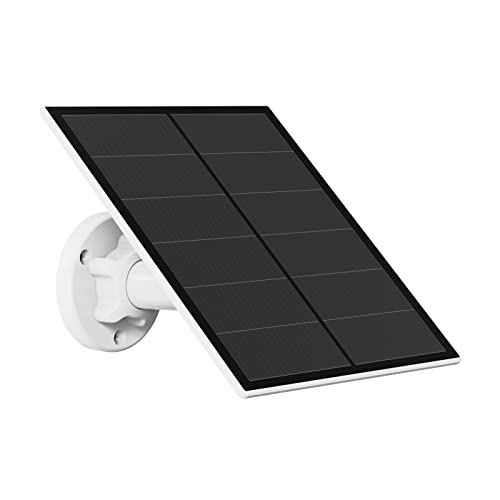
5W Solar Panel for Security Camera Outdoor, 5V USB Solar Panel Charger Compatible with Rechargeable Battery Powered Cam, IP65 Waterproof, 9.8ft Cable, 360° Adjustable Bracket
- Compatibility: For 5V rechargeable battery cameras
- Waterproof Rating: IP65 weatherproof for outdoor use
- Adjustable Bracket: 360° rotation for optimal sunlight
As an affiliate, we earn on qualifying purchases.
As an affiliate, we earn on qualifying purchases.
Renewport’s Role in Mediterranean Port Decarbonization
The Renewport project, launched in January 2024, is part of the EU’s broader strategy to promote renewable energy in ports across the Mediterranean. It aims to test various renewable sources, including solar, wind, and geothermal, with a focus on practical deployment and feasibility. The project builds on earlier initiatives that tested vertical solar panels on a section of the North Breakwater in 2023, which demonstrated the potential for large-scale PV systems integrated into port infrastructure. The Valencia pilot is the first large-scale vertical PV installation planned as part of this effort, representing a significant step forward in port-based renewable energy solutions.
“The installation of vertical PV panels on breakwaters could revolutionize how ports generate renewable energy, combining infrastructure and sustainability.”
— an anonymous researcher

Solar Panel Bird Guard,6inx100ft Critter Guard Kit with 70 Fastener Clip
- 𝗡𝗼𝘁𝗲: Due to product upgrades, we…
- 𝐒𝐌𝐀𝐋𝐋 𝐌𝐄𝐒𝐇 𝐃𝐈𝐌𝐄𝐍𝐒𝐈𝐎𝐍𝐒: Ansgery solar panel bird wire…
- 𝐏𝐑𝐄𝐌𝐈𝐔𝐌 𝐌𝐀𝐓𝐄𝐑𝐈𝐀𝐋: Our bird guards are made…
As an affiliate, we earn on qualifying purchases.
As an affiliate, we earn on qualifying purchases.
Uncertainties Around Long-Term Performance and Scalability
It is not yet clear how the pilot system will perform over the full operational lifespan, especially under harsh marine conditions. The scalability of the solution beyond the pilot phase remains untested, and economic assessments on a larger scale are still pending. Further monitoring results are needed to confirm whether this approach can be widely adopted across Mediterranean ports.

EVTSCAN High Accuracy Solar Radiation Sensor, with RS485 Output, Thermopile Element, Double Glass Inner Dome, Temperature Compensation, Pyranometer for Meteorology, Solar Energy and PV Monitoring
- High-Precision Solar Measurement: Accuracy up to ±3% with thermopile sensor
- Wide Measurement Range: 0-2000W/m² with fast response under 30s
- Durable Construction: Aluminum housing with double glass dome
As an affiliate, we earn on qualifying purchases.
As an affiliate, we earn on qualifying purchases.
Next Steps for Validation and Expansion
The project will continue monitoring energy production and structural behavior over the next two months. If results are positive, plans may be developed to expand the installation or replicate the system at other port locations. The final assessment of technical, economic, and environmental feasibility is expected after the completion of the pilot in September 2026, which will inform future deployment strategies.

Step-by-Step Design of Large-Scale Photovoltaic Power Plants
As an affiliate, we earn on qualifying purchases.
As an affiliate, we earn on qualifying purchases.
Key Questions
What is the main goal of the Valencia PV project?
The main goal is to validate the technical, economic, and environmental feasibility of installing large-scale vertical photovoltaic systems on port infrastructure, specifically on breakwaters.
When is the installation expected to be completed?
The installation is scheduled to be completed and operational by September 2026.
How does this project contribute to renewable energy goals?
It aims to reduce the carbon footprint of Mediterranean ports by demonstrating innovative renewable energy solutions, potentially encouraging wider adoption in the region.
What are the technical features of the PV system?
The pilot system consists of 21 modules, each rated at 410 W, mounted on a mesh structure secured directly to the breakwater, leveraging existing infrastructure to reduce costs and installation time.
What remains uncertain about the project?
Its long-term performance under marine conditions and the scalability of the system for larger deployments are still unconfirmed and require further monitoring and analysis.
Source: PV Magazine