
TL;DR
House Beautiful’s 2026 Whole Home feature highlights a bathroom by Indianapolis designer Anissa Zajac, combining a his-and-hers vanity, broad counters and concealed cabinet storage with decorative finishes. The feature presents organized bathroom space as support for self-care routines; it does not report a new product launch or establish that the design improves well-being.
House Beautiful’s 2026 Whole Home feature spotlights a bathroom designed by Anissa Zajac that combines a his-and-hers vanity, expansive counter space and concealed cabinet storage with patterned wallpaper and mixed-metal hardware. The design presents storage as part of a room’s look and as practical support for daily personal-care routines, rather than treating it as an afterthought.

Get home appliances delivered free with Prime
- Fast, free delivery on millions of items
- Prime Video, Amazon Music and more included
- Member-only deals all year
Zajac, founder and principal designer of Indianapolis-based House Seven Design, designed the bathroom around visual contrast and usable surface area. The feature describes whimsical wallpaper and mixed-metal hardware alongside a vanity with generous counter space. That open surface creates room for products used in everyday routines while leaving space between the objects and the room’s decorative details.
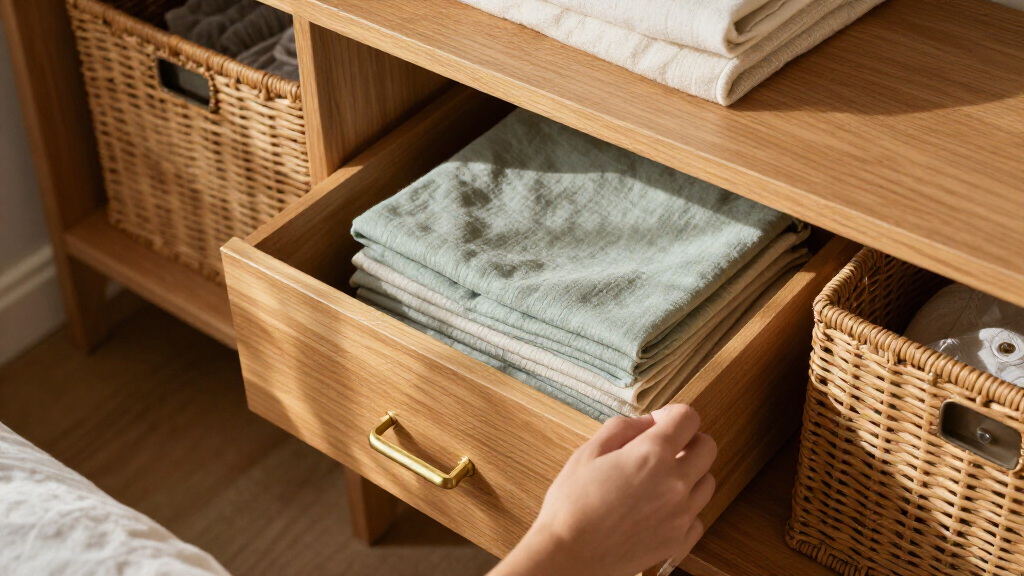
The cabinetry adds texture as well as capacity. According to House Beautiful, Zajac paired fluted cabinet doors with traditional wainscoted drawers. The fluted fronts hide storage intended for personal items and less frequently used products, keeping them out of sight while maintaining the room’s designed appearance.
The article places the room within a broader discussion of household storage, noting that closets, kitchens and bathroom vanities can become crowded as belongings accumulate. Its central design argument is that attractive finishes alone cannot keep a space functional: counters and cabinets need to accommodate the products people actually use.
Why Bathroom Storage Shapes Daily Routines
The feature matters to homeowners and renovators because it links storage planning to both the function and appearance of a bathroom. A larger counter can provide a place for daily-use items, while closed cabinets can keep less-used supplies nearby without leaving them on display. In this design, the storage is integrated into the decorative scheme rather than added as a separate utility.
That approach may be relevant for people considering a remodel, particularly where several household members share a bathroom or keep products at the vanity. It also reflects a practical trade-off: more surface area can make routines easier to organize, but visible counters can still become cluttered without enough enclosed storage. House Beautiful frames these choices as support for self-care, but the story describes a design approach, not evidence that a particular vanity improves health or well-being.
Products Worth Considering

Roborock Q7 M5+ Robot Vacuum and Mop with Self-Emptying Dock

Dyson Airwrap i.d. Multi-Styler

Philips Hue Smart Light Starter Kit with Bridge and 4 White and Color A19 Bulbs
As an affiliate, we earn on qualifying purchases.
The Shift Toward Larger Vanities
House Beautiful cites a 2026 Houzz survey reporting that 21 percent of bathroom projects are replacing standard 60-inch vanities with 72-inch models. The article says those projects expand floor plans and storage potential. The statistic is presented as a share of bathroom projects; the source material does not provide the survey sample, methodology or a comparison with an earlier year.
The Whole Home bathroom applies that broader interest in space to a specific design: a double vanity with expanded counters and storage built into textured cabinetry. The report does not say the project is a response to the Houzz survey. Rather, the survey serves as context for the article’s discussion of growing attention to bathroom storage and personal-care space.
““Our homes are only as beautiful as our storage solutions allow them to be.””
— House Beautiful
What the Feature Does Not Establish
The source describes a designed room and its intended storage uses, but does not provide construction costs, dimensions for the featured vanity, or information about how the bathroom performs in everyday use. It also does not establish that larger vanities are becoming more common over time; the cited 21 percent figure has no year-to-year comparison in the supplied material.
The article’s connection between bathroom design and self-care is a framing choice, not a measured outcome. It does not report interviews with homeowners using the room, research on the effects of storage on well-being, or evidence that the design reduces clutter. The feature’s publication date and any future plans for the Whole Home are also not specified in the source.
How Readers Can Apply the Design
The feature offers a design example rather than announcing a product release or a scheduled next milestone. Readers planning a bathroom update can use its elements as prompts: estimate how much counter space daily routines require, decide which products need to remain accessible, and plan concealed storage for backstock and occasional-use items.
Any renovation decision will depend on the room’s dimensions, household needs and project budget. The supplied report does not say whether House Beautiful will publish further details, plans or sourcing information for the Whole Home bathroom. For now, the confirmed development is the feature itself and its example of combining decorative finishes with more deliberate vanity storage.
Key Questions
What is House Beautiful’s 2026 Whole Home bathroom feature about?
It highlights a bathroom by Anissa Zajac that combines a double vanity and broad counters with fluted cabinetry, wainscoted drawers, wallpaper and mixed-metal hardware.
How does the design add storage?
The vanity includes concealed cabinet space behind fluted doors for personal items and less frequently used products, alongside counter space for daily routines.
What does the Houzz statistic say?
House Beautiful reports that a 2026 Houzz survey found 21 percent of bathroom projects were replacing standard 60-inch vanities with 72-inch models. The supplied material does not give the sample size or a comparison with previous years.
Does the article show that storage improves self-care?
No. The feature presents organized storage as a way to support personal-care routines, but it does not report research or measured outcomes showing that the design improves well-being.
Source: housebeautiful.com