
Climate control feels instant in some homes and slow in others due to several key factors. If your thermostat’s poorly placed, misreadings can lead to inefficient adjustments. Good insulation also plays a role, as it stabilizes temperature and prevents drafts. Duct efficiency affects airflow, while proper air circulation helps maintain even temperatures. By understanding these elements, you can enhance your home’s comfort. Want to discover more ways to optimize your climate control?

Get home appliances delivered free with Prime
- Fast, free delivery on millions of items
- Prime Video, Amazon Music and more included
- Member-only deals all year
Key Takeaways
- Proper thermostat placement in central locations avoids misreadings, leading to quicker temperature adjustments.
- High-quality insulation minimizes heat loss and stabilizes indoor temperature for faster comfort.
- Efficient ductwork ensures effective air circulation, preventing hot or cold spots in the home.
- Enhanced air circulation through fans and open vents promotes even temperature distribution.
- Regular system maintenance and assessments optimize performance for instant climate control responsiveness.
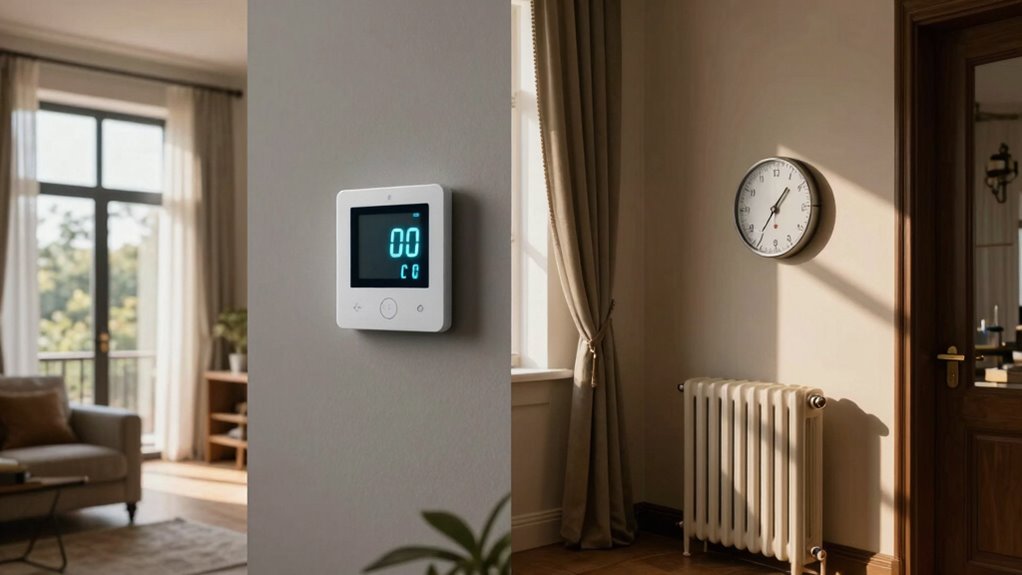
When you think about climate control, it’s easy to overlook the significant differences between various systems. Many homes have varying experiences with temperature adjustments, making some feel instant and others slow. The key factors often boil down to thermostat placement, insulation quality, duct efficiency, and air circulation. Understanding these can help you optimize your own climate control system.
First off, let’s discuss thermostat placement. If your thermostat’s in a poor location, like near a draft or direct sunlight, it can misread the actual room temperature. This misreading can lead to inefficient temperature adjustments. Ideally, you want your thermostat in a central location, away from windows and doors, to accurately gauge the home’s overall temperature. When you position it correctly, you’re setting the stage for a more responsive climate control system. Proper thermostat placement is crucial for quick and accurate temperature regulation.
Thermostat placement is crucial; a well-positioned thermostat leads to accurate readings and improved climate control efficiency.
Next, think about insulation quality. Good insulation keeps the temperature inside your home stable. If your insulation’s inadequate, heat can escape in winter or leak in during summer, making your climate control system work overtime. In this case, you might feel that adjustment time dragging on, as the system struggles to compensate for the temperature fluctuations. Investing in high-quality insulation can make a world of difference in how quickly your home reaches your desired temperature. Insulation quality directly impacts the efficiency of your climate control. Improving insulation can also help prevent drafts and heat loss, further enhancing comfort.
Duct efficiency also plays a critical role in how your climate control feels. If your ducts are dirty, damaged, or improperly sized, air may not circulate effectively throughout your home. This inefficiency can lead to hot or cold spots, prolonging the time it takes for your system to achieve a balanced temperature. Regular maintenance is essential; cleaning and inspecting your ducts can enhance their performance and guarantee air circulates evenly. Improving duct efficiency can significantly reduce the time your system takes to reach comfort levels. Additionally, upgrading to modern ductwork can further optimize airflow and temperature consistency.
Finally, consider air circulation. Even the best climate control system can struggle if air circulation’s inadequate. Ceiling fans, strategically placed vents, and open doors can all improve circulation, allowing conditioned air to reach every corner of your home more swiftly. Enhancing air movement can help create a more comfortable environment, making climate control feel more immediate. Proper air circulation can significantly reduce the time your system needs to reach your desired temperature. Ensuring good airflow and circulation can be a simple yet effective way to optimize your climate control experience.
Products Worth Considering

Levoit Vital 200S-P Smart Air Purifier for Large Rooms

LEVOIT Vital 100S-P Smart Air Purifier with Washable Pre-Filter

LG C2 Series 65-Inch OLED evo 4K Smart TV (OLED65C2PUA, 2022)
As an affiliate, we earn on qualifying purchases.
Frequently Asked Questions
How Does Insulation Affect Climate Control Speed?
Insulation affects climate control speed by minimizing air leaks and retaining temperature. When you use effective insulation materials, your home keeps the heat or cool air where it belongs, making adjustments feel quicker. If your insulation’s inadequate or there are gaps, air leaks can disrupt the balance, causing your system to work harder and slower. So, ensuring proper insulation can greatly enhance your home’s climate control efficiency.
What Role Do Windows Play in Temperature Changes?
“Don’t judge a book by its cover,” but when it comes to windows, their types can greatly impact your home’s temperature changes. Double-glazed or low-emissivity windows enhance energy efficiency, keeping heat in during winter and out in summer. If you’ve got older, single-pane windows, you’re likely losing energy and feeling temperature shifts more acutely. So, consider upgrading your windows for a more stable and comfortable indoor climate.
Can Humidity Levels Impact Climate Control Effectiveness?
Yes, humidity levels definitely impact climate control effectiveness. When humidity exceeds certain thresholds, your system has to work harder to remove moisture, making it feel less efficient. This moisture control is vital; if your home’s too humid, it can lead to discomfort and slower temperature adjustments. You’ll notice that maintaining balanced humidity levels can help your climate control system feel more responsive, creating a more comfortable living environment.
How Often Should HVAC Systems Be Serviced for Optimal Performance?
You should service your HVAC system at least twice a year for peak performance. Regular filter maintenance keeps your system running efficiently, while duct inspections guarantee there’s no blockage. This not only boosts energy efficiency but also prolongs the life of your system. If you’re considering system upgrades, make certain to include maintenance in your plan. By staying proactive, you’ll enjoy better comfort and lower energy bills year-round.
Does the Layout of a Home Influence Climate Control Efficiency?
Yes, the layout of your home definitely influences climate control efficiency. Open floorplans allow for better airflow, making temperature adjustments feel quicker. In contrast, room partitions can trap air, slowing down the process. Additionally, higher ceilings might require more time for the temperature to stabilize throughout the space. Duct placement also plays a vital role; poorly placed ducts can lead to uneven heating or cooling, impacting your overall comfort.
Conclusion
In some homes, climate control feels instant, while in others, it seems slow. This difference often boils down to insulation quality; homes with good insulation can maintain comfortable temperatures up to 20% more efficiently. By investing in proper insulation and HVAC systems, you can enjoy that rapid cooling or heating feeling, making your space cozy almost immediately. So, if you’re tired of waiting for your home to feel just right, it might be time for an upgrade!