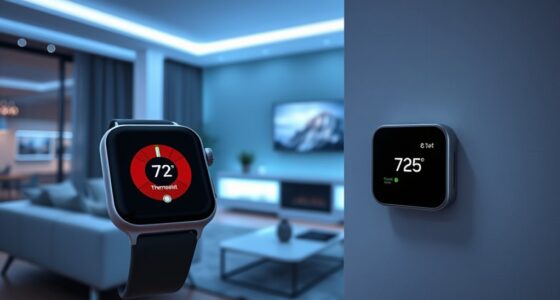
Using smart thermostats with Home Assistant lets you customize your home climate easily through open-source automation. You can set personalized schedules, use occupancy sensors, and incorporate weather data for ideal comfort and energy savings. The platform enables seamless integration for real-time control and insights into your energy use. With these tools, you’ll maximize efficiency and reduce waste effortlessly. Keep exploring to discover how to open the full potential of your smart thermostat setup.
Key Takeaways
- Integrate compatible smart thermostats with Home Assistant for centralized climate management and automation.
- Use open-source integrations and custom automations to tailor temperature schedules and responses.
- Monitor energy consumption and optimize settings based on real-time data and occupancy sensors.
- Create personalized routines, including geofencing and weather-based adjustments, for enhanced comfort.
- Leverage Home Assistant’s flexibility to build advanced automation rules and improve system efficiency.

Smart thermostats have transformed how you control your home’s temperature, making it easier to save energy and stay comfortable. By integrating these devices with your home automation system, particularly through open-source platforms like Home Assistant, you gain a powerful tool for optimizing energy efficiency. Unlike traditional thermostats, smart models learn your routines, adapt to your preferences, and allow you to customize settings to suit your lifestyle. This level of user customization means you’re not stuck with preset schedules; instead, you can fine-tune your heating and cooling to match your daily patterns, reducing unnecessary energy use and lowering your utility bills.
When you set up a smart thermostat with Home Assistant, you access a world of possibilities for managing your home’s climate. You can create tailored schedules that align with your work hours, sleep patterns, or weekend routines, all from an intuitive interface. This guarantees that your home isn’t heated or cooled when nobody’s there, maximizing energy efficiency. Plus, with real-time data and insights, you can monitor your energy consumption, identify inefficiencies, and adjust settings accordingly. Over time, this leads to smarter energy use, helping you reduce waste while maintaining comfort.
The user customization features are particularly beneficial because they give you control over how your system responds to various conditions. For example, if you prefer a warmer bedroom at night, you can set specific temperature targets for that time, while keeping the rest of the house cooler. You can also implement geofencing, where your thermostat adjusts based on your location, turning down the heat when you’re away and warming up just before you return. This level of personalization not only enhances comfort but also contributes notably to energy savings.
Additionally, integrating smart thermostats into Home Assistant opens the door for automation. You might set up rules that adjust temperatures based on weather forecasts, occupancy sensors, or time of day. These automations guarantee your system operates efficiently without constant manual adjustments. Because Home Assistant is open source, you can also customize the integrations and features to match your specific needs, making your smart home truly personalized. Understanding energy data analysis can further help you optimize your system for maximum savings.
In essence, using smart thermostats with Home Assistant empowers you to take full control of your home’s climate, blending user customization with energy efficiency. You gain the ability to tailor your environment precisely, reduce energy waste, and enjoy a more comfortable, cost-effective home. The combination of intelligent automation and personal preferences helps you create a smart, sustainable living space that adapts seamlessly to your lifestyle.
Frequently Asked Questions
Can I Integrate Multiple Smart Thermostats From Different Brands?
Yes, you can integrate multiple smart thermostats from different brands in Home Assistant. This multi-brand integration works because Home Assistant supports a wide range of devices through various integrations and custom components. verify device compatibility by checking if each thermostat is supported or if you need specific integrations. With this setup, you can control and automate all your thermostats seamlessly, regardless of brand, in a unified interface.
How Secure Is My Data When Using Smart Thermostats With Home Assistant?
Your data’s security with smart thermostats is like a fortress, thanks to robust data encryption that keeps your information safe from prying eyes. Home Assistant prioritizes user privacy, ensuring your personal data stays private and protected. While no system is invulnerable, using secure networks and keeping software updated drastically reduces risks. Trust that, with proper precautions, your smart thermostat data remains guarded, giving you peace of mind.
Do Smart Thermostats Support Voice Control Through Home Assistant?
Yes, smart thermostats often support voice control through Home Assistant. You can use voice recognition for hands-free adjustments, making it convenient to manage your home’s climate. Just make certain your thermostat is compatible with Home Assistant and integrates with voice assistants like Alexa or Google Assistant. Device compatibility varies, so check your specific model’s capabilities. This setup allows seamless voice commands, enhancing your smart home experience.
What Is the Typical Setup Time for a New Smart Thermostat?
The typical setup time for a new smart thermostat usually takes about 30 minutes to an hour. During the installation process, you’ll need to turn off power, connect the device to compatible wiring, and configure it through the app or Home Assistant. Make certain your thermostat is compatible with your HVAC system, as device compatibility affects both installation time and functionality. Once installed, you can quickly start enjoying smart control.
Can I Set Custom Temperature Schedules for Different Rooms?
Absolutely, you can set custom temperature schedules for different rooms, giving you control like a maestro conducting an orchestra. With custom schedule setup, you assign room-specific temperature preferences, ensuring each space feels just right. Imagine waking up to a cozy bedroom while your living room stays perfectly cool. Home Assistant makes it simple to personalize your environment, so you create comfort tailored to each room’s needs, all at your fingertips.
Conclusion
By integrating smart thermostats with Home Assistant, you open a world of effortless comfort and energy savings. You’ll control your home’s temperature with the flick of a finger, making traditional thermostats seem like ancient relics. With this setup, you’re not just managing your home—you’re transforming it into a futuristic sanctuary that adapts to your every need. Immerse yourself and experience the smart home revolution—your comfort level will skyrocket beyond anything you’ve ever imagined!