
If you’re shopping for air quality monitors for home, the biggest decision you’ll face is between simple standalone displays and connected models that track data over time. My top pick overall is the Airthings View Plus, because it’s the only model here that covers radon alongside CO2, PM2.5, humidity, and VOCs, runs on battery so you can place it anywhere, and syncs everything to an app. For tighter budgets, the 16-in-1 monitors with color displays pack an impressive range of readings into one screen, while the Aranet4 is the clear choice if you mainly want the most trustworthy CO2 reading for bedrooms, offices, or classrooms. The main tradeoffs: multi-sensor budget monitors trade long-term reliability for features, while premium models cost more but give you calibration confidence and history you can actually act on. Keep reading for the full breakdown of all 15 models.

Get home appliances delivered free with Prime
- Fast, free delivery on millions of items
- Prime Video, Amazon Music and more included
- Member-only deals all year
Complete the kit


Key Takeaways
- The Airthings View Plus earns the top spot because it’s the only monitor in this lineup that measures radon — a blind spot for every other pick here — while also covering CO2, PM2.5, VOCs, humidity, and temperature.
- The five near-identical 16-in-1 monitors differ mainly in screen size and interface polish, not sensor quality — buying the cheapest of the group rarely costs you anything meaningful.
- The Aranet4 and the Amazon Smart Air Quality Monitor represent opposite philosophies: one does a single measurement exceptionally well, while the other spreads across five metrics with deep smart-home integration.
- App connectivity and data history — not raw sensor count — is what separates actionable monitors from novelty gadgets; several 16-in-1 models show real-time numbers but offer no way to review trends.
- The ZEMEOLLO 10-in-1 and GoveeLife models land in the middle of the pack: fewer sensors than the 16-in-1s but better software than most of them, making them the sweet spot for buyers who want both.
| 16-in-1 Indoor Air Quality Monitor with Color Display |  | Best Portable Pick | Air quality measurements: PM1.0, PM2.5, PM10, TVOC, HCHO | Other measurements: Temperature and humidity | Update interval: 1.5 seconds | VIEW LATEST PRICE | See Our Full Breakdown |
| 16-in-1 Indoor Air Quality Monitor with 7-Inch Display |  | Best Large Display | Parameters monitored: CO2, PM2.5, PM1.0, PM10, HCHO, TVOC, temperature, humidity, AQI, time | Display: 7-inch LED display | Brightness settings: 3 | VIEW LATEST PRICE | See Our Full Breakdown |
| 16-in-1 Indoor Air Quality Monitor with HD Color Display | 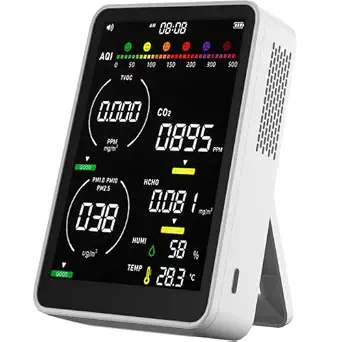 | Best for Full Coverage on the Go | Measured parameters: PM1.0, PM2.5, PM10, CO2, TVOC, HCHO, temperature, humidity | Update interval: 1.5 seconds | Battery runtime: 4–5 hours | VIEW LATEST PRICE | See Our Full Breakdown |
| Amazon Smart Air Quality Monitor |  | Best Smart Home Integration | Monitored factors: PM2.5, VOCs, carbon monoxide, humidity, temperature | Connectivity: Works with Alexa | Alerts: Phone notifications and announcements on Echo devices | VIEW LATEST PRICE | See Our Full Breakdown |
| 16-in-1 Indoor Air Quality Monitor with HD Color Screen |  | Best for Simple Operation | Measurements: PM1.0, PM2.5, PM10, CO2, TVOC, HCHO, temperature, humidity | Sampling interval: 1.5 seconds | Battery runtime: 4–5 hours | VIEW LATEST PRICE | See Our Full Breakdown |
| GoveeLife Smart Air Quality Monitor with PM2.5 Sensor and LED Display |  | Best for Smart Home Automation | Measurements: PM2.5, temperature, humidity | PM2.5 Accuracy: ±15 µg/m³ (0–100); ±15% (100–1000 µg/m³) | Response Time: 2 seconds | VIEW LATEST PRICE | See Our Full Breakdown |
| ZEMEOLLO 10-in-1 Indoor Air Quality Monitor |  | Best Battery Life on a Budget | Detected Pollutants: CO₂, HCHO, TVOC, benzene, PM2.5, PM10 | Stated Error Margin: Less than ±5% | Display: Color LED screen | VIEW LATEST PRICE | See Our Full Breakdown |
| BREATHE AirMonitor Plus Gen 2 Indoor Air Quality Monitor with CO2, PM & App |  | Best Full-Featured Pick | Sensors: CO₂ (NDIR), PM1, PM2.5, PM10, TVOC, HCHO, temperature, humidity | Battery Life: Up to 6 hours | Connectivity: 2.4 GHz Wi-Fi | VIEW LATEST PRICE | See Our Full Breakdown |
| 16-in-1 Indoor Air Quality Monitor with Color Screen |  | Best for Real-Time Readouts | Measurements: PM1.0, PM2.5, PM10, TVOC, HCHO, temperature, humidity | Update Interval: 1.5 seconds | Battery Runtime: 4–5 hours | VIEW LATEST PRICE | See Our Full Breakdown |
| Zemeollo 10-in-1 Indoor Air Quality Monitor |  | Best Portable Spot-Checker | Measurements: CO₂, HCHO, TVOC, benzene, PM2.5, PM10, temperature, AQI, PM0.3–1 | Battery: 2000 mAh rechargeable | Battery Life: Up to 20 hours | VIEW LATEST PRICE | See Our Full Breakdown |
| Airthings View Plus Battery-Powered Radon and Air Quality Monitor |  | Best for Radon Detection | Sensors: Radon, PM2.5, CO2, VOCs, humidity, temperature, air pressure | Connectivity: Wi-Fi | Power: Battery-powered | VIEW LATEST PRICE | See Our Full Breakdown |
| Aranet4 Indoor Air Quality Monitor with Wireless CO2 Detector |  | Best CO2 Specialist | Measurements: CO2, temperature, relative humidity, atmospheric pressure | Sensor technology: NDIR | Display: E-ink | VIEW LATEST PRICE | See Our Full Breakdown |
| Amazon Smart Air Quality Monitor (2-Pack) |  | Best for Smart Home Integration | Monitored factors: PM2.5, VOCs, carbon monoxide, humidity, temperature | Connectivity: Alexa app and compatible Echo devices | Alerts: Phone notifications or Echo announcements | VIEW LATEST PRICE | See Our Full Breakdown |
| 16-in-1 Indoor Air Quality Monitor with Real-Time Color Display |  | Best Portable Diagnostic Tool | Measured parameters: PM1.0, PM2.5, PM10, CO2, TVOC, HCHO, temperature, humidity | Update interval: 1.5 seconds | Battery runtime: 4–5 hours | VIEW LATEST PRICE | See Our Full Breakdown |
| YNAK 16-in-1 Indoor Air Quality Monitor with 5.5-Inch Display | 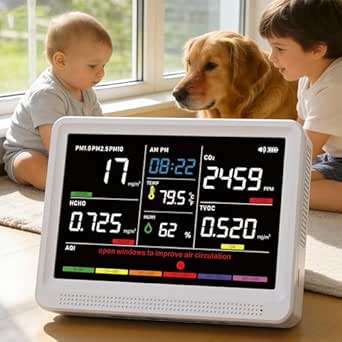 | Best Large-Display Option | Measurements: CO2, PM2.5, PM1.0, PM10, HCHO, TVOC, temperature, humidity, AQI | Display: 5.5-inch LED with 3 brightness settings | Battery: 2500mAh; up to 10 hours cordless | VIEW LATEST PRICE | See Our Full Breakdown |
| air quality monitors for home | Display |
|---|---|
| 16-in-1 Indoor Air Quality Mon | HD color screen with color-coded readings |
| 16-in-1 Indoor Air Quality Mon | 7-inch LED display |
| 16-in-1 Indoor Air Quality Mon | HD color screen with color-coded readings |
| Amazon Smart Air Quality Monit | — |
| 16-in-1 Indoor Air Quality Mon | HD color screen |
| GoveeLife Smart Air Quality Mo | — |
| ZEMEOLLO 10-in-1 Indoor Air Qu | Color LED screen |
| BREATHE AirMonitor Plus Gen 2 | — |
| 16-in-1 Indoor Air Quality Mon | HD color screen |
| Zemeollo 10-in-1 Indoor Air Qu | Color LED screen |
| Airthings View Plus Battery-Po | Customizable eInk screen |
| Aranet4 Indoor Air Quality Mon | E-ink |
| Amazon Smart Air Quality Monit | — |
| 16-in-1 Indoor Air Quality Mon | HD color screen |
| YNAK 16-in-1 Indoor Air Qualit | 5.5-inch LED with 3 brightness settings |
More Details on Our Top Picks
16-in-1 Indoor Air Quality Monitor with Color Display
This model stands out as the most travel-friendly option in the lineup, pairing a full particle breakdown (PM1.0 through PM10) with TVOC and formaldehyde readings on a color-coded HD screen. Compared with the 16-in-1 with 7-Inch Display, it trades screen size for portability — you can carry it from a nursery to a car to a basement in the same afternoon, which the larger deskbound unit simply can’t do. Readings refresh every 1.5 seconds, so you see almost immediate changes when you open a window or light a candle. The tradeoff is real: 4–5 hours of battery runtime means it effectively becomes a plugged-in device for continuous monitoring. Also note it covers no CO2, unlike the HD Color Display version, and it is explicitly not a smoke or CO alarm — treat it as an awareness tool, not a safety device.
Pros:- Covers PM1.0, PM2.5, PM10, TVOC and formaldehyde in one handheld unit
- 1.5-second refresh rate makes cause-and-effect obvious
- Genuinely portable with USB-C charging and adjustable audio prompts
- Includes AC adapter and 12-month warranty
Cons:- Only 4–5 hours of battery per charge
- No CO2 measurement, and explicitly not a smoke or carbon monoxide alarm
Best for: Renters and frequent movers who want to spot-check particulates and chemical off-gassing room by room
Not ideal for: Anyone who needs continuous CO2 tracking or an overnight unplugged monitor — the short battery and missing CO2 sensor rule it out
- Air quality measurements:PM1.0, PM2.5, PM10, TVOC, HCHO
- Other measurements:Temperature and humidity
- Update interval:1.5 seconds
- Display:HD color screen with color-coded readings
- Battery runtime:4–5 hours
- Charging:USB-C
- Included accessories:USB-C cable, AC power adapter, user manual
- Warranty:12 months
Our verdict“A solid choice if your priority is moving a monitor between rooms and vehicles rather than permanent wall-mounted tracking.”
16-in-1 Indoor Air Quality Monitor with 7-Inch Display
If reading a matchbook-sized screen from across the room frustrates you, this is the answer: a 7-inch LED display readable from a distance, with three brightness settings so it doesn’t glow like a nightlight in a bedroom. It is the only model in this batch that adds CO2 and a calculated AQI alongside the usual PM, formaldehyde, and TVOC readings, which makes it better suited to living rooms and home offices than the portable 16-in-1 with Color Display, where you have to walk up to the screen. The seven configurable alert buzzers can all be muted, a thoughtful touch for light sleepers. Two caveats: the sensors react to perfumes and strong odors, so placement matters, and the listing is vague on the power source — expect this to live on a shelf near an outlet rather than travel with you.
Pros:- Large 7-inch display readable from across a room
- Includes CO2 and AQI alongside particles and chemicals
- Three brightness settings for day and night use
- Seven alert buzzers, all mutable
Cons:- Sensors can be thrown off by perfumes and strong odors
- Power source is not clearly specified, limiting placement flexibility
Best for: Households that want at-a-glance, whole-room readings including CO2 without squinting at a small screen
Not ideal for: People who want a portable spot-checker or app-based alerts and history — this is a stationary, screen-only device
- Parameters monitored:CO2, PM2.5, PM1.0, PM10, HCHO, TVOC, temperature, humidity, AQI, time
- Display:7-inch LED display
- Brightness settings:3
- AQI alert buzzers:7 types, mutable
- Sensor accuracy:0.001 units (as stated)
- Time format:12- or 24-hour
Our verdict“The best pick here for a permanent, glanceable monitoring station in a main living space.”
16-in-1 Indoor Air Quality Monitor with HD Color Display
Think of this as the Color Display model plus CO2 — same 1.5-second refresh, same portable form factor, but with carbon dioxide added to the sensor list, which matters if stuffy bedrooms or crowded home offices are your concern. Compared with the HD Color Screen version, the practical differences are minor; both share the identical 4–5 hour battery and Type-C charging, so the decision comes down to whether CO2 matters to you — and for most homes it should, since it’s the single best proxy for ventilation. Compared with the Amazon Smart Air Quality Monitor, you gain portability and a self-contained screen but lose phone alerts, history logging, and smart-home automation. Be aware the “16-in-1” name is generous marketing: the description covers eight distinct measurements, which is still solid but not what the box implies.
Pros:- Adds CO2 to the full particle and chemical lineup in a portable body
- 1.5-second updates make ventilation changes visible instantly
- Works in rooms and vehicles with USB Type-C charging
- Includes AC adapter and 12-month warranty support
Cons:- 4–5 hour battery means near-constant plugging in for continuous use
- Marketing says 16-in-1 but only eight measurements are actually described
Best for: Buyers who want the portability of a handheld unit without giving up CO2 and ventilation tracking
Not ideal for: Anyone who wants app notifications, data history, or multi-day unplugged runtime — this delivers none of those
- Measured parameters:PM1.0, PM2.5, PM10, CO2, TVOC, HCHO, temperature, humidity
- Update interval:1.5 seconds
- Battery runtime:4–5 hours
- Charging port:USB Type-C
- Display:HD color screen with color-coded readings
- Included accessories:Type-C charging cable, AC power adapter, user manual
- Warranty support:12 months
Our verdict“The strongest all-sensor handheld in this batch for buyers who refuse to choose between portability and CO2 coverage.”
Amazon Smart Air Quality Monitor
This is the only product in this batch that lives in your phone and your smart home rather than on a screen you walk past. It tracks five factors — PM2.5, VOCs, carbon monoxide, humidity, and temperature — and pushes alerts to your phone or announces them on Echo speakers, something none of the 16-in-1 units can do. Its killer feature is Alexa Routines: when air quality drops, it can automatically trigger an air purifier or humidifier, turning monitoring into action. The tradeoffs are clear. It omits formaldehyde, CO2, and fine-particle detail compared with the 16-in-1 with HD Color Display, has no built-in screen at all, and its smart features are useless without the Alexa app and compatible devices. Households outside the Alexa ecosystem get a dumb box that measures five things you can’t see without pairing it first.
Pros:- Phone alerts and voice announcements on Echo devices
- Alexa Routines can automatically run purifiers and other devices
- Includes carbon monoxide sensing, rare at this tier
- Simple plug-in setup through the Alexa app
Cons:- Fully dependent on the Alexa app and compatible devices
- No CO2, formaldehyde, or PM1.0/PM10 detail, and no built-in display
Best for: Alexa households that want phone alerts, air quality history, and automated purifier or humidifier routines
Not ideal for: Google Home or Apple Home users, or anyone who wants a standalone screen and formaldehyde/CO2 readings — the ecosystem lock-in and sensor list will disappoint
- Monitored factors:PM2.5, VOCs, carbon monoxide, humidity, temperature
- Connectivity:Works with Alexa
- Alerts:Phone notifications and announcements on Echo devices
- Automation:Triggers compatible devices via Alexa Routines
- Setup:Plug in and connect through the Alexa app
Our verdict“The obvious choice for Alexa households that want monitoring to trigger action, and a poor fit for everyone else.”
16-in-1 Indoor Air Quality Monitor with HD Color Screen
Where most monitors in this roundup bury settings in menus, this one leans on one-button controls and an adjustable audio prompt, making it the least intimidating option for first-time buyers or older family members who just want to see a number and a color. Its sensor list matches the HD Color Display model — PM1.0 through PM10, CO2, TVOC, formaldehyde, temperature, and humidity — refreshed every 1.5 seconds, so you give up nothing in coverage. What you give up is transparency: the listing provides no stated measurement accuracy, so if you need confidence that a formaldehyde reading of 0.07 is trustworthy, the Aranet4 elsewhere in this roundup is the more credible instrument. The 4–5 hour battery also mirrors its siblings, so plan on leaving it plugged in for continuous duty. For a straightforward, no-app, no-pairing air checker, it gets the job done.
Pros:- One-button operation makes it genuinely easy to use
- Full sensor coverage including CO2 and formaldehyde
- Fast 1.5-second sampling with color-coded display
- Portable for use in rooms and vehicles
Cons:- No published accuracy specifications for its sensors
- Battery lasts only 4–5 hours per charge
Best for: Anyone who wants a no-setup, no-app monitor — especially older relatives or air-quality beginners who value simplicity
Not ideal for: Data-driven users who need stated sensor accuracy, app logging, or long unplugged runtime
- Measurements:PM1.0, PM2.5, PM10, CO2, TVOC, HCHO, temperature, humidity
- Sampling interval:1.5 seconds
- Battery runtime:4–5 hours
- Charging port:USB Type-C
- Display:HD color screen
- Controls:One-button with adjustable audio prompt
- Included accessories:Type-C charging cable, AC power adapter, user manual
- Warranty support:12 months
Our verdict“A sensible pick when ease of use matters more than data precision or smart features.”
GoveeLife Smart Air Quality Monitor with PM2.5 Sensor and LED Display
This option stands out for its 2-second refresh rate and its ability to trigger automations on other GoveeLife devices when air quality dips — something no other monitor in this lineup does. Compared with the ZEMEOLLO 10-in-1, the GoveeLife covers fewer pollutants (PM2.5, temperature, and humidity only), but its Wi-Fi connectivity and 13-day graphs with 2-year data export make it far better for long-term trend tracking than the ZEMEOLLO’s screen-only readings. The tradeoff is that it must stay plugged into USB-C power with no battery option, so it’s a fixed station rather than a carry-around diagnostic tool. It also requires 2.4 GHz Wi-Fi for remote features and the clock display.
Pros:- Readings refresh every two seconds for near-instant feedback
- Bluetooth and Wi-Fi remote monitoring with 13-day graphs and up to 2 years of exportable data
- Automates compatible GoveeLife devices based on air quality readings
- Compact, lightweight design fits on a shelf or nightstand
Cons:- No built-in battery — requires a constant USB-C power connection
- Only measures PM2.5, temperature, and humidity; no CO₂, VOC, or formaldehyde sensing
Best for: GoveeLife ecosystem owners who want air readings to automatically trigger purifiers or humidifiers, plus anyone tracking PM2.5 trends over weeks and months
Not ideal for: Buyers who want to check formaldehyde, CO₂, or VOCs, or anyone needing a portable unit to carry between rooms — it has no battery and only tracks particulates
- Measurements:PM2.5, temperature, humidity
- PM2.5 Accuracy:±15 µg/m³ (0–100); ±15% (100–1000 µg/m³)
- Response Time:2 seconds
- Connectivity:Bluetooth and 2.4 GHz Wi-Fi
- Data History:13-day graphs; export up to 2 years
- Power:USB-C wired, no battery
- Dimensions:5.31 × 1.57 × 2.47 inches
Our verdict“This pick makes the most sense for smart-home users already in the GoveeLife ecosystem who want fast PM2.5 data that can drive automations, not for buyers who need full pollutant coverage.”
ZEMEOLLO 10-in-1 Indoor Air Quality Monitor
Where the GoveeLife locks you to an outlet, the ZEMEOLLO flips the equation with a 2000mAh battery rated for up to 20 hours — the longest runtime in this batch and triple what the BREATHE AirMonitor Plus Gen 2 offers. It reads CO₂, formaldehyde, TVOC, benzene, PM2.5, and PM10, and its color screen flags readings that exceed safety thresholds. The honest tradeoff: there’s no app, no data export, and no Wi-Fi, so everything lives on the device itself. Compared with the BREATHE’s NDIR CO₂ sensor and CSV logging, the ZEMEOLLO’s sensors are less verifiable, and the “10-in-1” claim isn’t fully itemized in its documentation. What you get is simple, portable, multi-pollutant spot-checking.
Pros:- Up to 20 hours of operation per charge, the longest in this group
- Detects CO₂, formaldehyde, TVOC, benzene, PM2.5, and PM10
- Color display highlights readings above safety thresholds
- Lightweight, portable design for room-to-room or travel use
Cons:- No app, Wi-Fi, or data history — readings exist only on the screen
- The 10-in-1 claim isn’t fully itemized, leaving some measured values unclear
Best for: Budget-conscious buyers, renters, and travelers who want long battery life and on-screen readings of multiple pollutants without an app or subscription
Not ideal for: Data-driven users who want historical graphs, remote monitoring, or exportable logs — this device has none of those capabilities
- Detected Pollutants:CO₂, HCHO, TVOC, benzene, PM2.5, PM10
- Stated Error Margin:Less than ±5%
- Display:Color LED screen
- Battery:2000mAh rechargeable lithium
- Battery Life:Up to 20 hours
- Weight:7 ounces
Our verdict“This model is better suited to buyers who prioritize all-day battery life and multi-pollutant spot checks over connectivity and logged data.”
BREATHE AirMonitor Plus Gen 2 Indoor Air Quality Monitor with CO2, PM & App
This is the most technically credible device in the batch, pairing an NDIR CO₂ sensor — the same technology trusted in higher-end monitors like the Aranet4 — with laser particle sensing and dedicated VOC/formaldehyde sensors for eight simultaneous measurements. Unlike the ZEMEOLLO, it backs those readings with a free app offering alerts, 90-day history, and CSV export over 2.4 GHz Wi-Fi, which matters if you’re investigating a specific problem like off-gassing furniture or poor bedroom ventilation. The tradeoff is portability: just 6 hours of battery versus 20 on the ZEMEOLLO, so it works best as a plugged-in station you occasionally unplug to diagnose another room. A two-year warranty adds confidence the budget monitors here don’t provide.
Pros:- NDIR CO₂ sensor and dedicated VOC/formaldehyde sensors for trustworthy readings
- App with alerts, 90-day history, and CSV data export
- Quick CO₂ calibration and easy setup out of the box
- Two-year manufacturer warranty
Cons:- Only 6 hours of battery life for portable use
- No 5 GHz Wi-Fi support — requires a 2.4 GHz network
Best for: Serious indoor-air investigators — allergy sufferers, new parents, or anyone diagnosing CO₂ buildup or VOC sources — who want sensor credibility plus logged, exportable data
Not ideal for: Buyers wanting a grab-and-go device for all-day portable checks; the 6-hour battery falls well short of the ZEMEOLLO’s 20-hour runtime
- Sensors:CO₂ (NDIR), PM1, PM2.5, PM10, TVOC, HCHO, temperature, humidity
- Battery Life:Up to 6 hours
- Connectivity:2.4 GHz Wi-Fi
- App Features:Remote readings, alerts, 90-day history, CSV export
- Charging:USB-C
- Warranty:2 years
Our verdict“Compared with the rest of this batch, this is the pick for buyers who want professional-grade sensing and real data tools rather than just a screen full of numbers.”
16-in-1 Indoor Air Quality Monitor with Color Screen
If your main goal is watching numbers move the moment you open a window or light a candle, this monitor’s 1.5-second update interval is the fastest in the roundup — quicker even than the GoveeLife’s 2-second refresh. It covers PM1.0, PM2.5, PM10, TVOC, HCHO, temperature, and humidity on a color-coded HD screen, and the included AC adapter means you’re not scavenging for a charger. The tradeoff is stamina: 4–5 hours per charge, the shortest runtime here, roughly a quarter of the ZEMEOLLO’s 20 hours. Unlike the BREATHE Gen 2, there’s no app or data logging, and no CO₂ measurement — so it’s a live dashboard rather than an analysis tool. At 14.4 ounces, it’s also the heaviest portable in this group.
Pros:- Fastest readings in this batch, updating every 1.5 seconds
- Covers PM1.0, PM2.5, PM10, TVOC, and formaldehyde plus temperature and humidity
- Color-coded HD screen makes levels readable at a glance
- Includes both an AC adapter and USB Type-C charging cable
Cons:- Only 4–5 hours of runtime per charge
- No CO₂ sensing, app, or data history
Best for: Curious homeowners who want instant, visible feedback on how cooking, cleaning, or ventilation changes their air, without needing an app
Not ideal for: All-day portable monitoring or CO₂ tracking — the 4–5 hour battery is short, and carbon dioxide isn’t measured at all
- Measurements:PM1.0, PM2.5, PM10, TVOC, HCHO, temperature, humidity
- Update Interval:1.5 seconds
- Battery Runtime:4–5 hours
- Charging:USB Type-C
- Display:HD color screen
- Weight:14.4 ounces
- Warranty:12 months
Our verdict“This option stands out for live, at-a-glance feedback in a fixed spot — choose the ZEMEOLLO instead if battery life or CO₂ readings matter more.”
Zemeollo 10-in-1 Indoor Air Quality Monitor
Think of this as the travel and vehicle companion in the lineup. It matches the other ZEMEOLLO’s 20-hour battery, but adds flexibility the original lacks: Celsius or Fahrenheit switching, PM0.3–1 detection, an AQI readout, and stated use in cars, hotels, and around pets and plants. Compared with the 16-in-1 color-screen model, it trades update speed and the AC adapter for far longer runtime in a lighter package. The honest caveat is transparency: no measurement ranges or calibration details are published for its sensors, so treat its readings as directional indicators rather than lab-grade numbers — the BREATHE Gen 2 is the choice when accuracy claims need backing. For quick “is this room okay?” checks while moving through your day, it does the job.
Pros:- Up to 20 hours of battery life for all-day portable use
- Broad readout list including CO₂, HCHO, TVOC, benzene, AQI, and PM0.3–1 detection
- Celsius/Fahrenheit toggle for flexible use
- Simple operation with a color screen that flags abnormal levels
Cons:- No published measurement ranges or independent calibration details
- No app connectivity or data logging
Best for: Frequent travelers, car commuters, and multi-room wanderers who want a long-lasting handheld check of CO₂, VOCs, and particulates anywhere
Not ideal for: Buyers who need documented accuracy, calibration info, or logged data for serious air-quality investigation
- Measurements:CO₂, HCHO, TVOC, benzene, PM2.5, PM10, temperature, AQI, PM0.3–1
- Battery:2000 mAh rechargeable
- Battery Life:Up to 20 hours
- Display:Color LED screen
- Charging:USB charging cable included
- Temperature Units:Celsius and Fahrenheit
- Intended Use:Home, cars, plants, pets, hotels
Our verdict“This pick makes the most sense for on-the-go spot checks across rooms, cars, and hotels — just don’t expect documented lab-grade accuracy.”
Airthings View Plus Battery-Powered Radon and Air Quality Monitor
Most monitors in this roundup track particles and CO2, but radon is the gap they leave wide open — and that’s exactly where the Airthings View Plus justifies its premium positioning. Its passive diffusion chamber with alpha spectrometry gives you continuous radon sampling rather than the single-point lab tests most homeowners rely on, alongside PM2.5, CO2, VOCs, humidity, temperature, and pressure. Compared with the Aranet4, which covers only four measurements, this model reads seven — though the Aranet4 wins on battery longevity. The customizable eInk display means you can glance at the reading that matters most, and multi-unit support lets you build a whole-home system over time. The tradeoff is structural, not cosmetic: an account, Wi-Fi, and cloud storage are mandatory, so privacy-minded buyers or anyone wanting a fully offline device should look elsewhere.
Pros:- Monitors seven indoor air quality measures including radon
- Continuous sampling with app trends, notifications, and a customizable eInk display
- Battery-powered design allows placement anywhere without cables
- Expandable into a multi-room system with additional Airthings monitors
Cons:- Requires an account, internet access, and the Airthings app to function fully
- Air quality data is stored in the cloud rather than locally
Best for: Homeowners concerned about radon exposure who want continuous long-term monitoring with app trends and multi-room expansion
Not ideal for: Privacy-conscious buyers or those without reliable internet — all data flows through Airthings’ cloud and requires an account
- Sensors:Radon, PM2.5, CO2, VOCs, humidity, temperature, air pressure
- Connectivity:Wi-Fi
- Power:Battery-powered
- Display:Customizable eInk screen
- Radon detection:Passive diffusion chamber with alpha spectrometry
- Operating temperature:4–40°C (39–104°F)
- Warranty:Optional free registration for extended 5-year warranty
Our verdict“Buy this if radon is your primary concern and you want hospital-grade tracking depth; skip it if you want a standalone, offline device.”
Aranet4 Indoor Air Quality Monitor with Wireless CO2 Detector
The Aranet4 does one thing exceptionally well: CO2. Its NDIR sensor is the same technology used in commercial ventilation audits, and it’s far more trustworthy than the estimated CO2 readings you’ll get from budget multi-sensor units like the 16-in-1 monitor, which infers CO2 from VOC sensors. For anyone who wants to know precisely when to open a window or ventilate a bedroom, office, or classroom, this is the tool. Battery life is the other headline — up to four years on two included AAs, demolishing the 4–5 hour runtime of portable color-screen rivals and even outlasting the Airthings View Plus. The color-coded e-ink display and optional buzzer make alerts readable at a glance. The catch: it only measures four parameters, and app history caps at 90 days, so long-term trend tracking requires exporting data.
Pros:- NDIR CO2 sensor delivers lab-grade accuracy rather than estimates
- Up to 4 years of battery life on two included AA batteries
- Color-coded display alerts plus optional buzzer for instant feedback
- App provides graphs and 90 days of historical data
Cons:- Only measures four parameters — no PM, VOC, or formaldehyde coverage
- App history limited to 90 days, restricting long-term trend analysis
Best for: Remote workers, light sleepers, and anyone tracking ventilation with a need for accurate, calibration-grade CO2 readings
Not ideal for: Buyers worried about particulates, formaldehyde, or VOCs — this monitors none of those
- Measurements:CO2, temperature, relative humidity, atmospheric pressure
- Sensor technology:NDIR
- Display:E-ink
- Battery life:Up to 4 years on 2 AA batteries (included)
- App history:Up to 90 days
- Dimensions:2.76 x 2.76 x 0.94 inches
- Weight:3.67 ounces
- Country of manufacture:European Union
Our verdict“If knowing your exact CO2 level matters more than tracking a long list of pollutants, this precision tool beats every jack-of-all-trades option here.”
Amazon Smart Air Quality Monitor (2-Pack)
What separates the Amazon Smart Air Quality Monitor from standalone units like the ZEMEOLLO 10-in-1 is that its readings don’t just inform you — they trigger action automatically. Pair it with Alexa Routines and a spike in PM2.5 can turn on an air purifier or fan without you lifting a finger. The two-pack format means you can cover upstairs and downstairs, something a single unit can’t manage given how differently rooms behave. Its five tracked factors include carbon monoxide, which most portable monitors here ignore entirely. The tradeoff is dependence: detailed readings live in the Alexa app — there’s no built-in screen showing numbers — and automation only works if you’ve already bought into the Echo ecosystem. Compared with the Airthings View Plus, you lose radon and battery power but gain a lower barrier to entry for smart-home households.
Pros:- Tracks five factors including carbon monoxide, which most rivals omit
- Alexa Routines can automatically control purifiers and climate devices
- Two-pack covers multiple rooms or floors for whole-home awareness
- Simple plug-in setup with phone and Echo announcements for alerts
Cons:- Requires the Alexa app for setup and any detailed readings
- Automation features only work with compatible Alexa devices
Best for: Alexa households that want multi-room monitoring and automatic purifier or HVAC reactions to air quality changes
Not ideal for: Households without Echo devices or anyone who wants readings on the unit itself — there’s no numeric display
- Monitored factors:PM2.5, VOCs, carbon monoxide, humidity, temperature
- Connectivity:Alexa app and compatible Echo devices
- Alerts:Phone notifications or Echo announcements
- Automation:Alexa Routines for compatible devices
- Setup:Plug in and connect through the Alexa app
- Pack size:2 monitors
Our verdict“The obvious pick if you already run an Alexa smart home and want air quality that acts, not just reports.”
16-in-1 Indoor Air Quality Monitor with Real-Time Color Display
Where the Aranet4 settles in one room for years, this 16-in-1 monitor is built to move — carried from the nursery to the basement to the garage, answering “is this room the problem?” as you walk. Its sensor list is unusually broad for the price bracket: PM1.0, PM2.5, PM10, CO2, TVOC, and formaldehyde, refreshed every 1.5 seconds on a color screen. That update speed matters when you’re testing whether an air purifier is actually working, something slower units make frustrating. One-button operation keeps it accessible for non-technical users. The obvious weakness is endurance: 4–5 hours per charge means it’s a diagnostic instrument, not an always-on sentinel — the YNAK 5.5-inch model doubles that runtime if cordless longevity matters more to you. Sensor accuracy is also consumer-grade rather than laboratory-grade, so treat readings as relative indicators.
Pros:- Broad sensor coverage including three particulate sizes, CO2, TVOC, and formaldehyde
- 1.5-second updates make cause-and-effect testing fast and intuitive
- One-button operation with clear color display for non-technical users
- Compact, portable design with included Type-C cable and AC adapter
Cons:- Only 4–5 hours of battery runtime per charge
- Consumer-grade sensors are better for relative trends than absolute precision
Best for: Homeowners troubleshooting which room or activity degrades their air, and anyone testing purifier or ventilation effectiveness room by room
Not ideal for: Buyers wanting continuous 24/7 whole-home monitoring — the short battery life keeps it tethered to a charger
- Measured parameters:PM1.0, PM2.5, PM10, CO2, TVOC, HCHO, temperature, humidity
- Update interval:1.5 seconds
- Battery runtime:4–5 hours
- Charging:USB Type-C
- Display:HD color screen
- Included accessories:Type-C cable, AC power adapter, user manual
- Warranty support:12 months
Our verdict“A handheld problem-finder for room-by-room air investigations — just don’t expect it to be your always-on guardian.”
YNAK 16-in-1 Indoor Air Quality Monitor with 5.5-Inch Display
The YNAK’s 5.5-inch screen is the standout here — roughly double the display area of the 16-in-1 portable monitor, with three brightness settings so it works as a kitchen-counter fixture or a dim nightstand companion. Readings cover the full expected spread — CO2, three particulate sizes, formaldehyde, TVOC, temperature, humidity, and a calculated AQI score that condenses everything into one at-a-glance number. With up to 10 hours of cordless runtime, it doubles the portable 16-in-1’s endurance and works as a semi-permanent placement you only charge occasionally. Audible alerts with a mute button are a thoughtful touch for bedrooms. Two honest caveats: the sensors can be thrown off by perfumes and strong odors, so placement away from kitchens and cosmetics matters, and like most budget multi-sensors, expect indicative rather than certified readings.
Pros:- Large 5.5-inch display with three brightness settings for any room
- Up to 10 hours of cordless operation, double many portable rivals
- Audible alerts with mute button for bedroom-friendly use
- Consolidated AQI score plus nine individual measurements
Cons:- Sensor accuracy can be affected by perfumes and strong odors
- Requires the included cable and adapter for charging — no standard always-on power option
Best for: Families and older users who want a big, readable, always-visible display showing the whole air picture at a glance
Not ideal for: Buyers needing precise readings near strong odor sources — perfumes and cooking smells can skew the sensors
- Measurements:CO2, PM2.5, PM1.0, PM10, HCHO, TVOC, temperature, humidity, AQI
- Display:5.5-inch LED with 3 brightness settings
- Battery:2500mAh; up to 10 hours cordless
- Temperature accuracy:±1 to ±3 °F
- Humidity accuracy:±2% to ±3% RH
- Alerts:Audible alerts with mute button
- Included items:Monitor, charging adapter, USB-C cable, user manual
Our verdict“If readability is your top priority and you want every key pollutant on one big screen, this delivers where smaller displays force squinting.”

How We Picked
I evaluated these monitors against the criteria that actually change a buying decision: sensor coverage and credibility (which pollutants are measured, and whether the sensors are the type professionals trust), data access (app support, history, and exportability versus a screen-only device), placement flexibility (battery versus outlet power, size, mounting), and long-term cost of ownership including calibration and sensor drift. A monitor that reads nine pollutants with uncalibrated sensors ranks below one that reads three pollutants reliably, which is why the Aranet4 outranks several higher-spec models.
Ranking also reflected how well each device fits a real home workflow. Devices that integrate with Alexa or routines (Amazon, GoveeLife) earned credit for automation potential, while the 16-in-1 family was judged largely on display usability and price-to-information ratio. Duplicate listings — the five 16-in-1 variants and two ZEMEOLLO listings — were compared head-to-head so you can see which version of each is worth buying rather than treating them as separate products.
Factors to Consider When Choosing Air Quality Monitors For Home
Before picking a monitor, it helps to understand what separates a genuinely useful device from an expensive gadget. These are the factors I weighed most heavily, plus the mistakes buyers commonly make.Sensor Count Means Less Than Sensor Quality
The biggest marketing trap in this category is the race to “16-in-1” style spec sheets. Many of those sixteen readings come from just three or four physical sensors, with the rest inferred or duplicated in different units — formaldehyde and TVOC readings on budget monitors are often the same sensor output presented twice. What matters more is whether the core sensors (CO2 NDIR, PM2.5 laser scattering, temperature, humidity) are the types with proven accuracy. A device with an NDIR CO2 sensor will hold its calibration for years; cheaper electrochemical approximations drift within months. If a monitor doesn’t specify its sensor technology, treat the spec sheet skeptically.
Decide Whether You Need Data History or Just Live Readings
Some buyers only want a glanceable number on the nightstand; others need weeks of trend data to figure out whether their ventilation, purifier, or humidity strategy is working. Screen-only monitors satisfy the first need cheaply, but without an app you can’t see whether CO2 spikes overnight or PM2.5 rises during cooking hours — the patterns that actually drive fixes. If you own an air purifier or run HVAC schedules, app-connected models like the Airthings, Aranet, Amazon, and GoveeLife options pay for themselves in insight. Don’t pay for connectivity you won’t use, but don’t cheap out on a screen-only model if your goal is diagnosing a recurring problem.
Power Source Determines Placement — and Placement Determines Accuracy
Outlet-powered monitors end up wherever your outlets are, which is often the worst spot for measurement: near kitchens, hallways, or hidden behind furniture. Battery-powered models like the Airthings View Plus and Aranet4 can be placed at breathing height in the rooms where you actually spend time, which is the only location where readings reflect the air you’re breathing. A common mistake is putting a single monitor in a central hallway and expecting it to represent the whole house — air quality is room-specific, and bedroom CO2 overnight is a completely different problem from kitchen particulates. If you can only afford one device, put it in the bedroom.
Radon, CO, and Other Gaps to Check For
No monitor in this lineup measures carbon monoxide — that requires a dedicated CO alarm, and conflating the two is a genuine safety mistake. Radon is similarly rare: only the Airthings View Plus covers it, and if you live in a known radon zone, that single feature justifies the premium on its own. Formaldehyde is measured by the 16-in-1 family and the ZEMEOLLO models, which matters if you’ve recently renovated or bought new furniture, but expect indicative rather than lab-grade numbers. Match the pollutant to your actual concern instead of assuming more coverage equals better protection.
Smart Home Integration and Automation
The Amazon Smart Air Quality Monitor stands apart for its Alexa integration — it can trigger routines, so a CO2 rise can automatically prompt a fan or send a notification. GoveeLife offers similar hooks into its own ecosystem, which is convenient if you already own Govee purifiers or humidifiers. The Airthings and Aranet apps are stronger for analysis but weaker for automation. If your goal is a set-and-forget system that reacts to air quality without your involvement, ecosystem compatibility should outrank raw sensor specs in your decision. Buyers already deep in one smart home platform should stay inside it where possible.
Calibration and Long-Term Ownership
Every consumer air sensor drifts over time, and how a device handles recalibration is a hidden cost. The Aranet4 supports automatic baseline calibration and is known for holding accuracy across years; many budget multi-sensors offer no calibration path at all, meaning readings become decorative after twelve to eighteen months. Fresh-air calibration — taking the device outside or to a well-ventilated space — is possible on some models and impossible on others. Factor in whether the manufacturer provides firmware updates and replacement support, because a monitor that can’t be recalibrated is a subscription to eventually-wrong numbers.
Frequently Asked Questions
Do I really need a 16-in-1 monitor, or is fewer sensors better?
More sensors sound better, but many of the sixteen readings on budget monitors overlap or are inferred from a smaller set of physical sensors. A focused device like the Aranet4, which does CO2 plus basic climate readings with high accuracy, often delivers more actionable information than a screen full of approximate numbers. Where the 16-in-1 models genuinely win is awareness: seeing temperature, humidity, PM2.5, CO2, and formaldehyde together helps you notice patterns you’d otherwise miss. If you’re diagnosing a specific issue — stuffy bedrooms, cooking smoke, renovation off-gassing — match the sensors to that issue rather than chasing the biggest spec sheet.
Is the Airthings View Plus worth the premium over cheaper models?
It depends almost entirely on radon. If you live in an area with elevated radon risk or have a basement living space, the View Plus is the only monitor in this lineup that measures it, and professional radon mitigation decisions cost far more than the price difference. Its battery power and long-term app history also make it more flexible and more useful over time than screen-only rivals. If radon isn’t a concern and you mainly want CO2 or PM2.5 readings, the Aranet4 or a good 16-in-1 model covers those needs for less. Paying the premium for sensors you’ll never act on is the wrong move.
Can the Amazon Smart Air Quality Monitor replace a dedicated CO2 detector like the Aranet4?
They overlap but aren’t interchangeable. The Amazon monitor measures CO2, PM2.5, VOCs, humidity, and temperature and integrates with Alexa routines, which makes it the better whole-home automation hub. The Aranet4 uses a professional-grade NDIR sensor that holds calibration longer and is the device I’d trust for decisions like when to ventilate a bedroom or small office. If your priority is notifications and smart home reactions, Amazon wins; if your priority is measurement you can act on with confidence, the Aranet4 wins. Some households legitimately benefit from running both.
How accurate are the PM2.5 and formaldehyde readings on budget monitors?
Budget laser PM2.5 sensors are surprisingly useful for tracking relative changes — seeing particles spike when you cook or when wildfire smoke rolls in — even if the absolute numbers run approximate. Formaldehyde and TVOC readings on the 16-in-1 and 10-in-1 models should be treated as directional indicators rather than measurements you’d make health decisions from. The practical approach is to watch trends: a sustained rise after new furniture or renovation is worth investigating regardless of the exact figure. Anyone needing lab-grade formaldehyde numbers should hire professional testing rather than expect it from any consumer device.
Where should I place an air quality monitor in my home?
Place it in the room where you spend the most time at breathing height — for most people that’s the bedroom, since overnight CO2 buildup is one of the most common and fixable problems a monitor reveals. Avoid kitchens unless cooking emissions are your specific concern, because temporary spikes will dominate your readings, and keep it away from windows, vents, and direct sunlight. Battery-powered models like the Airthings View Plus and Aranet4 make correct placement easy; outlet-tethered monitors force compromises. If you buy a multi-pack like the Amazon 2-Pack, split the units between bedroom and main living area rather than clustering them.
Conclusion
For the best overall home air quality monitor, the Airthings View Plus stands alone thanks to radon coverage, battery placement freedom, and an app built for long-term insight. The best value pick is the 16-in-1 monitor with the color display — since the five 16-in-1 variants are near-identical inside, choosing the cheapest gets you the same sensor package and a readable screen for a fraction of premium pricing. For buyers on a smart home budget, the Amazon Smart Air Quality Monitor (or the 2-Pack for multi-room coverage) is the beginner-friendly entry point with genuine automation potential. The best premium single-purpose tool is the Aranet4: skip it if you want whole-home coverage, choose it if trustworthy CO2 readings in a bedroom or office are your real goal. The GoveeLife and ZEMEOLLO 10-in-1 land in between, and the BREATHE AirMonitor Plus Gen 2 suits app-focused buyers who want CO2 and PM tracking without the Airthings price. Match the monitor to the problem you’re trying to solve, and you won’t overspend on sensors you’ll never use.
Black Friday Picks

Sonos Era 100 SL Wireless Speakers, Black, Pack of 2
As an affiliate, we earn on qualifying purchases.