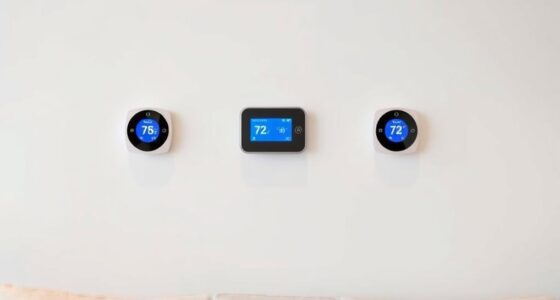

The best smart thermostat for a heat pump is the ecobee Smart Thermostat Enhanced, a strong all-around choice for homeowners who want smart controls and heat-pump-focused scheduling. The Sensi Smart Thermostat ST55 stands out for DIY-minded buyers, while the Amazon Smart Thermostat suits households already using Alexa. The main tradeoffs are system compatibility, support for auxiliary heat, installation requirements, and how much control you want from an app or the thermostat itself. Not every Wi-Fi thermostat handles every heat-pump setup, so check your equipment and wiring before choosing. Continue reading for the full comparison and a guide to finding the right match.

Get home appliances delivered free with Prime
- Fast, free delivery on millions of items
- Prime Video, Amazon Music and more included
- Member-only deals all year
Complete the kit



Key Takeaways
- The ecobee Smart Thermostat Enhanced leads as the best overall pick because it balances smart control with features suited to households seeking more than basic scheduling.
- The Sensi ST55 is the clearest DIY-oriented alternative, while the Amazon Smart Thermostat makes more sense when Alexa is already central to household controls.
- Compatibility matters more than a long feature list: heat pumps with auxiliary or emergency heat can require specific thermostat support and wiring.
- Several models in the list are close relatives or repeated entries, including the Honeywell Home X2S, so buyers should compare exact model numbers rather than assume each listing represents a distinct option.
- Basic scheduling, touchscreen controls, and app features serve different needs: a simpler model can be a better fit than a feature-heavy thermostat if you mainly want reliable temperature changes.
| ecobee Smart Thermostat Essential |  | Best for Smart-Home Flexibility | Connectivity: Wi-Fi | Display: 3.74-inch LCD touchscreen | Power: Battery powered; a Power Extender Kit may be needed without a C-wire | VIEW LATEST PRICE | See Our Full Breakdown |
| vine Smart Thermostat for Home, WiFi Compatible with Alexa and Google Assistant, 7-Day Programmable, Energy Star Certified |  | Best for Straightforward Scheduling | Connectivity: Wi-Fi | System compatibility: 24V AC systems, including heat pumps | Power: C-wire required | VIEW LATEST PRICE | See Our Full Breakdown |
| Amazon Smart Thermostat |  | Best for Alexa Households | HVAC compatibility: Most 24V HVAC systems; not compatible with 110–240V systems such as electric baseboard heat | Power: C-wire or separately sold power adapter kit | Wi-Fi: 2.4 GHz, 802.11 b/g/n; does not support 5 GHz | VIEW LATEST PRICE | See Our Full Breakdown |
| Sensi Smart Thermostat, Wi-Fi, DIY Installation, ST55 |  | Best for Easier Wiring | Model: ST55 | Connectivity: Wi-Fi | HVAC compatibility: Air conditioner, boiler, furnace, and heat pump | VIEW LATEST PRICE | See Our Full Breakdown |
| Honeywell Home Lyric T6 Pro Wi-Fi Programmable Thermostat |  | Best for Multi-Stage Heat Pumps | Model: TH6220WF2006/U | Connectivity: Wi-Fi | Heat-pump support: Up to 2 heat / 1 cool stages | VIEW LATEST PRICE | See Our Full Breakdown |
| Honeywell Home X2S Smart Wi-Fi Thermostat |  | Best for Matter Smart-Home Integration | Model: RTH2CWF | Heat-pump compatibility: Up to 2 heat / 1 cool stage | Conventional-system compatibility: Up to 2 heat / 2 cool stages | VIEW LATEST PRICE | See Our Full Breakdown |
| Sensi Lite Smart Wi-Fi Thermostat, ST25W |  | Best for C-Wire-Free Installation | Model: ST25W | Compatible systems: Air conditioner, boiler, furnace, heat pump | Connectivity: 2.4 GHz Wi-Fi | VIEW LATEST PRICE | See Our Full Breakdown |
| Vine ST300 Wi-Fi Smart Thermostat with Large Knob and Nightlight |  | Best for Hands-On Controls | Model: ST300 | Heat-pump compatibility: Supported 24V systems up to 2 heat / 2 cool stages | C-wire: Required | VIEW LATEST PRICE | See Our Full Breakdown |
| Sensi Touch 2 Smart Wi-Fi Thermostat, ST76 |  | Best for Room-by-Room Temperature Balancing | Model: Sensi Touch 2 ST76 | Compatible HVAC systems: Air conditioner, boiler, furnace, heat pump | Connectivity: 2.4 and 5.0 GHz Wi-Fi | VIEW LATEST PRICE | See Our Full Breakdown |
| Honeywell Home X2S Smart Wi-Fi Thermostat |  | Best for a Flexible Display and Finish | Model: RTH2SMC/N | Heat-pump compatibility: Up to 2 heat / 1 cool stage with electric backup | Conventional-system compatibility: Up to 2 heat / 2 cool stages | VIEW LATEST PRICE | See Our Full Breakdown |
| Cielo Smart Thermostat Eco for Central HVAC (Black) |  | Best for Heat-Pump Compatibility | Model: Cielo Smart Thermostat Eco | System support: Conventional 2H/2C; heat pump 4H/2C | Listed compatibility: Gas, electric, oil, hot water, heat pump, geothermal | VIEW LATEST PRICE | See Our Full Breakdown |
| Honeywell Home RTH9600WF Smart Color Thermostat |  | Best for a Customizable Display | Model: RTH9600WF | Display: Color LCD touchscreen | Heat-pump compatibility: Heat pumps with electric backup | VIEW LATEST PRICE | See Our Full Breakdown |
| ecobee Smart Thermostat Enhanced |  | Best for Occupancy-Based Comfort | HVAC compatibility: Listed as compatible with 90% of HVAC systems | Voltage: 24V | Display: 4-inch LCD | VIEW LATEST PRICE | See Our Full Breakdown |
| Honeywell Home T5 Smart Wi-Fi Thermostat |  | Best for Geofencing and Weekly Schedules | Model: RTH8800WF2022 | Display: 4.95-inch LCD touchscreen | Connectivity: Wi-Fi | VIEW LATEST PRICE | See Our Full Breakdown |
| Vine Smart Thermostat with Nightlight, 4.3-inch WiFi Touchscreen |  | Best for a Visible Touchscreen on a Budget Setup | Model: TJ-919T-V2 | Display: 4.3-inch LCD touchscreen with nightlight | Connectivity: Wi-Fi | VIEW LATEST PRICE | See Our Full Breakdown |
| smart thermostats for heat pump | Connectivity | Display | Power | Smart-home compatibility |
|---|---|---|---|---|
| ecobee Smart Thermostat Essent | Wi-Fi | 3.74-inch LCD touchscreen | Battery powered; a Power Extender Kit may be needed without a C-wire | Apple HomeKit, Google Assistant, and Alexa |
| vine Smart Thermostat for Home | Wi-Fi | LCD | C-wire required | Alexa and Google Assistant |
| Amazon Smart Thermostat | — | — | C-wire or separately sold power adapter kit | — |
| Sensi Smart Thermostat | Wi-Fi | 5-inch LED | Corded electric; 2 AA batteries included | — |
| Honeywell Home Lyric T6 Pro Wi | Wi-Fi | 11.4 cm manual screen | AC/DC power and 2 AA batteries | Amazon Alexa and Apple HomeKit |
| Honeywell Home X2S Smart Wi-Fi | Wi-Fi | 6.57-inch LCD | C-wire required; power adapter may be needed depending on wiring | Matter, Amazon Alexa, Google Assistant, Apple HomeKit |
| Sensi Lite Smart Wi-Fi Thermos | 2.4 GHz Wi-Fi | — | 2 AAA batteries or C-wire | Amazon Alexa, Google Assistant, SmartThings |
| Vine ST300 Wi-Fi Smart Thermos | Wi-Fi | 3.5-inch LCD touchscreen | — | — |
| Sensi Touch 2 Smart Wi-Fi Ther | 2.4 and 5.0 GHz Wi-Fi | LCD touchscreen | C-wire required | Amazon Alexa, Google Assistant, SmartThings |
| Honeywell Home X2S Smart Wi-Fi | Wi-Fi, 2.4 or 5 GHz; Matter | LCD | 24 VAC; C-wire required | Amazon Alexa, Google Assistant, Apple HomeKit |
| Cielo Smart Thermostat Eco for | Wi-Fi | LCD | — | — |
| Honeywell Home RTH9600WF Smart | Wi-Fi | Color LCD touchscreen | 24V; C-wire required | Alexa, Google Assistant, Microsoft Cortana, IFTTT |
| ecobee Smart Thermostat Enhanc | Wi-Fi | 4-inch LCD | — | Alexa, Google Assistant, Apple HomeKit, SmartThings |
| Honeywell Home T5 Smart Wi-Fi | Wi-Fi | 4.95-inch LCD touchscreen | 24V corded electric | Alexa, Google Assistant, Apple HomeKit |
| Vine Smart Thermostat with Nig | Wi-Fi | 4.3-inch LCD touchscreen with nightlight | Hardwired; C-wire required | Alexa and Google Assistant |
More Details on Our Top Picks
ecobee Smart Thermostat Essential
The ecobee Smart Thermostat Essential is a strong fit for heat-pump owners who want broad smart-home support without committing to a single voice platform. It works with many 24 VAC systems and supports Apple HomeKit, Google Assistant, and Alexa, giving it wider ecosystem coverage than the Alexa- and Google-focused vine model. Schedules, auto-away, and app control can help manage comfort when household routines change, while the touchscreen offers a direct alternative to using a phone.
The tradeoff is installation readiness: homes without a C-wire may need a separately sold Power Extender Kit, and the SmartSensor is also an extra purchase. Its product data lists battery power, so I would verify wiring and heat-pump compatibility before choosing it. Pick this over the Amazon Smart Thermostat when platform flexibility matters more than Alexa-centered control.
Pros:- Supports Apple HomeKit, Google Assistant, and Alexa
- Combines app control with a 3.74-inch touchscreen
- Auto-away and auto-scheduling can adapt temperature settings to household routines
- Indoor humidity detection and fan control add useful HVAC monitoring
Cons:- A Power Extender Kit may be needed without a C-wire and is sold separately
- SmartSensor and trim kit are separate purchases
- Compatibility must be checked against the specific heat-pump system
Best for: Heat-pump households using a mix of Apple HomeKit, Google Assistant, or Alexa devices who want app scheduling and touchscreen control.
Not ideal for: Buyers who need an included room sensor or a clearly C-wire-free installation, since the SmartSensor and possible Power Extender Kit are separate.
- Connectivity:Wi-Fi
- Display:3.74-inch LCD touchscreen
- Power:Battery powered; a Power Extender Kit may be needed without a C-wire
- System compatibility:Most 24 VAC HVAC equipment
- Smart-home compatibility:Apple HomeKit, Google Assistant, and Alexa
- Controls and features:Touchscreen, ecobee app, schedules, auto-away, fan control, and indoor humidity detection
- Mounting:Wall mount
Our verdict“Choose the ecobee if your heat-pump setup is compatible and you want more smart-home platform choice than the Amazon Smart Thermostat offers.”
vine Smart Thermostat for Home, WiFi Compatible with Alexa and Google Assistant, 7-Day Programmable, Energy Star Certified
The vine Smart Thermostat suits heat-pump owners who want a defined weekly routine rather than a wider set of connected-home options. Its 7-day, 8-period schedule gives households room to set different temperatures across workdays and weekends, and Auto Home/Away can adjust settings when occupancy changes. It is listed for 24V AC heat pumps as well as other common systems, and supports Alexa and Google Assistant. Compared with the ecobee Smart Thermostat Essential, it has a more schedule-centered pitch but lacks Apple HomeKit support in the supplied compatibility data.
Its main limitation is power: a C-wire is required, so this is less adaptable to older wiring than the Sensi ST55, which does not need a common wire in most applications. The compact LCD and app, voice, and touch controls keep operation straightforward, but buyers should check system compatibility before installation.
Pros:- Supports 7-day programming with 8 schedule periods
- Auto Home/Away can adjust settings around occupancy
- Listed as compatible with 24V AC heat-pump systems
- Works with Alexa and Google Assistant and carries Energy Star certification
Cons:- Requires a C-wire for installation
- Compatibility must be checked for the specific HVAC system
- Does not list Apple HomeKit support
Best for: Heat-pump owners with an existing C-wire who want detailed weekly schedules, app control, and Alexa or Google Assistant support.
Not ideal for: Owners of older homes without a C-wire, or households that rely on Apple HomeKit.
- Connectivity:Wi-Fi
- System compatibility:24V AC systems, including heat pumps
- Power:C-wire required
- Programming:7-day schedule with 8 periods and Auto Home/Away
- Display:LCD
- Controls:App, voice, and touch
- Smart-home compatibility:Alexa and Google Assistant
- Certification:Energy Star certified
- Dimensions:0.98 in D x 3.54 in W x 3.54 in H
Our verdict“Pick the vine when your heat pump has a C-wire and weekly schedule control matters more than the broader platform support of the ecobee.”
Amazon Smart Thermostat
For a heat-pump home already built around Alexa, the Amazon Smart Thermostat keeps control close to the devices that household uses: the Alexa or Ring app, compatible Echo devices, and on-device touch buttons. It supports schedules, vacation mode, humidity sensing, and automatic temperature adjustments based on presence. Compared with the ecobee Smart Thermostat Essential, it is a more Alexa-centered choice and does not list the same broad Apple HomeKit and Google Assistant support.
The Amazon model includes an energy dashboard and emergency heat mode, useful features to have in a heat-pump control setup, but buyers still need to confirm their system is among the compatible 24V types. Installation also depends on a C-wire or separately sold power adapter kit. Its Wi-Fi is limited to 2.4 GHz, and voice control requires a compatible Echo device, so it is less appealing for homes with 5 GHz-only network access or no Alexa hardware.
Pros:- Offers emergency heat mode and vacation mode
- Can adjust temperatures using schedules and presence
- Includes indoor humidity sensing and an energy dashboard
- Control is available through Alexa and Ring apps, compatible Echo devices, or on-device buttons
Cons:- Requires a C-wire or separately sold power adapter kit
- Supports 2.4 GHz Wi-Fi only
- Voice control requires a compatible Alexa-enabled device
Best for: Alexa households with a compatible 24V heat pump, a 2.4 GHz Wi-Fi network, and a C-wire or willingness to add the power adapter kit.
Not ideal for: Homes that need 5 GHz Wi-Fi support, want voice control without an Echo device, or prefer Apple HomeKit or Google Assistant integration.
- HVAC compatibility:Most 24V HVAC systems; not compatible with 110–240V systems such as electric baseboard heat
- Power:C-wire or separately sold power adapter kit
- Wi-Fi:2.4 GHz, 802.11 b/g/n; does not support 5 GHz
- Controls:Three on-device touch buttons, Alexa app, Ring app, or compatible Echo device
- Features:Schedules, humidity sensing, presence-based adjustments, emergency heat mode, vacation mode, and energy dashboard
- Dimensions:3.56 x 3.56 x 0.84 in
- Weight:3.86 oz
- Certifications:ENERGY STAR and ECOLOGO Gold
Our verdict“Choose the Amazon Smart Thermostat if Alexa is already central to your home and your heat-pump wiring and Wi-Fi meet its requirements.”
Sensi Smart Thermostat, Wi-Fi, DIY Installation, ST55
The Sensi ST55 stands out for heat-pump owners who want app-based scheduling without assuming a C-wire is available. Its common wire is not required for most applications, giving it a wiring advantage over the vine thermostat and the Amazon Smart Thermostat, both of which require a C-wire or power kit. Sensi also supplies DIY installation guidance, along with remote access, usage reports, equipment alerts, and filter reminders—practical details for owners who want more than basic temperature control.
It covers several smart-home platforms, including Apple HomeKit, Alexa, Google Assistant, SmartThings, and Vera, so it is more flexible than the Alexa-focused Amazon model. The tradeoff is that “most applications” is not every heat-pump configuration: wiring needs vary, and compatibility should be checked before purchase. Its LED display and button-led controls are more functional than touchscreen-focused options such as the ecobee.
Pros:- Common wire is not required for most applications
- DIY guidance includes a built-in level and step-by-step app instructions
- Supports Alexa, Apple HomeKit, Google Assistant, SmartThings, and Vera
- Provides scheduling, usage reports, equipment alerts, and filter reminders
Cons:- Common-wire needs vary by heat-pump setup
- HVAC compatibility depends on the home’s specific equipment
- LED display is less touchscreen-oriented than the ecobee Smart Thermostat Essential
Best for: Heat-pump owners seeking DIY installation guidance, broad smart-home compatibility, and a thermostat that often works without a C-wire.
Not ideal for: Buyers who want a large touchscreen or a guaranteed no-C-wire installation regardless of their specific HVAC wiring.
- Model:ST55
- Connectivity:Wi-Fi
- HVAC compatibility:Air conditioner, boiler, furnace, and heat pump
- Voltage:24 V AC
- Common wire:Not required for most applications
- Display:5-inch LED
- Compatible platforms:Amazon Alexa, Apple HomeKit, Google Assistant, SmartThings, and Vera
- Controls and features:Buttons, app, touch, and voice; schedules, remote access, usage reports, equipment alerts, and filter reminders
- Power:Corded electric; 2 AA batteries included
Our verdict“Choose the Sensi ST55 if wiring flexibility and guided DIY setup matter more than having a touchscreen-first interface.”
Honeywell Home Lyric T6 Pro Wi-Fi Programmable Thermostat
The Honeywell Home Lyric T6 Pro is the most clearly specified choice here for buyers with a heat pump that needs multi-stage control. It supports up to 2 heat/1 cool stages for heat-pump systems, making its equipment support a more specific match than the general compatibility descriptions for the ecobee Smart Thermostat Essential and Sensi ST55. Wi-Fi, app scheduling, Alexa, and Apple HomeKit provide remote control and familiar smart-home links.
This model is a better fit for owners prioritizing system-stage compatibility than for buyers seeking a modern touchscreen experience. Its display is described as a manual screen, and the thermostat also uses two AA batteries alongside AC/DC power. Compared with the Amazon Smart Thermostat, it adds Apple HomeKit support, but the supplied data does not list features such as presence-based adjustments or an energy dashboard. Check wiring and equipment requirements against the exact heat-pump configuration before buying.
Pros:- Specifically supports heat pumps with up to 2 heat and 1 cool stage
- Offers Wi-Fi app control and scheduling
- Works with Amazon Alexa and Apple HomeKit
- Also supports conventional systems with up to 2 heat and 2 cool stages
Cons:- Display is a manual screen rather than a full touchscreen
- Requires two AA batteries in addition to AC/DC power
- Compatibility and wiring should be checked against the exact heat-pump system
Best for: Owners of multi-stage heat pumps who need support for up to two heating stages and want Wi-Fi scheduling with Alexa or Apple HomeKit.
Not ideal for: Buyers who want a full touchscreen, detailed occupancy automation, or a model with broadly documented heat-pump wiring requirements.
- Model:TH6220WF2006/U
- Connectivity:Wi-Fi
- Heat-pump support:Up to 2 heat / 1 cool stages
- Conventional system support:Up to 2 heat / 2 cool stages
- Smart-home compatibility:Amazon Alexa and Apple HomeKit
- Power:AC/DC power and 2 AA batteries
- Display:11.4 cm manual screen
- Dimensions:4.06 in W x 4.06 in H x 1.09 in D
Our verdict“Pick the Lyric T6 Pro when your heat pump needs multi-stage support and that matters more than touchscreen controls or richer automation.”
Honeywell Home X2S Smart Wi-Fi Thermostat
For a heat-pump owner building around more than one smart-home platform, the Honeywell Home X2S stands out for Matter support alongside Alexa, Google Assistant, and Apple HomeKit. That breadth gives it an advantage over the Sensi Lite ST25W, which supports Alexa, Google Assistant, and SmartThings but does not list Matter or HomeKit. The X2S also offers flexible weekly schedules, auto-away, humidity display, and filter reminders, so its appeal goes beyond voice commands.
Its heat-pump support is specified up to 2 heat and 1 cool stage, which suits many conventional configurations but rules out systems needing more stages. A C-wire is required, and some installations may need an adapter; buyers should check their wiring before choosing it over a battery-powered option. The LCD and push-button controls are functional, though less touch-oriented than the Sensi Touch 2.
Pros:- Matter support plus compatibility with Alexa, Google Assistant, and Apple HomeKit
- Flexible scheduling and auto-away options
- Humidity display and filter-change reminders
- ENERGY STAR certified
Cons:- Requires a C-wire; some homes may need a power adapter
- Heat-pump compatibility is limited to up to 2 heat and 1 cool stage
- LCD and push-button interface is less touch-focused than the Sensi Touch 2
Best for: Heat-pump households using Matter, Apple HomeKit, or several smart-home platforms and whose wiring includes a C-wire.
Not ideal for: Owners without a C-wire who want a simpler installation, or those with a heat pump requiring more than 2 heat and 1 cool stage.
- Model:RTH2CWF
- Heat-pump compatibility:Up to 2 heat / 1 cool stage
- Conventional-system compatibility:Up to 2 heat / 2 cool stages
- Connectivity:Wi-Fi
- Smart-home compatibility:Matter, Amazon Alexa, Google Assistant, Apple HomeKit
- Display:6.57-inch LCD
- Power:C-wire required; power adapter may be needed depending on wiring
- Scheduling:5-1-1 day, 5-2 day, 7 day, or non-programmable
- Warranty:2 years
Our verdict“Choose the X2S if broad Matter-based smart-home control matters more than avoiding C-wire installation.”
Sensi Lite Smart Wi-Fi Thermostat, ST25W
The Sensi Lite ST25W is the practical pick for heat-pump owners who want app control but would rather not make a C-wire the starting point of the project. It runs on batteries or a C-wire and is designed to work without one in most homes, unlike the Sensi Touch 2 ST76, which requires a common wire. That can simplify a DIY replacement, and the included installation guidance and built-in level add useful help during mounting.
Remote access, geofencing, schedules, and usage reports cover the core smart functions without a more elaborate interface. The tradeoff is a narrower smart-home list: it supports Alexa, Google Assistant, and SmartThings, while the Honeywell Home X2S adds Matter and Apple HomeKit. The Sensi Lite also requires 2.4 GHz Wi-Fi, and some HVAC configurations still need a C-wire or compatible power accessory. Check the wiring and system compatibility before relying on battery operation.
Pros:- Designed to operate without a C-wire in most homes
- Supports app control, schedules, geofencing, and usage reports
- DIY installation includes a built-in level and step-by-step instructions
- ENERGY STAR certified
Cons:- Some HVAC systems require a C-wire or compatible power accessory
- Requires a 2.4 GHz Wi-Fi connection
- Does not list Matter or Apple HomeKit support
Best for: DIY heat-pump owners replacing a thermostat in a home without a C-wire who want scheduling, remote access, and basic voice control.
Not ideal for: Buyers seeking Matter or Apple HomeKit support, or households whose Wi-Fi setup does not provide a 2.4 GHz network.
- Model:ST25W
- Compatible systems:Air conditioner, boiler, furnace, heat pump
- Connectivity:2.4 GHz Wi-Fi
- Smart-home compatibility:Amazon Alexa, Google Assistant, SmartThings
- Power:2 AAA batteries or C-wire
- Voltage:24 volts
- Controls:App, touch, voice
- Dimensions:0.88 × 5.07 × 3.13 inches (D × W × H)
- Warranty:3 years
Our verdict“Pick the Sensi Lite if avoiding a C-wire is your priority and its Wi-Fi and smart-home requirements fit your home.”
Vine ST300 Wi-Fi Smart Thermostat with Large Knob and Nightlight
The Vine ST300 suits households that want smart scheduling without making everyday adjustments depend on an app. Its physical knob and 3.5-inch touchscreen offer direct control, while Alexa and Google Assistant add voice access. Compared with the Sensi Lite ST25W, the Vine gives more prominence to on-device controls and adds an adjustable nightlight and child lock—useful details where family members may adjust the temperature at the wall.
For heat pumps, the stated compatibility is up to 2 heat and 2 cool stages on supported 24V systems, but buyers should verify their exact setup before installation. The cost of its straightforward hardwired design is a required C-wire, unlike the Sensi Lite’s battery option. It also lacks the X2S’s Matter and Apple HomeKit support. Its 7-day scheduling and Auto Home/Away mode provide everyday automation, but this is not the pick for homes needing broad platform integration or a C-wire-free install.
Pros:- Physical knob and touchscreen provide direct on-device control
- 7-day scheduling and Auto Home/Away mode
- Alexa and Google Assistant support
- Adjustable nightlight and child lock
Cons:- Requires a C-wire and hardwired installation
- Compatibility is limited to supported 24V systems and should be checked before purchase
- Does not list Matter or Apple HomeKit support
Best for: Families with a compatible 24V heat pump who prefer physical thermostat controls, individual daily schedules, and a child lock.
Not ideal for: Households without a C-wire or buyers who want Matter, Apple HomeKit, or compatibility beyond the specified 24V systems.
- Model:ST300
- Heat-pump compatibility:Supported 24V systems up to 2 heat / 2 cool stages
- C-wire:Required
- Display:3.5-inch LCD touchscreen
- Connectivity:Wi-Fi
- Voice assistants:Amazon Alexa, Google Assistant
- Scheduling:7-day programmable
- Additional features:Auto Home/Away, geofencing, adjustable nightlight, child lock
Our verdict“Choose the Vine ST300 if your heat pump is compatible and easy physical controls matter more than broad smart-home integration.”
Sensi Touch 2 Smart Wi-Fi Thermostat, ST76
For a heat-pump home where one thermostat location does not reflect comfort in every room, the Sensi Touch 2 ST76 has a standout advantage: support for up to 15 Sensi room sensors, sold separately. Those sensors give buyers a way to address temperature differences around the home, a capability not listed for the more straightforward Sensi Lite ST25W. App and voice control, scheduling, usage reports, and maintenance alerts make it a fuller monitoring choice as well.
The tradeoff is installation: the ST76 requires a C-wire, whereas the Sensi Lite is designed to work without one in most homes. Sensors also add a separate purchase and setup step. Its touchscreen and support for both 2.4 and 5.0 GHz Wi-Fi give it a more feature-rich feel than the LCD-focused X2S, but buyers who only need basic remote scheduling may not benefit enough from the extra sensor ecosystem.
Pros:- Supports up to 15 compatible Sensi room sensors
- Touchscreen, app, voice control, and flexible scheduling
- Usage reports, equipment alerts, and filter reminders
- Supports 2.4 and 5.0 GHz Wi-Fi
Cons:- C-wire is required
- Room sensors are sold separately
- The sensor system adds cost and setup beyond basic thermostat control
Best for: Owners of compatible heat-pump homes with uneven room temperatures who are willing to use separate Sensi sensors and have a C-wire.
Not ideal for: Buyers without a C-wire, those who do not need room sensing, or anyone seeking a thermostat with included room sensors.
- Model:Sensi Touch 2 ST76
- Compatible HVAC systems:Air conditioner, boiler, furnace, heat pump
- Connectivity:2.4 and 5.0 GHz Wi-Fi
- Power:C-wire required
- Voltage:24 V
- Smart-home compatibility:Amazon Alexa, Google Assistant, SmartThings
- Room sensor support:Up to 15 Sensi room sensors, sold separately
- Dimensions:5.6 × 3.25 × 0.77 inches
- Display:LCD touchscreen
Our verdict“Choose the Sensi Touch 2 if room-to-room comfort is a real problem and you have a C-wire for installation.”
Honeywell Home X2S Smart Wi-Fi Thermostat
This Honeywell Home X2S version is a practical match for heat-pump owners who want Matter-enabled control and a little flexibility in how the wall unit looks. Its interchangeable white and gray accent pieces let it blend with different room finishes, while scheduling, auto-away, humidity monitoring, and filter reminders cover useful day-to-day needs. Like the other Honeywell Home X2S in this lineup, it supports heat pumps up to 2 heat and 1 cool stage; it is a better fit for compatible systems than a general-purpose choice for every HVAC configuration.
Compared with the Vine ST300, the X2S adds Matter and Apple HomeKit alongside Alexa and Google Assistant, but the Vine offers a physical knob and child lock. This Honeywell model also requires a C-wire and does not support 120–240 V electric baseboard heating. Check wiring and system type first; its smart-home reach cannot compensate for an incompatible installation.
Pros:- Matter support with Alexa, Google Assistant, and Apple HomeKit
- Flexible schedules and auto-away
- Humidity monitoring and filter reminders
- Interchangeable white and gray accent pieces
Cons:- Requires a C-wire
- Not compatible with 120–240 V electric baseboard heat
- Heat-pump compatibility is limited to up to 2 heat and 1 cool stage
Best for: Heat-pump owners with a C-wire who want Matter, Apple HomeKit support, and a choice of white or gray accent trim.
Not ideal for: Homes with electric baseboard heating, no C-wire, or heat-pump staging beyond 2 heat and 1 cool.
- Model:RTH2SMC/N
- Heat-pump compatibility:Up to 2 heat / 1 cool stage with electric backup
- Conventional-system compatibility:Up to 2 heat / 2 cool stages
- Connectivity:Wi-Fi, 2.4 or 5 GHz; Matter
- Smart-home compatibility:Amazon Alexa, Google Assistant, Apple HomeKit
- Power:24 VAC; C-wire required
- Display:LCD
- Not compatible with:120–240 V electric baseboard heat
- Warranty:2 years
Our verdict“Pick this X2S if your system matches its staging and wiring requirements and you want Matter control with a choice of accent color.”
Cielo Smart Thermostat Eco for Central HVAC (Black)
The Cielo Smart Thermostat Eco earns this role because its listed support for heat pumps up to 4H/2C gives buyers useful system flexibility, while its included C-wire adapter may simplify installation in homes that lack a dedicated C-wire. Its ENERGY STAR certification, scheduling, and energy-use insights also make it a stronger fit for owners who want to track how their HVAC habits affect consumption. Compared with the Honeywell Home RTH9600WF, Cielo lists geothermal compatibility and does not specify the same electric-backup condition for heat pumps. The tradeoff is that compatibility still depends on a 24V central system: this is not a mini-split controller, and the product details do not spell out advanced heat-pump staging or auxiliary-heat behavior. I’d shortlist it for conventional central heat pumps, then confirm wiring and equipment support before buying.
Pros:- Lists heat-pump support up to 4H/2C, plus geothermal compatibility.
- Includes a C-wire adapter for installations without a spare C-wire.
- ENERGY STAR certified with scheduling and energy-consumption insights.
- Works with Alexa, Google Assistant, Siri, and SmartThings.
Cons:- Not compatible with mini-split systems.
- Requires 24V HVAC infrastructure.
- The supplied details do not clarify heat-pump staging or auxiliary-heat configuration.
Best for: Owners of 24V central heat pumps, including geothermal systems, who want energy-use insights and may need a C-wire adapter.
Not ideal for: Mini-split owners or households with high-voltage, proprietary, or otherwise non-24V equipment.
- Model:Cielo Smart Thermostat Eco
- System support:Conventional 2H/2C; heat pump 4H/2C
- Listed compatibility:Gas, electric, oil, hot water, heat pump, geothermal
- Voltage:24V AC
- Connectivity:Wi-Fi
- Controls:App, touch, voice
- Display:LCD
- Included components:Thermostat, C-wire adapter, installation guide
Our verdict“Choose Cielo if your heat pump is a compatible 24V central system and you value broad listed system support plus energy-use reporting.”
Honeywell Home RTH9600WF Smart Color Thermostat
The RTH9600WF is the display-focused choice here: its customizable color touchscreen makes schedules and readings easy to see at the wall, and Smart Response learns how quickly a home heats and cools. That learning can help it time calls for heat more thoughtfully, but it should not be mistaken for a heat-pump-specific staging feature. Its listed heat-pump compatibility is limited to systems with electric backup, a narrower fit than the Cielo Eco’s stated heat-pump support. It also requires a C-wire, unlike the ecobee Smart Thermostat Enhanced, which includes a Power Extender Kit for some homes lacking one. I’d choose Honeywell for owners who want a prominent color interface and have confirmed both the backup-heat and wiring requirements; buyers with uncertain wiring should look elsewhere.
Pros:- Customizable color touchscreen presents settings and readings clearly.
- Smart Response learns heating and cooling cycle times.
- ENERGY STAR certified with app and voice-assistant control.
- Lists compatibility with heat pumps that have electric backup.
Cons:- Requires a C-wire, which may call for an additional power adapter.
- Heat-pump compatibility is specified only for systems with electric backup.
- Not compatible with 120–240V electric baseboard heat.
Best for: Heat-pump households with electric backup and an existing C-wire that want a color touchscreen and learned cycle timing.
Not ideal for: Owners of heat pumps without electric backup, homes lacking a C-wire, or users with electric baseboard heat.
- Model:RTH9600WF
- Display:Color LCD touchscreen
- Heat-pump compatibility:Heat pumps with electric backup
- Power:24V; C-wire required
- Connectivity:Wi-Fi
- Smart-home compatibility:Alexa, Google Assistant, Microsoft Cortana, IFTTT
- Certification:ENERGY STAR
- Dimensions:1 in D × 4.75 in W × 3.5 in H
Our verdict“Pick the RTH9600WF if your heat pump has electric backup, your wiring includes a C-wire, and a customizable wall display matters to you.”
ecobee Smart Thermostat Enhanced
The ecobee Smart Thermostat Enhanced stands out for using occupancy and schedule data to adjust temperatures, a practical approach for homes where rooms are empty for long stretches. For heat-pump owners, the potential benefit is less unnecessary conditioning without giving up remote app control. The included Power Extender Kit can also address the missing-C-wire problem, unlike the C-wire-dependent Honeywell RTH9600WF. But ecobee’s supplied specifications say it works with 90% of HVAC systems rather than naming heat-pump stages or auxiliary-heat details, so I would verify compatibility with the exact equipment before purchasing. Room-by-room sensing is another extra: SmartSensors are sold separately. Compared with the Cielo Eco, ecobee’s standout is occupancy-based adjustment, not a more explicit heat-pump support specification.
Pros:- Adjusts temperatures based on occupancy and schedule.
- Includes a Power Extender Kit for homes without a C-wire.
- Supports Alexa, Google Assistant, Apple HomeKit, and SmartThings.
- ENERGY STAR certified and backed by a three-year warranty.
Cons:- Specific heat-pump stages and auxiliary-heat support are not listed in the supplied specifications.
- SmartSensors for room-by-room comfort are sold separately.
- Compatibility should be checked against the exact HVAC system.
Best for: Households with compatible 24V heat pumps that have variable occupancy and want automatic adjustments plus an included option for homes without a C-wire.
Not ideal for: Buyers who need published heat-pump staging details, want room-by-room sensing included, or prefer to avoid checking system compatibility.
- HVAC compatibility:Listed as compatible with 90% of HVAC systems
- Voltage:24V
- Display:4-inch LCD
- Connectivity:Wi-Fi
- Included wiring accessory:Power Extender Kit
- Smart-home compatibility:Alexa, Google Assistant, Apple HomeKit, SmartThings
- Certification:ENERGY STAR
- Warranty:3 years
Our verdict“Choose ecobee if occupancy-based adjustments matter more than having heat-pump staging details stated upfront, and confirm your system is supported.”
Honeywell Home T5 Smart Wi-Fi Thermostat
The Honeywell Home T5 is the schedule-and-location pick: seven-day programming and geofencing let it adjust the home when occupants leave or return, which can suit predictable routines better than ecobee’s occupancy-led approach. The touchscreen and compatibility with Alexa, Google Assistant, and Apple HomeKit add straightforward control, while ENERGY STAR certification and monthly reports offer a way to review usage. Its limitation for heat-pump buyers is the supplied data: it identifies the unit as a 24V thermostat but does not state supported heat-pump stages or backup-heat configurations. The Cielo Smart Thermostat Eco is clearer about listed heat-pump support, including 4H/2C; the T5 is a less certain choice until its wiring and equipment compatibility are confirmed. Many installations also need a C-wire adapter.
Pros:- Geofencing can adjust settings around household members’ locations.
- Offers seven-day flexible scheduling.
- Supports Alexa, Google Assistant, and Apple HomeKit.
- ENERGY STAR certified with monthly energy reports and tips.
Cons:- The supplied specifications do not identify heat-pump stages or backup-heat support.
- Many installations require a C-wire power adapter.
- Heating-only oil systems are not supported unless a C-wire is present.
Best for: Heat-pump households with regular comings and goings that want location-based adjustments and flexible weekly scheduling.
Not ideal for: Owners who need clearly specified heat-pump staging or backup-heat support, or who cannot provide the required C-wire power.
- Model:RTH8800WF2022
- Display:4.95-inch LCD touchscreen
- Connectivity:Wi-Fi
- Power:24V corded electric
- Programming:Seven-day flexible schedule
- Smart-home compatibility:Alexa, Google Assistant, Apple HomeKit
- Certification:ENERGY STAR
- Mounting:Wall mount
Our verdict“Consider the T5 for location-aware scheduling, but verify heat-pump compatibility and C-wire needs before choosing it over the more explicitly specified Cielo Eco.”
Vine Smart Thermostat with Nightlight, 4.3-inch WiFi Touchscreen
Vine’s differentiator is practical visibility: the 4.3-inch touchscreen and built-in nightlight make wall adjustments easier in dim rooms, while seven-day scheduling and Auto Home/Away modes cover everyday routine control. It lists compatibility with 24V heat pumps and works with Alexa and Google Assistant, but the supplied details do not specify heat-pump stages or how auxiliary heat is handled. That makes it less clearly documented for equipment matching than the Cielo Smart Thermostat Eco, which lists heat-pump support up to 4H/2C. Vine also requires a C-wire, so its DIY-friendly installation guides do not solve missing-power wiring. I’d choose it when the clear screen and simple schedule features are the draw, provided the system is standard 24V and compatibility is confirmed first.
Pros:- Large 4.3-inch touchscreen includes a built-in nightlight.
- Lists compatibility with 24V heat pumps.
- Seven-day scheduling and Auto Home/Away modes support routine adjustments.
- Works with Alexa, Google Assistant, iOS, and Android.
Cons:- Requires a C-wire for power.
- Limited to 24V AC systems, excluding some high-voltage or specialized equipment.
- The supplied details do not specify heat-pump staging or auxiliary-heat behavior.
Best for: Owners of standard 24V heat pumps who want a large, nightlight-equipped touchscreen, basic scheduling, and Alexa or Google control.
Not ideal for: Homes without a C-wire, mini-split or high-voltage systems, or heat-pump owners who need published staging and auxiliary-heat details.
- Model:TJ-919T-V2
- Display:4.3-inch LCD touchscreen with nightlight
- Connectivity:Wi-Fi
- System compatibility:24V AC gas, oil, electric, boiler, and heat pump
- Power:Hardwired; C-wire required
- Smart-home compatibility:Alexa and Google Assistant
- Dimensions:1.02 in D × 4.84 in W × 3.35 in H
- Mounting:Wall mount
Our verdict“Choose Vine for an easy-to-read screen and basic scheduling on a confirmed 24V heat pump, but skip it if you lack a C-wire or need detailed system support information.”

How We Picked
I ranked these 15 listed thermostat entries around the needs that make heat-pump shopping different from choosing a thermostat for a conventional furnace. The main criteria were published compatibility with heat pumps, support for auxiliary or emergency heat where specified, wiring and installation demands, clarity of app and on-device controls, and the usefulness of scheduling and smart-home functions. I also weighed whether a thermostat’s feature set offers a real advantage for heat-pump owners, rather than treating connectivity or a color display as proof of better system fit.
The order gives priority to heat-pump suitability, practical control, and a clear reason to choose the model. Options with accessible setup or broad everyday usefulness rank ahead of models whose appeal is mostly a particular interface or a narrow convenience feature. Product listings include the Honeywell Home X2S twice, so I treat those as the same model rather than separate competing designs. Compatibility can vary by HVAC configuration, so a high placement is a starting point—not a substitute for checking the manufacturer’s wiring guide and your system’s exact stages.
Factors to Consider When Choosing Smart Thermostats For Heat Pumps
Heat-pump thermostat shopping starts with the equipment, not the app. Use these checks to narrow the field before comparing screens, schedules, or voice controls.
Match the thermostat to your heat-pump stages
Heat pumps can use a reversing valve to switch between heating and cooling, and many systems add auxiliary heat for colder conditions. Thermostat support for heat-pump operation and auxiliary heat can vary, so look for documentation that matches your system’s number of heating and cooling stages. A thermostat that supports a basic heat pump may not support every auxiliary or dual-fuel arrangement. Check the outdoor unit and air handler documentation, or ask an HVAC professional to identify the configuration. Do not assume that a familiar wire label alone confirms compatibility. This check can rule out a poor fit before installation or return hassles.
Check the wiring before choosing a screen
Many Wi-Fi thermostats need a continuous source of power, often through a C-wire, while some models offer another power method or a compatible adapter. Take a photo of the existing thermostat wiring and label each conductor before removing anything. The presence of a wire marked C does not always mean it is connected at the equipment end, so verify both sides when possible. Heat-pump wiring can include terminals that control the reversing valve or auxiliary heat; moving those wires by guesswork can lead to incorrect operation. If your wiring is unfamiliar, confirm it with the thermostat’s compatibility checker or a qualified installer. A larger touchscreen is little help if the unit cannot be powered or wired correctly.
Think through auxiliary heat and cold-weather behavior
Auxiliary heat can help maintain comfort when a heat pump cannot keep up, but frequent use may increase energy consumption, particularly when the backup source is electric resistance heat. Look for controls that let you set or manage auxiliary heat behavior in a way that matches your equipment and local conditions. Avoid changing thresholds based on a generic internet tip; the right settings depend on the heat pump, backup system, climate, and home. Ask an installer how your system is designed to call for backup heat. If you have a dual-fuel setup, verify that the thermostat supports the specific heat source combination. These details can matter more to operating costs than adding another smart-home integration.
Decide how much automation you will actually use
App control is useful when schedules change, but it does not automatically mean lower energy use or better comfort. Start with a realistic weekly schedule and check whether the thermostat supports the routines, remote access, and household accounts you expect. Voice-assistant compatibility matters most if you already use that platform; it is less valuable if you prefer physical controls. Geofencing and learning features can be convenient, yet they may require location access, extra configuration, or a period of adjustment. Consider who will change settings at home and whether a clear thermostat interface matters more than advanced automation. Paying for unused features can add setup complexity without improving daily control.
Choose an interface that fits the household
A touchscreen can make settings easier to find, while physical buttons or a dial may be quicker for people who prefer direct controls. A large, bright display is not automatically easier to use if the menus are confusing or the screen is difficult to read from across the room. Consider whether household members will adjust temperature at the wall or mainly through an app. Nightlights and display options may help in a hallway, but they should not outweigh system compatibility. Also check whether the thermostat’s app can be shared with other household members without handing over one account. The best interface is the one everyone can use without accidentally changing heat-pump settings.
Weigh DIY installation against professional setup
DIY installation can be manageable when the wiring is clearly documented and the thermostat’s compatibility tools confirm your system. Heat pumps with multiple stages, auxiliary heat, or dual-fuel equipment can make that process less straightforward. Before buying, check what installation hardware is included and whether your setup may need an adapter or additional wiring. Professional installation can help with configuration and testing, but it adds a service step and may be unnecessary for a simple compatible system. After installation, test heating, cooling, and backup-heat calls according to the thermostat instructions. A successful screen startup alone does not prove every heat-pump function is operating as intended.
Frequently Asked Questions
How can I tell whether a smart thermostat will work with my heat pump and auxiliary heat?
Find the model information for your indoor air handler and outdoor unit, then check the thermostat maker’s compatibility information for heat-pump and auxiliary-heat support. Compare the listed terminals and stages with the wiring at your current thermostat, including the reversing-valve connection. If you have electric backup, gas backup, or a dual-fuel system, verify that exact arrangement rather than relying on a general “heat pump compatible” label. Take photos of the wiring before removing the old thermostat. When the equipment details or wiring are unclear, ask an HVAC professional to confirm before you buy.
Do I need a C-wire for a smart thermostat on a heat pump?
Some smart thermostats need a C-wire for steady power, while others may support an alternative power method or an adapter. Heat-pump systems can use more thermostat connections than a basic heating system, so do not assume that a spare wire can be repurposed safely. Check the exact model’s wiring requirements and confirm whether the C-wire is connected at both the thermostat and HVAC equipment. A compatibility checker can help, but unusual wiring may need professional review. Confirming power needs before purchase can prevent an installation that appears to fit but cannot run reliably.
Will a smart thermostat lower my heat-pump energy use automatically?
A smart thermostat can make scheduling and remote adjustments easier, but savings depend on how it is configured and how your household uses the system. Frequent setbacks may not suit every heat pump, especially if recovery prompts auxiliary heat to run. Ask your installer or consult the equipment guidance before setting large temperature changes or altering backup-heat controls. A steady, practical schedule is often a better starting point than relying on automation without checking how the system responds. Track comfort and energy use after changing settings, then adjust gradually.
Can I install a smart thermostat myself if my current thermostat already controls a heat pump?
Possibly, if the new thermostat explicitly supports your heat-pump configuration, the wiring is identified, and the manufacturer’s installation instructions match your setup. Heat-pump terminals can control functions that differ from those on a furnace, and auxiliary heat adds another source of possible wiring mistakes. Label and photograph every connection before removing the existing thermostat, then follow the new model’s wiring diagram rather than copying wire positions by color alone. Test heating, cooling, and auxiliary operation after installation. If the wiring or system stages do not match the guide, use a qualified installer.
Should I choose a thermostat with more smart-home features or simpler controls?
Choose based on who will operate the system and which functions you will use regularly. If your household already relies on Alexa or another supported platform, voice control and app access may fit naturally into existing routines. If people prefer changing the temperature at the wall, a straightforward display and clear physical controls may matter more than automation. Extra features can bring additional setup, app permissions, or account requirements, so check those before buying. For a heat pump, confirmed equipment support should come before either a richer interface or a longer list of integrations.
Conclusion
For most buyers, I recommend the ecobee Smart Thermostat Enhanced as the best overall starting point in this lineup, with system compatibility checked before purchase. The Sensi ST55 is my best value-oriented pick for DIY-minded households, while the ecobee Smart Thermostat Essential is a sensible alternative for buyers who want a more streamlined smart-thermostat feature set. For beginners, I would start with the Amazon Smart Thermostat if Alexa is already part of the home, or choose a simpler interface that household members will comfortably use. Buyers who prioritize a dedicated display or a particular control style can compare the Honeywell color-screen models and Vine touchscreen or dial options, but should not let appearance outrank heat-pump and auxiliary-heat compatibility. The right choice is the model whose documented wiring and system support match your equipment, with features that fit the way you actually control heating and cooling.