
Choosing a smart thermostat with student discount pricing requires balancing upfront costs with long-term energy savings and ease of installation. The Amazon Smart Thermostat stands out as the best overall pick for students due to its aggressive pricing and seamless integration with common student tech like Alexa and Ring. For those with older heating systems, the Honeywell Home T5 offers a reliable bridge between traditional and smart technology without requiring complex rewiring. However, students renting apartments must carefully check if their landlord allows thermostat swaps, as many units require a C-wire or specific voltage compatibility. This guide breaks down which models offer the best value for tight budgets and which are worth the extra effort for advanced features. Continue reading to see which thermostat fits your specific housing situation and heating setup.

Get home appliances delivered free with Prime
- Fast, free delivery on millions of items
- Prime Video, Amazon Music and more included
- Member-only deals all year
Complete the kit


Key Takeaways
- The Amazon Smart Thermostat consistently offers the lowest barrier to entry for students, often coming close to the cost of a textbook while delivering core smart features.
- Models like the Vine Smart Wi-Fi Thermostat provide premium touchscreen aesthetics at budget prices but often require a C-wire, which can be a dealbreaker for renters in older buildings.
- Compatibility with existing smart home ecosystems (Alexa vs. Google Home vs. Apple HomeKit) is a stronger differentiator for student dorms and apartments than raw hardware specs.
- Budget options like the Riseem and Vine often lack remote sensor support, meaning they are best suited for single-room setups rather than multi-zone homes.
- Installation complexity varies wildly; Google Nest and ecobee offer guided setups that reduce anxiety for first-time DIYers, while generic brands often require manual wiring knowledge.
| Vine Smart Wi-Fi Thermostat with Alexa and Google Assistant, 7-Day Programmable, C-Wire Required |  | Best Value for Multi-Assistant Control | Connectivity: Wi-Fi | HVAC compatibility: Most 24V AC conventional, heat pump, heating-only, and cooling-only systems | Voice assistants: Amazon Alexa and Google Assistant | VIEW ON AMAZON | See Our Full Breakdown |
| Amazon Smart Thermostat (Like-New), Alexa and Ring Compatible |  | Best for Alexa-Centered Households | Condition: Refurbished, tested, and certified to look and work like new | HVAC compatibility: Most 24V systems; not compatible with 110–240V systems | Power requirement: C-wire or separately sold power adapter kit | VIEW ON AMAZON | See Our Full Breakdown |
| Mysa Smart Thermostat Lite for Electric Baseboard Heaters |  | Best for Electric Baseboard Heating | Compatible heaters: Electric baseboard, fan-forced, wall, and convector heaters | Voltage: 120V, 208V, and 240V | Wiring: Four wires; requires a neutral or second live wire | VIEW ON AMAZON | See Our Full Breakdown |
| Google Nest Smart Thermostat, Programmable Wi-Fi, Charcoal | 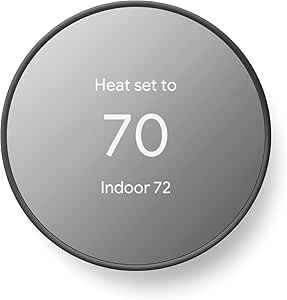 | Best for DIY Setup and Google Home | Connectivity: Wi-Fi (2.4 GHz and 5 GHz) and Bluetooth Low Energy | Compatibility: Heating and cooling; 24 volts; heat-pump use listed | Power: Battery powered; some systems may require a C-wire or compatible power accessory | VIEW ON AMAZON | See Our Full Breakdown |
| Honeywell Home X2S Smart Wi-Fi Thermostat |  | Best for Matter-Compatible Scheduling | Connectivity: Wi-Fi (2.4 or 5 GHz) and Matter | Power: 24 VAC; C-wire required | System compatibility: Up to 2 heat/2 cool conventional; up to 2 heat/1 cool heat pump with electric backup | VIEW ON AMAZON | See Our Full Breakdown |
| Honeywell Home T5 Smart Wi-Fi Thermostat |  | Best for Flexible Scheduling | Model: RTH8800WF2022 | Connectivity: Wi-Fi | Display: 4.95-inch LCD touchscreen | VIEW ON AMAZON | See Our Full Breakdown |
| Amazon Smart Thermostat with Alexa and Ring Compatibility | | Best for Alexa Households | Model: S6ED3R | Dimensions: 3.56 × 3.56 × 0.84 inches | Weight: 3.86 oz | VIEW ON AMAZON | See Our Full Breakdown |
| ecobee Smart Thermostat Essential |  | Best for Cross-Platform Smart Homes | Connectivity: Wi-Fi | Display: 3.74-inch LCD touchscreen | Power source: Battery powered | VIEW ON AMAZON | See Our Full Breakdown |
| Riseem Smart Wi-Fi Thermostat for Single-Stage Heating and Cooling |  | Best for Basic Single-Stage Systems | Model: STN701W-Blue | System compatibility: Conventional single-stage 1 heat/1 cool systems | Wi-Fi: 2.4 GHz only | VIEW ON AMAZON | See Our Full Breakdown |
| Sensi Smart Wi-Fi Thermostat ST55 |  | Best for Easier DIY Installation | Model: ST55 | Connectivity: Wi-Fi | Display: 5-inch LED screen | VIEW ON AMAZON | See Our Full Breakdown |
| Vine TJ550 Wi-Fi Smart Thermostat with 2.8-Inch Touchscreen |  | Best Value for Straightforward Scheduling | Model: TJ550 | System compatibility: Conventional 2H/2C and heat pump 4H/2C; supported 24-volt heating sources | Display: 2.8-inch color LCD touchscreen | VIEW ON AMAZON | See Our Full Breakdown |
| ecobee Smart Thermostat Enhanced |  | Best for Broad Smart-Home Compatibility | HVAC compatibility: Compatible with 90% of HVAC systems | Display: 4-inch LCD screen | Connectivity: Wi-Fi | VIEW ON AMAZON | See Our Full Breakdown |
| Vine Smart Thermostat with 4.3-Inch Touchscreen and Nightlight |  | Best for a Large, Easy-to-Read Display | Model: TJ-919T-V2 | Display: 4.3-inch LCD touchscreen | HVAC compatibility: Compatible with 90% of 24V AC systems, including conventional systems and heat pumps | VIEW ON AMAZON | See Our Full Breakdown |
| Vine ST300 Wi-Fi Smart Thermostat with Large Knob and Nightlight |  | Best for Tactile, No-Phone Adjustments | Model: ST300 | Compatibility: 24V AC systems; conventional 2H/2C, heat pump 2H/2C with auxiliary or emergency heat, and heat-only or cool-only | Display: 3.5-inch LCD touchscreen | VIEW ON AMAZON | See Our Full Breakdown |
| smart thermostat with student discount pricing | Connectivity | Display | Power | Model |
|---|---|---|---|---|
| Vine Smart Wi-Fi Thermostat wi | Wi-Fi | — | — | — |
| Amazon Smart Thermostat | — | — | — | — |
| Mysa Smart Thermostat Lite for | Wi-Fi and Bluetooth | — | — | — |
| Google Nest Smart Thermostat | Wi-Fi (2.4 GHz and 5 GHz) and Bluetooth Low Energy | 2-inch LCD | Battery powered; some systems may require a C-wire or compatible power accessory | — |
| Honeywell Home X2S Smart Wi-Fi | Wi-Fi (2.4 or 5 GHz) and Matter | LCD | 24 VAC; C-wire required | — |
| Honeywell Home T5 Smart Wi-Fi | Wi-Fi | 4.95-inch LCD touchscreen | — | RTH8800WF2022 |
| Amazon Smart Thermostat with A | — | — | — | S6ED3R |
| ecobee Smart Thermostat Essent | Wi-Fi | 3.74-inch LCD touchscreen | — | — |
| Riseem Smart Wi-Fi Thermostat | — | Backlit LCD | 24V AC; C-wire required | STN701W-Blue |
| Sensi Smart Wi-Fi Thermostat S | Wi-Fi | 5-inch LED screen | 24V AC; two AA batteries included | ST55 |
| Vine TJ550 Wi-Fi Smart Thermos | Wi-Fi | 2.8-inch color LCD touchscreen | 24 volts; C-wire required | TJ550 |
| ecobee Smart Thermostat Enhanc | Wi-Fi | 4-inch LCD screen | 24 volts, corded electric | — |
| Vine Smart Thermostat with 4.3 | Wi-Fi | 4.3-inch LCD touchscreen | Hardwired; C-wire required | TJ-919T-V2 |
| Vine ST300 Wi-Fi Smart Thermos | Wi-Fi | 3.5-inch LCD touchscreen | Hardwired; C-wire required | ST300 |
More Details on Our Top Picks
Vine Smart Wi-Fi Thermostat with Alexa and Google Assistant, 7-Day Programmable, C-Wire Required
For students comparing smart thermostat options, I’d put the Vine Smart Wi-Fi Thermostat on the shortlist when broad 24V system compatibility and app control matter more than a high-end interface. Its 7-day schedule, automatic home/away adjustments, and alerts can help make temperature routines easier to manage from a dorm-style apartment or shared house. Unlike the Amazon Smart Thermostat, it supports both Alexa and Google Assistant without tying voice control to one ecosystem. The tradeoff is power: this model requires a C-wire, and compatibility should be checked against the HVAC system before buying. Its LCD and touch controls are more straightforward than feature-heavy options, but it lacks the Nest’s stated 5 GHz Wi-Fi support. I’d choose Vine for flexible assistant support, not for a wire-free installation.
Pros:- Works with both Amazon Alexa and Google Assistant
- Seven-day scheduling and automatic home/away adjustments support changing class and work routines
- Temperature alerts, filter reminders, and child lock add practical household controls
- Supports a range of conventional, heat pump, heating-only, and cooling-only 24V systems
Cons:- C-wire is required
- System compatibility needs to be checked before purchase
- The listed Wi-Fi specs do not state support for 5 GHz networks
Best for: Students in rentals with compatible 24V HVAC, an available C-wire, and a household split between Alexa and Google Assistant.
Not ideal for: Renters without access to a C-wire or anyone who cannot confirm that their heating and cooling system is compatible.
- Connectivity:Wi-Fi
- HVAC compatibility:Most 24V AC conventional, heat pump, heating-only, and cooling-only systems
- Voice assistants:Amazon Alexa and Google Assistant
- Schedule:7-day programmable
- Power requirement:C-wire required
- Display and controls:LCD; app, voice, and touch
- Dimensions:0.98 x 3.54 x 3.54 in (D x W x H)
Our verdict“Choose Vine if you have a compatible 24V system with a C-wire and want scheduled control across Alexa and Google Assistant.”
Amazon Smart Thermostat (Like-New), Alexa and Ring Compatible
I’d rank this refurbished Amazon Smart Thermostat as the most appealing pick for students already using Alexa, especially when guided setup and routine-based temperature changes are priorities. The Alexa app handles remote control and installation guidance, while compatible Echo devices can provide voice control; routines can adjust temperatures for home, away, and sleep. Compared with the Vine Smart Wi-Fi Thermostat, this model is more closely tied to one assistant ecosystem, and its schedule supports up to four daily periods rather than Vine’s seven-day programming approach. The tradeoffs are practical: it needs a C-wire or a separately sold power adapter, works only on 2.4 GHz Wi-Fi, and voice control requires an Alexa-enabled device. Its like-new refurbished condition may suit budget-conscious buyers, but it is not the right fit for Google- or Apple-led homes.
Pros:- Remote temperature control through the Alexa app
- Can adjust settings around home, away, and sleep routines
- Guided installation is available in the Alexa app
- Compatible Echo devices can provide voice control and act as temperature sensors
Cons:- Requires a C-wire or a separately sold power adapter kit
- Supports 2.4 GHz Wi-Fi, not 5 GHz
- Voice control requires a separate Alexa-enabled device
Best for: Students with an Alexa-enabled Echo, compatible 24V HVAC, and a preference for app-guided installation and routine-based control.
Not ideal for: Households using 5 GHz-only Wi-Fi or primarily relying on Google Assistant or Apple HomeKit.
- Condition:Refurbished, tested, and certified to look and work like new
- HVAC compatibility:Most 24V systems; not compatible with 110–240V systems
- Power requirement:C-wire or separately sold power adapter kit
- Wi-Fi:2.4 GHz, 802.11 b/g/n; no 5 GHz support
- Controls:Alexa app, Alexa-enabled voice control, on-device buttons, and compatible Echo devices
- Scheduling:Up to four time periods per day
- Dimensions and weight:3.56 x 3.56 x 0.84 in; 3.86 oz
Our verdict“Pick this refurbished model if Alexa is already central to your home and your HVAC system and Wi-Fi meet its requirements.”
Mysa Smart Thermostat Lite for Electric Baseboard Heaters
The Mysa Smart Thermostat Lite fills a gap the other picks here do not: it is built for compatible electric heaters, including baseboard, wall, fan-forced, and convector units, rather than typical 24V central HVAC. For a student in an electrically heated apartment, its 120V, 208V, and 240V support plus seven-day scheduling can make remote temperature adjustments more practical than choosing a conventional thermostat like the Google Nest Smart Thermostat, which is designed around compatible central heating and cooling systems. Mysa also works with Apple HomeKit, Alexa, and Google Home, and has a five-year warranty. The limitation is fit: it requires four wires, including a neutral or second live wire, and is unsuitable for gas or standard central HVAC. Check the heater wiring before choosing it.
Pros:- Designed for several types of electric heaters, including baseboard and convector models
- Supports 120V, 208V, and 240V systems
- Works with Apple HomeKit, Amazon Alexa, and Google Home
- Includes a five-year manufacturer warranty and has no monthly subscription
Cons:- Requires four-wire installation with a neutral or second live wire
- Not compatible with conventional 24V central HVAC systems
- Its installation and compatibility depend on the specific electric heater wiring
Best for: Students in apartments with compatible electric baseboard, wall, fan-forced, or convector heaters and the required four-wire setup.
Not ideal for: Students with central 24V HVAC, gas heating, or electric heaters whose wiring lacks a neutral or second live wire.
- Compatible heaters:Electric baseboard, fan-forced, wall, and convector heaters
- Voltage:120V, 208V, and 240V
- Wiring:Four wires; requires a neutral or second live wire
- Connectivity:Wi-Fi and Bluetooth
- Voice assistants:Apple HomeKit, Amazon Alexa, and Google Home
- Scheduling:7-day scheduling
- Warranty:5 years
Our verdict“Choose Mysa when your rental uses compatible electric heaters and its four-wire requirement is met; skip it for central HVAC.”
Google Nest Smart Thermostat, Programmable Wi-Fi, Charcoal
I’d favor the Google Nest Smart Thermostat for students who want remote control and a self-install design without committing to a thermostat built around Alexa. It can adjust settings when the home is unoccupied, and the Google Home app gives a way to manage temperatures away from the apartment. Unlike the Amazon Smart Thermostat, Nest supports both 2.4 and 5 GHz Wi-Fi and works with Google Assistant plus compatible Matter-certified voice assistants. That broader network support can help in homes where 2.4 GHz access is inconvenient. The tradeoff is HVAC power compatibility: some systems need a C-wire or compatible power accessory, and remote access and notifications depend on internet and Wi-Fi. I’d check the system requirements before choosing it over the more schedule-focused Vine or the Alexa-centered Amazon option.
Pros:- Remote temperature control through the Google Home app
- Can adjust settings when the home is unoccupied
- Supports 2.4 GHz and 5 GHz Wi-Fi
- Designed for self-installation and compatible with Google Assistant and Matter-certified voice assistants
Cons:- Some systems require a C-wire or compatible power accessory
- Remote access and notifications depend on internet and Wi-Fi
- Compatibility should be confirmed for the specific HVAC system before installation
Best for: Students who want a DIY-oriented thermostat, use Google Home or compatible voice assistants, and have compatible 24V heating or cooling.
Not ideal for: Students without reliable Wi-Fi, or with HVAC wiring that needs a C-wire or power accessory they cannot install.
- Connectivity:Wi-Fi (2.4 GHz and 5 GHz) and Bluetooth Low Energy
- Compatibility:Heating and cooling; 24 volts; heat-pump use listed
- Power:Battery powered; some systems may require a C-wire or compatible power accessory
- Controller compatibility:Amazon Alexa, Android, Google Assistant, iOS, and Nest
- Display:2-inch LCD
- Mounting:Wall mount
- Color:Charcoal
Our verdict“Choose Nest if DIY installation and Google Home control suit your setup and your HVAC system meets its power requirements.”
Honeywell Home X2S Smart Wi-Fi Thermostat
The Honeywell Home X2S is the strongest match here for students who want flexible schedules and a thermostat that can join a Matter-compatible smart home. Its options include seven-day, 5-1-1, 5-2, one-week, and non-programmable setups, so roommates can choose a routine that fits variable class and work hours instead of being locked into one schedule style. Compared with the Google Nest Smart Thermostat, the X2S offers a wider set of named schedule formats and an optional humidity display; Nest has a battery-powered listing and 5 GHz Wi-Fi support. The X2S requires a C-wire and Wi-Fi, and it does not work with 120–240V electric baseboard heat. I’d choose it for compatible conventional or heat-pump systems, not for electric-heated rentals.
Pros:- Matter-certified and compatible with Alexa, Google Assistant, and Apple HomeKit
- Offers several scheduling formats, including 7-day, 5-1-1, and 5-2
- Auto-away, optional humidity display, and filter reminders add useful control options
- Supports compatible conventional and heat-pump systems
Cons:- Requires a C-wire and Wi-Fi connection
- Not compatible with 120–240V electric baseboard heat
- Two-year warranty is shorter than the five-year warranty listed for Mysa
Best for: Students with compatible conventional or heat-pump HVAC who want Matter integration and a choice of weekly scheduling patterns.
Not ideal for: Students using 120–240V electric baseboard heaters or systems without a C-wire.
- Connectivity:Wi-Fi (2.4 or 5 GHz) and Matter
- Power:24 VAC; C-wire required
- System compatibility:Up to 2 heat/2 cool conventional; up to 2 heat/1 cool heat pump with electric backup
- Scheduling:7-day, 5-1-1, 5-2, 1-week, or non-programmable
- Display:LCD
- Not compatible with:120–240V electric baseboard heat
- Warranty:2 years
Our verdict“Choose the X2S for flexible scheduling and Matter support on a compatible C-wire-equipped HVAC system, but not for electric baseboard heat.”
Honeywell Home T5 Smart Wi-Fi Thermostat
For students who want to set different temperatures across the week and adjust plans remotely, the Honeywell Home T5 pairs 7-day programming with geofencing that can switch between home and away settings. Its Apple HomeKit support also gives it an advantage over the Alexa-centered Amazon Smart Thermostat for households already using Apple devices. The touchscreen and broad heating-and-cooling compatibility make day-to-day control straightforward, while ENERGY STAR certification and monthly energy reports add useful context for tracking usage.
The tradeoff is installation: some systems need a C-wire or compatible power adapter, and oil heating without a C-wire is not supported. Compared with the Sensi ST55, the T5 offers geofencing, but the Sensi is the more appealing pick if avoiding a C-wire is the priority. For a student renter, confirm both HVAC compatibility and permission to replace the wall thermostat before buying.
Pros:- 7-day scheduling and geofencing support routines that change across class and work days.
- Works with Alexa, Google Assistant, and Apple HomeKit.
- Touchscreen and smartphone control provide convenient ways to adjust settings.
- ENERGY STAR certification and monthly energy reports help track usage.
Cons:- Some installations require a C-wire or compatible power adapter.
- Does not support heating-only oil furnace systems unless a C-wire is present.
Best for: Students with compatible heating and cooling who want detailed weekly schedules, geofencing, and Apple HomeKit support.
Not ideal for: Students with an oil furnace and no C-wire, or renters who cannot verify wiring and thermostat replacement permission.
- Model:RTH8800WF2022
- Connectivity:Wi-Fi
- Display:4.95-inch LCD touchscreen
- Scheduling:7-day programmable
- Compatible systems:Air conditioner, furnace, and heat pump
- Smart home compatibility:Amazon Alexa, Google Assistant, Apple HomeKit, Android, and iOS
- Features:Geofencing, auto home and away mode, fan control, vacation mode, and auto changeover
- Power and wiring:24 V corded electric; C-wire required in some installations
- Certification:ENERGY STAR
Our verdict“Choose the T5 if you want flexible weekly programming and geofencing, and your wiring is compatible.”
Amazon Smart Thermostat with Alexa and Ring Compatibility
The Amazon Smart Thermostat is the clearest fit for students already using Alexa or Ring: schedules and temperature adjustments can be handled through their apps or a compatible Echo device. Its guided setup through the Alexa app may also suit first-time thermostat buyers who want installation prompts rather than a more feature-heavy control experience. Compared with the Honeywell Home T5, it is more tightly centered on Amazon’s ecosystem and has fewer listed scheduling and comfort controls, but its compact design keeps the wall unit visually restrained.
That simplicity comes with firm limits. It requires a C-wire or separately sold adapter, uses 2.4 GHz Wi-Fi only, and will not run 110–240V electric baseboard systems. The Sensi ST55 offers broader smart-home platform compatibility and often avoids a C-wire, making it a stronger alternative for students outside Alexa households. Check the HVAC type and wiring before choosing this model.
Pros:- Alexa app guidance supports a more approachable installation process.
- Control is available through the Alexa app, Ring app, and compatible Echo devices.
- Schedules and automatic temperature adjustments support routine-based control.
- ENERGY STAR and ECOLOGO Gold certifications.
Cons:- Requires a C-wire or separately sold power adapter kit.
- Does not support 110–240V systems such as electric baseboard heat.
- Supports 2.4 GHz Wi-Fi only, not 5 GHz.
Best for: Students with a compatible 24V HVAC system who already control their home through Alexa or Ring.
Not ideal for: Students with electric baseboard heat, 5 GHz-only Wi-Fi, or no C-wire and no plan to obtain the adapter kit.
- Model:S6ED3R
- Dimensions:3.56 × 3.56 × 0.84 inches
- Weight:3.86 oz
- HVAC compatibility:Most 24V systems, including conventional forced air, heat pump, and radiant boiler
- Wi-Fi:2.4 GHz, 802.11 b/g/n; does not support 5 GHz
- Controls:Three touch buttons, Alexa app, Ring app, and compatible Echo device
- Power requirement:C-wire or separately sold power adapter kit
- Certifications:ENERGY STAR and ECOLOGO Gold
- Included:Thermostat, installation tool, wall plate, cosmetic plate, and quick start guide
Our verdict“Pick this thermostat for straightforward Alexa and Ring control if your wiring, HVAC, and Wi-Fi meet its requirements.”
ecobee Smart Thermostat Essential
The ecobee Smart Thermostat Essential stands out for students who want app and touchscreen control without committing to a single voice-assistant ecosystem. Its Apple HomeKit, Google Assistant, and Alexa support is broader than the Amazon Smart Thermostat’s Alexa-and-Ring focus, while auto-away, auto-scheduling, fan control, and humidity detection cover useful everyday comfort needs. Time-of-use features may also help households adapt settings around utility schedules where those programs apply.
Its main compromise is that advertised compatibility still needs checking against the home’s HVAC setup. A Power Extender Kit, trim kit, and SmartSensor are sold separately, which can add extra steps or equipment depending on the installation. Compared with the Honeywell Home T5, the Essential offers indoor humidity detection but does not list the same geofencing feature. It makes the most sense for a student seeking flexible ecosystem support who is comfortable verifying system fit before purchase.
Pros:- Touchscreen and app controls allow local or remote adjustments.
- Supports Apple HomeKit, Google Assistant, and Amazon Alexa.
- Auto-away, auto-scheduling, fan control, and humidity detection support flexible comfort management.
- Designed for DIY installation.
Cons:- Compatibility varies by HVAC system and should be verified before purchase.
- Power Extender Kit, trim kit, and SmartSensor are sold separately.
Best for: Students with compatible 24 VAC HVAC who want a touchscreen thermostat that works across Apple, Google, and Alexa systems.
Not ideal for: Students who need guaranteed compatibility without checking their wiring, or who expect accessories such as a SmartSensor to be included.
- Connectivity:Wi-Fi
- Display:3.74-inch LCD touchscreen
- Power source:Battery powered
- Compatible systems:Most 24 VAC HVAC equipment, including gas, oil, electric, dual fuel, forced air, heat pumps, and boilers
- System compatibility:Product text states compatibility with 85% of systems
- Smart home compatibility:Apple HomeKit, Google Assistant, and Amazon Alexa
- Features:Auto-away, auto-scheduling, fan control, indoor humidity detection, and time-of-use features
- Additional equipment:Power Extender Kit, trim kit, and SmartSensor sold separately
Our verdict“Choose the ecobee Essential if broad smart-home compatibility matters more than included accessories or geofencing.”
Riseem Smart Wi-Fi Thermostat for Single-Stage Heating and Cooling
The Riseem is a narrowly targeted choice for students with a conventional single-stage, 1 heat/1 cool system who want app access and a weekly schedule without choosing a more broadly compatible thermostat. Its backlit LCD can make quick checks easier in a dim room, and remote temperature changes are useful when class or work plans shift. Compared with the Honeywell Home T5, it gives up heat-pump and wider system support; compared with the Amazon Smart Thermostat, it is also limited to basic single-stage setups rather than most listed 24V system types.
That narrower fit is the key tradeoff, not a minor detail: this model does not support heat pumps or multi-stage systems. It also needs a 24V C-wire and 2.4 GHz Wi-Fi, so buyers should check the wiring and router before ordering. If the system matches exactly, it offers the core scheduling and remote-control functions; if not, the T5 or Sensi ST55 is a more flexible direction.
Pros:- Remote app control supports temperature changes away from home.
- 7-day programmable scheduling accommodates different weekday and weekend routines.
- Backlit LCD is easier to read in dim areas.
- Designed for compatible gas, oil, or electric single-stage systems.
Cons:- Requires a 24V C-wire and cannot run on batteries.
- Incompatible with heat pumps and multi-stage systems.
- Works only with 2.4 GHz Wi-Fi.
Best for: Students in apartments or homes with a confirmed conventional single-stage gas, oil, or electric heating-and-cooling system.
Not ideal for: Students with heat pumps, multi-stage HVAC, no 24V C-wire, or a Wi-Fi network that only uses 5 GHz.
- Model:STN701W-Blue
- System compatibility:Conventional single-stage 1 heat/1 cool systems
- Wi-Fi:2.4 GHz only
- Power:24V AC; C-wire required
- Temperature control accuracy:Within 2°F
- Display:Backlit LCD
- Scheduling:7-day programmable
- Dimensions:0.98 × 4.72 × 3.86 inches
- Mounting:Wall mount
Our verdict“Choose the Riseem only if you have a confirmed single-stage system and want basic app control with weekly scheduling.”
Sensi Smart Wi-Fi Thermostat ST55
The Sensi ST55 is a practical match for students who want app-based scheduling and remote access but would rather avoid a C-wire requirement where possible. Its built-in level and step-by-step app instructions support a more approachable DIY installation than the Riseem, which requires a C-wire and fits only single-stage systems. Sensi also works with Alexa, Apple HomeKit, Google Assistant, SmartThings, and Vera, giving it broader platform reach than the Alexa-focused Amazon Smart Thermostat.
Flexible scheduling, energy usage reports, and HVAC maintenance alerts make this the most information-oriented pick in this group. The tradeoff is that “C-wire not required in most applications” does not mean every home is compatible, so students still need to check their system before replacing the thermostat. Compared with the Honeywell Home T5, Sensi offers the easier wiring proposition in many setups, while the T5 adds geofencing. Choose based on whether installation flexibility or location-based automation matters more.
Pros:- Built-in level and app instructions support DIY installation.
- Works with Alexa, Apple HomeKit, Google Assistant, SmartThings, and Vera.
- Includes flexible scheduling, remote access, energy usage reports, and HVAC maintenance alerts.
- C-wire is not required in most applications.
Cons:- Some installations still require a C-wire.
- Compatibility depends on the home’s HVAC equipment.
Best for: Students who want guided DIY installation, broad smart-home compatibility, and a thermostat that often works without a C-wire.
Not ideal for: Students whose HVAC equipment is incompatible or who want geofencing as a central feature.
- Model:ST55
- Connectivity:Wi-Fi
- Display:5-inch LED screen
- Control methods:App, button, touch, and voice
- Compatible HVAC:Air conditioner, boiler, furnace, and heat pump
- Smart home compatibility:Amazon Alexa, Apple HomeKit, Google Assistant, SmartThings, and Vera
- Power:24V AC; two AA batteries included
- Common wire:Not required in most applications
- Features:Flexible scheduling, remote access, energy usage reports, and HVAC maintenance alerts
Our verdict“Pick the Sensi ST55 if guided installation and wide smart-home compatibility matter more than geofencing.”
Vine TJ550 Wi-Fi Smart Thermostat with 2.8-Inch Touchscreen
The Vine TJ550 makes sense for students who want app and voice control without paying for a more elaborate smart-home setup. Its 7-day schedules, Auto Home/Away mode, and temperature alerts cover practical day-to-day needs, while the compact 2.8-inch touchscreen keeps local adjustments simple. Compared with the Vine TJ-919T-V2, the TJ550 takes up less space but gives you a much smaller screen and no listed nightlight. It also works with Alexa and Google Assistant, though it offers fewer named smart-home integrations than the ecobee Smart Thermostat Enhanced. The main catch is installation: this thermostat requires a C-wire, and compatibility depends on having a supported 24-volt HVAC system. It is a useful feature set, but not a fit for every rental or heating setup.
Pros:- 7-day schedules and Auto Home/Away mode support routine-based temperature control.
- Works with Alexa and Google Assistant as well as app and touchscreen controls.
- Temperature alerts and filter reminders add useful maintenance prompts.
- Compact touchscreen takes up less wall space than the larger Vine TJ-919T-V2.
Cons:- Requires a C-wire, which can limit suitability in older homes or rentals.
- The 2.8-inch screen is smaller than the displays on the Vine TJ-919T-V2 and ecobee Enhanced.
- HVAC compatibility must be checked before purchase.
Best for: Students in a home or apartment with compatible 24-volt HVAC and an existing C-wire who want scheduled control through an app or voice assistant.
Not ideal for: Renters without permission to change the thermostat, homes without a C-wire, or people who want a large display or broader smart-home integration.
- Model:TJ550
- System compatibility:Conventional 2H/2C and heat pump 4H/2C; supported 24-volt heating sources
- Display:2.8-inch color LCD touchscreen
- Connectivity:Wi-Fi
- Voice assistants:Amazon Alexa and Google Assistant
- Programming:7-day schedules and Auto Home/Away mode
- Power:24 volts; C-wire required
- Dimensions:0.98 x 3.54 x 3.54 inches
Our verdict“Choose the TJ550 for compact, scheduled app-and-voice control if your HVAC system is compatible and already has a C-wire.”
ecobee Smart Thermostat Enhanced
The ecobee Smart Thermostat Enhanced is the strongest fit here for students who already use several smart-home platforms or want occupancy-based adjustments. It works with Alexa, Google Assistant, Apple HomeKit, and SmartThings, a wider named ecosystem than either Vine model in this group. Its occupancy and schedule adjustments can help a household avoid heating or cooling an empty space, and the included Power Extender Kit offers an installation route for some homes without a C-wire. Compared with the simpler TJ550, this ecobee has broader integrations and a larger screen, but it adds setup complexity and compatible SmartSensors are sold separately. The supplied information also does not list a seven-day schedule or a physical control knob. I’d pick it for connected-home flexibility, not for the simplest or most tactile controls.
Pros:- Supports Alexa, Google Assistant, Apple HomeKit, and SmartThings.
- Occupancy and schedule adjustments can respond to household routines.
- Power Extender Kit is included for installation in homes without a C-wire.
- Four-inch LCD screen is larger than the Vine TJ550 display.
Cons:- Compatible SmartSensors are sold separately.
- HVAC compatibility still needs to be confirmed for the specific system.
- The feature set may be more involved than necessary for buyers who only need basic scheduling.
Best for: Students sharing a compatible HVAC-equipped home who use Apple HomeKit, SmartThings, or multiple voice platforms and want occupancy-aware temperature adjustments.
Not ideal for: Buyers seeking the simplest low-fuss thermostat, homes with incompatible HVAC, or anyone who expects room sensors to be included.
- HVAC compatibility:Compatible with 90% of HVAC systems
- Display:4-inch LCD screen
- Connectivity:Wi-Fi
- Compatible platforms:Amazon Alexa, Google Assistant, Apple HomeKit, and SmartThings
- Power:24 volts, corded electric
- Installation accessories:Power Extender Kit and Trim Kit included
- Warranty:3 years
- Certification:Energy Star
Our verdict“Pick ecobee Enhanced if broad smart-home support and occupancy-based adjustments matter more than a simple setup or included room sensors.”
Vine Smart Thermostat with 4.3-Inch Touchscreen and Nightlight
When seeing and adjusting the thermostat at a glance matters, the Vine TJ-919T-V2 has a clear advantage over the compact TJ550: its 4.3-inch touchscreen is easier to read, and the nightlight helps with visibility after dark. It keeps the useful basics—app and voice control, seven-day scheduling, and Auto Home/Away mode—without the broader platform list offered by the ecobee Smart Thermostat Enhanced. That makes this Vine a more direct choice for households centered on Alexa or Google Assistant rather than a multi-platform smart home. The tradeoff is installation flexibility: it is hardwired and requires a C-wire, and its compatibility is limited to supported 24V AC systems. The larger screen is a meaningful convenience, but it does not solve wiring or HVAC compatibility problems.
Pros:- 4.3-inch touchscreen is larger than the Vine TJ550’s display.
- Nightlight improves visibility for checking or adjusting the thermostat after dark.
- Seven-day schedules and Auto Home/Away mode support changing weekly routines.
- Includes installation hardware and a guide.
Cons:- Requires a C-wire and hardwired installation.
- Limited to supported 24V AC HVAC systems.
- Names Alexa and Google Assistant but not the wider platform support listed for ecobee Enhanced.
Best for: Students who prefer a large, readable wall display and want Alexa or Google Assistant control in a compatible 24V home with a C-wire.
Not ideal for: Renters who cannot change wiring, households without a C-wire, or buyers who need support for smart-home platforms beyond Alexa and Google Assistant.
- Model:TJ-919T-V2
- Display:4.3-inch LCD touchscreen
- HVAC compatibility:Compatible with 90% of 24V AC systems, including conventional systems and heat pumps
- Connectivity:Wi-Fi
- Voice assistants:Amazon Alexa and Google Assistant
- Programming:7-day schedules and Auto Home/Away mode
- Power:Hardwired; C-wire required
- Dimensions:1.02 x 4.84 x 3.35 inches
Our verdict“Choose this Vine model over the TJ550 if display size and a nightlight matter more than compact dimensions or broader platform support.”
Vine ST300 Wi-Fi Smart Thermostat with Large Knob and Nightlight
The Vine ST300 stands apart from the touchscreen-focused TJ550 and TJ-919T-V2 by pairing a physical control knob with touch, app, and voice options. That gives students and housemates a quick way to change the temperature without opening an app or tapping through the display. Its 3.5-inch screen is larger than the TJ550’s, while the dimmable nightlight, child lock, and geofencing add practical flexibility. Like the other Vine models, it supports seven-day scheduling and Auto Home/Away mode, but the ST300 lists broader system configurations, including heat-only and cool-only setups. The limitation remains important: it needs a C-wire and is restricted to supported 24V AC systems. Choose its knob-led controls over the larger screen of the TJ-919T-V2 if tactile adjustment matters more than display size.
Pros:- Physical knob provides a direct adjustment option alongside touch, app, and voice control.
- 3.5-inch touchscreen is larger than the Vine TJ550’s 2.8-inch display.
- Dimmable nightlight and child lock add useful household controls.
- Lists compatibility with conventional, heat-pump, heat-only, and cool-only 24V systems.
Cons:- Requires a C-wire and hardwired installation.
- Compatibility is limited to supported 24V AC systems.
- Its screen is smaller than the 4.3-inch display on the Vine TJ-919T-V2.
Best for: Students in shared housing who want a physical knob for quick adjustments, alongside app and voice controls, and have compatible 24V HVAC with a C-wire.
Not ideal for: People without a C-wire, homes using unsupported HVAC systems, or buyers who prioritize the largest touchscreen over physical controls.
- Model:ST300
- Compatibility:24V AC systems; conventional 2H/2C, heat pump 2H/2C with auxiliary or emergency heat, and heat-only or cool-only
- Display:3.5-inch LCD touchscreen
- Controls:Physical knob, touch, app, and voice
- Connectivity:Wi-Fi
- Voice assistants:Amazon Alexa and Google Assistant
- Scheduling:7-day programmable; Auto Home/Away mode
- Power:Hardwired; C-wire required
- Additional features:Dimmable nightlight, child lock, and geofencing
Our verdict“Choose the ST300 if you want a physical knob and mixed control options, provided your system supports a C-wire thermostat.”

How We Picked
I evaluated these 14 thermostats by prioritizing three factors critical to students: affordability, installation ease, and ecosystem compatibility. Since many students live in rentals or shared housing, I penalized models that require professional installation or complex wiring changes unless the energy savings were substantial enough to justify the hassle. I also looked for features that align with student lifestyles, such as remote control via smartphone apps for leaving and returning to dorms, and voice assistant integration for hands-free control.
The ranking logic favors devices that offer the most features for the lowest financial risk. I compared build quality and interface responsiveness to ensure that cheaper models didn’t feel flimsy or laggy. Special attention was paid to whether a product works with standard residential heating systems common in student housing, filtering out niche industrial or high-voltage-only units unless they had a clear use case for specific student living situations like electric baseboard heaters in older apartments.
| smart thermostat with student discount pricing | Connectivity |
|---|---|
| Vine Smart Wi-Fi Thermostat wi | Wi-Fi |
| Amazon Smart Thermostat | — |
| Mysa Smart Thermostat Lite for | Wi-Fi and Bluetooth |
| Google Nest Smart Thermostat | Wi-Fi (2.4 GHz and 5 GHz) and Bluetooth Low Energy |
| Honeywell Home X2S Smart Wi-Fi | Wi-Fi (2.4 or 5 GHz) and Matter |
| Honeywell Home T5 Smart Wi-Fi | Wi-Fi |
| Amazon Smart Thermostat with A | — |
| ecobee Smart Thermostat Essent | Wi-Fi |
| Riseem Smart Wi-Fi Thermostat | — |
| Sensi Smart Wi-Fi Thermostat S | Wi-Fi |
| Vine TJ550 Wi-Fi Smart Thermos | Wi-Fi |
| ecobee Smart Thermostat Enhanc | Wi-Fi |
| Vine Smart Thermostat with 4.3 | Wi-Fi |
| Vine ST300 Wi-Fi Smart Thermos | Wi-Fi |
Factors to Consider When Choosing Smart Thermostat With Student Discount Pricing
Buying a thermostat on a student budget isn’t just about the price tag. It’s about compatibility, permission, and practicality. Here are the key factors you need to weigh before hitting purchase.
Housing Permission and Ownership
Before you buy any smart thermostat, you must determine if you are allowed to install one. If you rent, your lease likely prohibits swapping out fixtures, and removing the original thermostat could cost you your security deposit. Some landlords provide smart thermostats, but if they don’t, you might be better off with a smart plug or a portable space heater with smart controls instead of replacing the wall unit. If you own your home or have explicit written permission from your landlord, then a wired smart thermostat like the Google Nest or ecobee becomes a viable option for long-term energy savings.
Wiring Compatibility and the C-Wire Issue
Most smart thermostats need power to run their Wi-Fi radios and screens, which usually requires a C-wire (common wire). Many older homes and dorms lack this extra wire, leaving you with four or five wires instead of six. Models like the Vine Smart Wi-Fi Thermostat explicitly require a C-wire, meaning you might need to buy an adapter or hire an electrician, which kills the student budget advantage. Look for models with battery backup or specific power adapters (like some Honeywell or Nest models) that can work without a dedicated C-wire, or choose a budget unit that supports a power extender kit if your system allows it.
Ecosystem Integration for Dorms and Apartments
Students often already own a specific smart speaker or phone. If you have an Amazon Echo Dot in your dorm, the Amazon Smart Thermostat is the path of least resistance. If you are deep in the Apple ecosystem, an ecobee or a Google Nest might offer better HomeKit or Google Home integration. Don’t buy a thermostat that requires a third-party app just to turn it on; prioritize devices that work seamlessly with the voice assistants you already use daily. This reduces the learning curve and makes the device actually useful rather than a novelty.
Heating System Type Matters
Not all thermostats work with all heating systems. If your student housing has electric baseboard heaters or radiators, a standard low-voltage thermostat like the Amazon Smart Thermostat won’t work and could be dangerous. You need a line-voltage thermostat specifically designed for electric heat, such as the Mysa Smart Thermostat Lite. Misidentifying your heating system is the most common mistake students make. Check your current thermostat label or the breaker panel to confirm voltage before ordering anything.
Long-Term Energy Savings vs. Upfront Cost
A $50 thermostat might save you $20 a year, while a $150 thermostat with remote sensors might save $60. For a student who moves every year, the payback period is critical. If you are staying in one place for four years, the premium model pays for itself. If you are moving after one semester, the cheapest reliable option like the Riseem or Amazon unit makes more financial sense. Consider the thermostat a temporary tool if you move often, and a permanent investment if you are settling down.
Frequently Asked Questions
Can I install a smart thermostat in my college dorm room?
Generally, no. Most college dorms use centralized HVAC systems or strict landlord policies that prohibit tenants from altering electrical fixtures. Removing the existing thermostat often triggers an alarm or violates housing contracts. If you need temperature control in a dorm, consider a smart plug for a fan or a smart space heater instead. These devices offer similar app-based control and scheduling without the risk of fines or losing your housing deposit.
What is a C-wire and do I really need one for a student budget thermostat?
A C-wire provides constant power to the thermostat, allowing it to run Wi-Fi and screens without draining batteries. While many budget thermostats like the Vine models require one, some brands offer power adapters (like the Nest Power Connector) that allow you to use existing wires. If your current thermostat has only four wires, you will likely need to buy an adapter or hire an electrician, which adds cost. Check your wiring before buying; if you don’t have a C-wire and don’t want to install one, choose a model explicitly compatible with 4-wire systems.
Are refurbished or like-new thermostats safe to buy for students?
Yes, models like the Amazon Smart Thermostat (Like-New) are often excellent for students. These units are typically customer returns that were tested and repackaged. The risk is minimal because thermostats are solid-state electronics with few moving parts. However, ensure the seller offers a return policy. If the device fails within the first month, you want to be able to swap it out without hassle. Just verify that the mounting plate and screws are included, as these are often missing from used units.
Will a smart thermostat work with my landlord’s central air system?
It depends on the age and type of the system. Modern central air and heat pumps usually work with standard 24-volt thermostats like the Honeywell Home T5 or Google Nest. However, very old systems or those using 120-volt electric heat require specific line-voltage thermostats. Always take a photo of your current wiring and thermostat model number before purchasing. If your system uses a proprietary controller or a high-voltage system, standard smart thermostats will not work and could damage your HVAC unit.
How much money can a student realistically save with a smart thermostat?
Energy savings depend heavily on how much you adjust your habits. If you use the app to turn off heating when you leave for class and back on when you return, you might save 10-15% on heating bills. However, if you keep the temperature constant, a smart thermostat saves you almost nothing over a manual one. The real value for students is convenience and control—being able to pre-heat your apartment before you get home from late-night study sessions—rather than massive financial payback in a single semester.
Conclusion
Choosing the right smart thermostat with student discount pricing comes down to your living situation and technical comfort level. For the best overall value, the Amazon Smart Thermostat is unmatched for its low cost and easy Alexa integration. If you need a premium experience with detailed energy reports and HomeKit support, the Google Nest is the superior choice, provided you have permission to install it. For students with electric baseboard heaters, the Mysa Smart Thermostat Lite is the only safe and effective option on this list. Beginners should stick to the Amazon or Honeywell Home T5 for their guided setups and robust support. Ultimately, verify your wiring and housing permissions first; the best thermostat is the one you can legally and safely install.