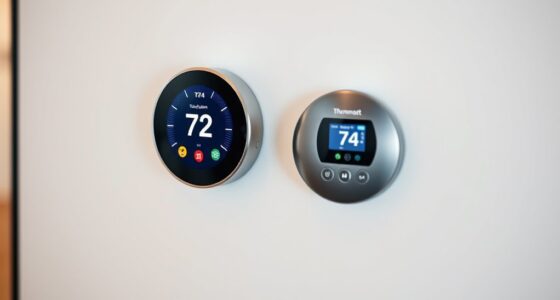
Understanding thermostat algorithms like PID control helps you maintain a comfortable and energy-efficient indoor environment. PID combines proportional, integral, and derivative components to precisely manage heating and cooling responses. It reacts quickly to temperature changes, smoothing out fluctuations and reducing unnecessary system cycling. Proper calibration guarantees accurate readings, which improves performance and saves energy. If you want to learn how these parts work together to optimize your thermostat, keep exploring the details behind PID control.

Get home appliances delivered free with Prime
- Fast, free delivery on millions of items
- Prime Video, Amazon Music and more included
- Member-only deals all year
Key Takeaways
- PID control adjusts heating/cooling by combining proportional, integral, and derivative components to respond accurately to temperature deviations.
- Proportional reacts to current error, providing immediate correction; integral considers past errors to eliminate steady-state discrepancies.
- Derivative predicts future temperature trends by analyzing the rate of change, helping to prevent overshoot and oscillations.
- Proper calibration of sensors ensures accurate temperature readings for effective PID regulation and energy efficiency.
- Combining all three components results in smooth, stable indoor temperature control, reducing energy waste and enhancing comfort.

Thermostat algorithms play a essential role in maintaining comfortable and energy-efficient indoor temperatures. Among these, Proportional–Integral–Derivative (PID) control stands out as a sophisticated method that fine-tunes heating and cooling systems to respond accurately to changing conditions. When you understand how PID algorithms work, you can better appreciate how they optimize energy efficiency and guarantee your indoor environment remains comfortable. One crucial aspect of effective PID control is sensor calibration. If your sensors are miscalibrated, the thermostat’s measurements will be off, leading to inaccurate temperature readings. This can cause the system to overcorrect or undercorrect, wasting energy and potentially compromising comfort. Regular sensor calibration helps maintain precise temperature readings, enabling the PID algorithm to function at its best. It guarantees that the thermostat accurately detects temperature deviations and responds swiftly, minimizing energy waste and reducing utility costs.
In a PID-controlled system, the algorithm constantly compares the current temperature to your desired setpoint. The proportional component reacts to the current error, providing an immediate response that helps correct temperature discrepancies quickly. The integral component considers the accumulation of past errors, smoothing out any persistent deviations that might cause temperature fluctuations over time. Meanwhile, the derivative part anticipates future trends by analyzing the rate of temperature change, allowing the system to adjust preemptively. This combination results in a smooth, controlled response that maintains stable indoor temperatures without excessive cycling of the HVAC system. Such refined control not only enhances user comfort but also markedly boosts energy efficiency because the system avoids unnecessary heating or cooling cycles.
As an affiliate, we earn on qualifying purchases.
Frequently Asked Questions
How Do PID Controllers Handle Sudden Temperature Changes?
When sudden temperature changes occur, your PID controller reacts quickly by adjusting its output based on the error. It uses adaptive tuning to optimize response, preventing overshoot or undershoot, and relies on sensor calibration for accurate readings. This allows the system to stabilize fast, maintaining comfort. The derivative component predicts future changes, helping the controller respond even more swiftly to abrupt fluctuations.
Can Thermostat Algorithms Learn From User Behavior Over Time?
Yes, thermostat algorithms can learn from your behavior over time using machine learning and adaptive algorithms. These systems analyze your temperature preferences and adjusting patterns, allowing the thermostat to anticipate your needs. By continuously updating their models, they optimize comfort and energy efficiency. Over time, you’ll notice your thermostat personalizes its behavior, making your environment more comfortable without needing manual adjustments, effectively “learning” your habits.
What Are Common Challenges in Implementing PID Control?
Imagine steering a ship through fog; that’s what implementing PID control feels like. You face challenges like sensor calibration, ensuring temperature readings are precise, and hysteresis management to prevent constant switching. These issues cause instability and slow responses, making it tough to maintain comfort. You must fine-tune the system carefully, balancing responsiveness with stability, so your thermostat can navigate the temperature seas smoothly, avoiding abrupt changes or lag.
How Does Environmental Noise Affect Thermostat Accuracy?
Environmental noise can markedly impact your thermostat’s accuracy by causing fluctuations in sensor readings. To counter this, you should focus on proper sensor calibration and implement noise filtering techniques. These measures help reduce false signals, ensuring your thermostat responds accurately to genuine temperature changes. This way, you maintain a stable environment, avoiding unnecessary heating or cooling caused by environmental interference, and keep your system working efficiently.
Are There Energy-Efficient Alternatives to Traditional PID Control?
You might find that model predictive control (MPC) offers an energy-efficient alternative to traditional PID control, especially in smart grid systems. MPC predicts future conditions, optimizing energy use while integrating renewable sources. This approach adapts better to fluctuating loads and renewable variability, reducing energy waste. As smart grids evolve, such advanced control algorithms help you save energy and support sustainable power, making your thermostat smarter and more efficient.
smart thermostat with sensor calibration
As an affiliate, we earn on qualifying purchases.
As an affiliate, we earn on qualifying purchases.
Conclusion
Now that you understand PID control, you can think of your thermostat as a wise old alchemist, balancing heat with the precision of a clockmaker. Just like tuning a vintage radio to catch the perfect station, your thermostat fine-tunes your comfort, ensuring your home stays cozy without overdoing it. With these algorithms, you’re fundamentally wielding a modern-day magic wand—turning your house into a perfectly temped sanctuary, no matter if the wind blows like a knight’s steed or the sun beats down like a dragon’s breath.
energy-efficient programmable thermostat
As an affiliate, we earn on qualifying purchases.
As an affiliate, we earn on qualifying purchases.
thermostat with adaptive learning
As an affiliate, we earn on qualifying purchases.
As an affiliate, we earn on qualifying purchases.
Cold & flu season Picks
humidifiers
As an affiliate, we earn on qualifying purchases.