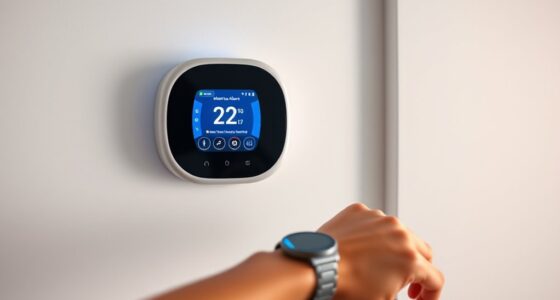
Integrating smart thermostats with Z-Wave or Zigbee networks lets you easily connect your HVAC system to other smart devices, enhancing home comfort and energy efficiency. These protocols provide reliable, low-power communication, enabling seamless control and automation through user-friendly apps or voice assistants. You can set custom routines, monitor energy usage, and enjoy smarter climate management. To get the most out of your setup and discover useful tips, keep exploring how these protocols work together.

Get home appliances delivered free with Prime
- Fast, free delivery on millions of items
- Prime Video, Amazon Music and more included
- Member-only deals all year
Key Takeaways
- Ensure your smart thermostat supports Z-Wave or Zigbee protocols for seamless network integration.
- Use a compatible hub or controller that connects with your chosen protocol for centralized management.
- Pair the thermostat with other smart devices, such as sensors, via Z-Wave or Zigbee for automation and energy savings.
- Configure network settings to ensure reliable communication and quick responsiveness within the Z-Wave or Zigbee ecosystem.
- Utilize user-friendly apps or voice assistants to control and monitor your smart thermostat remotely.

Smart thermostats are transforming how you manage home comfort by offering intuitive controls and energy savings. When you integrate these devices with Z-Wave or Zigbee networks, you *unlock* a new level of convenience and efficiency. These protocols enable seamless communication between your thermostat and other smart home devices, allowing you to automate and optimize your climate control system effortlessly. The key advantage here is the enhanced user interfaces that come with integrated systems, making it easier than ever to customize and monitor your HVAC settings remotely. With a well-connected network, you can adjust temperatures from your smartphone, set schedules, or even trigger changes based on occupancy patterns—all from a single, user-friendly app.
Energy savings become more achievable when your smart thermostat is part of a Z-Wave or Zigbee network. These protocols support reliable, low-power communication, ensuring your thermostat responds quickly to commands and environmental changes. By integrating with motion sensors, window sensors, or smart lighting, your thermostat can intelligently adjust temperatures, reducing unnecessary heating or cooling. For example, when a motion sensor detects no one is home, the thermostat can automatically lower heating or cooling levels, saving energy without sacrificing comfort. Over time, these intelligent adjustments can *substantially* cut your energy bills, as your system learns your routines and adapts accordingly.
Integrating motion sensors with your smart thermostat can substantially reduce energy costs.
The user interfaces provided through these integrations are designed with simplicity and functionality in mind. Instead of juggling multiple apps or complicated controls, you benefit from a unified platform that consolidates all your smart devices. The interfaces are often customizable, allowing you to set preferences, view energy consumption data, and receive alerts—all in a clear, straightforward layout. This ease of use encourages regular engagement, helping you stay informed about your home’s energy use and making it easier to implement efficiency strategies. Additionally, many systems support voice control through integration with assistants like Alexa or Google Assistant, further streamlining your interaction with the thermostat.
Incorporating a smart thermostat into your Z-Wave or Zigbee network not only boosts comfort but also enhances your ability to manage energy consumption proactively. The combination of reliable communication protocols and intuitive user interfaces empowers you to create a more efficient, responsive, and comfortable home environment. With real-time data and automated adjustments, you’re better equipped to make smart decisions that save money and reduce your carbon footprint, all while enjoying the convenience of a seamlessly connected smart home.
Frequently Asked Questions
Can I Use a Smart Thermostat Without a Hub?
Yes, you can use a smart thermostat without a hub. Many models connect directly to your Wi-Fi, allowing you to control them via an app. With features like remote sensors and geofencing, you can optimize energy use and comfort without extra hardware. These thermostats typically work independently, giving you easy access and control through your smartphone, making your smart home setup simpler and more convenient.
How Secure Are Z-Wave and Zigbee Networks?
Z-Wave and Zigbee networks are generally secure because they use wireless encryption to protect your data and device authentication to verify devices before granting access. These features help prevent unauthorized access and guarantee your smart thermostat communicates safely within your network. However, it’s crucial to keep your firmware updated and change default passwords to maintain peak security, giving you peace of mind with your smart home setup.
Do Smart Thermostats Support Voice Control?
Yes, many smart thermostats support voice control, allowing you to adjust temperature settings using voice commands. This feature offers hands-free control, making it convenient to manage your climate without needing to touch any buttons. You can connect your thermostat to voice assistants like Amazon Alexa, Google Assistant, or Apple Siri, enabling seamless integration and easy control through simple voice commands whenever you need to change the temperature or check settings.
What Is the Energy Savings Potential With These Integrations?
Imagine lowering your thermostat remotely during work hours—this simple action can boost your energy efficiency and save you money. Integrating smart thermostats with Z-Wave or Zigbee networks enhances these savings by automating temperature adjustments based on your schedule and occupancy. You could see significant cost savings over time, as reduced energy consumption directly translates into lower utility bills, making your home more efficient and environmentally friendly.
Are There Compatibility Issues With Existing HVAC Systems?
You might face compatibility challenges with your existing HVAC system when integrating smart thermostats via Z-Wave or Zigbee. Installation concerns can arise if your system isn’t compatible or lacks necessary wiring, making setup tricky. To avoid issues, check your HVAC’s specifications and confirm the thermostat supports your system. Sometimes, an adapter or professional installation is needed to resolve compatibility challenges and ensure smooth operation.
Conclusion
Now that you understand how to integrate smart thermostats with Z-Wave or Zigbee networks, imagine the possibilities ahead. Your home’s climate could become smarter than ever, adapting seamlessly to your routines. But what if there’s an even better way to optimize comfort and energy savings? The journey doesn’t end here—stay tuned, because the future of home automation might hold surprises you never saw coming. Are you ready to take the next step?
Fall yard work Picks
leaf blowers
As an affiliate, we earn on qualifying purchases.