Choosing among ducted fan coil units starts with a system question: do you need a replacement coil for an existing water or electric-heat setup, or a complete ducted heat-pump system? I’d put the First Company 18HX5 near the top for a straightforward horizontal unit with built-in 5 kW electric heat, while the Cooper & Hunter 36,000 BTU stands out when a larger space and flexible air-handler orientation matter. For a smaller ducted system with connected controls, the ROVSUN 17,000 BTU is the more feature-rich alternative.

Get home appliances delivered free with Prime
- Fast, free delivery on millions of items
- Prime Video, Amazon Music and more included
- Member-only deals all year
Those choices are not direct substitutes. The First Company models are fan coils intended to work with hydronic or electric-heat arrangements; the ROVSUN and Cooper & Hunter are ducted mini-split heat-pump systems with outdoor equipment. I’ve ranked them by how clearly each fits a buyer’s installation and capacity needs, while calling out uncertainties such as conflicting airflow information and equipment that is not included. The main tradeoff is compatibility versus system completeness: an inexpensive-looking indoor unit may still require the right existing plant, while a mini split brings heating and cooling but calls for professional installation and compatible outdoor equipment.
Complete the kit


Key Takeaways
- The First Company 18HX5 is the clearest pick here when you need a horizontal, uncased fan coil with 1.5-ton capacity and included 5 kW electric heat.
- The First Company 4HBC3RH is the hydronic choice for chilled- or hot-water systems, but confirm its actual airflow because the listing gives both 400 and 600 CFM.
- ROVSUN’s 17,000 BTU ducted mini split suits smaller spaces where app and voice control, inverter operation, and heating, cooling, and dehumidification are priorities.
- Cooper & Hunter offers the largest listed capacity at 36,000 BTU and supports horizontal, upflow, or downflow placement, but the optional auxiliary heater is separate.
- Before buying any option, match capacity, power, coil or refrigerant connections, drain orientation, duct layout, and included equipment to the project with an HVAC professional.
| First Company 18HX5 Horizontal Fan Coil Unit, 1.5 Tons |  | Best Overall for a Horizontal Fan Coil With Electric Heat | Model: 18HX5 | Capacity: 1.5 tons | Output: 18 MBH | VIEW LATEST PRICE | See Our Full Breakdown |
| First Company 4HBC3RH 400 CFM Horizontal Hydronic Fan Coil |  | Best for Existing Hot- or Chilled-Water Systems | Model: 4HBC3RH | Airflow: 400 CFM in title; 600 CFM in description—verify | Motor: 120 V, three-speed | VIEW LATEST PRICE | See Our Full Breakdown |
| ROVSUN 17,000 BTU Smart Wi-Fi Ducted Mini-Split Heat Pump, 20.3 SEER2, 230V | 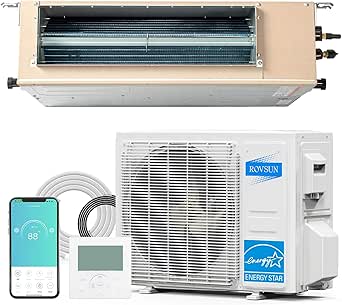 | Best Smart Pick for Smaller Ducted Spaces | Cooling capacity: 17,000 BTU | Heating capacity: 18,000 BTU | Coverage: Up to 1,000 sq. ft.; confirm by load calculation | VIEW LATEST PRICE | See Our Full Breakdown |
| Cooper & Hunter 36,000 BTU 230V Ducted Mini Split Heat Pump |  | Best High-Capacity Pick for Flexible Air-Handler Placement | Cooling capacity: 36,000 BTU | System capacity: 3 ton | Voltage: 230 V | VIEW LATEST PRICE | See Our Full Breakdown |
| ducted fan coil unit | Model | Dimensions | Weight | Cooling capacity |
|---|---|---|---|---|
| First Company 18HX5 Horizontal | 18HX5 | 10 × 37.25 × 21 in | 59 lb | — |
| First Company 4HBC3RH 400 CFM | 4HBC3RH | 36-1/8 W × 21-1/2 D × 10 H in | 50 lb | — |
| ROVSUN 17,000 BTU Smart Wi-Fi | — | — | — | 17,000 BTU |
| Cooper & Hunter 36,000 BTU 230 | — | — | — | 36,000 BTU |
More Details on Our Top Picks
First Company 18HX5 Horizontal Fan Coil Unit, 1.5 Tons
The First Company 18HX5 is my most balanced pick for buyers who have a compatible ducted system and want a clearly specified horizontal fan coil. Its 1.5-ton capacity and 18 MBH rating describe a smaller-to-midrange application than Cooper & Hunter’s 3-ton system, while its 5 kW electric heat gives it a built-in heating element that the First Company hydronic model does not include. That distinction is useful: this unit is for an electric-heat arrangement, not a chilled- or hot-water coil.
Its 208–230 V single-phase requirement makes the electrical check straightforward to identify, but it is not permission to assume the existing circuit is suitable. The listed size of 10 × 37.25 × 21 inches may help with a tight horizontal installation, yet the product is uncased. I would plan for the surrounding cabinet, access, insulation, and service clearances rather than treating the unit itself as a finished enclosure. At 59 pounds, it also calls for proper support and safe handling overhead.
Compared with the 4HBC3RH, the 18HX5 is the more direct choice when electric resistance heat is part of the plan; the 4HBC3RH instead depends on a hot- or chilled-water loop. Compared with the ROVSUN and Cooper & Hunter, the 18HX5 is not a complete inverter heat-pump system with app controls. That is a limitation for buyers starting from scratch, but a practical advantage when the job is replacing or fitting a fan coil into an existing compatible system. I would skip it if a finished cabinet, hydronic operation, or a complete heating-and-cooling package is required.
Pros:- Includes 5 kW of electric heat
- Horizontal configuration for compatible installations
- 1.5-ton, 18 MBH capacity is clearly stated
- Runs on 208–230 V single-phase power
Cons:- Uncased design may require a separate enclosure or careful integration
- At 59 lb, overhead placement needs suitable support and handling
- Not a complete heat-pump system and has no listed smart controls
Best for: Homeowners or contractors replacing a horizontal fan coil in a compatible 208–230 V single-phase system who want 1.5-ton capacity and included 5 kW electric heat.
Not ideal for: Buyers needing a fully cased appliance, a hydronic coil, smart controls, or a complete heat-pump system with outdoor equipment.
- Model:18HX5
- Capacity:1.5 tons
- Output:18 MBH
- Electric heat:5 kW
- Power:208–230 V, single-phase, 60 Hz
- Dimensions:10 × 37.25 × 21 in
- Weight:59 lb
- Configuration:Horizontal, uncased
Our verdict“I’d choose the 18HX5 for a compatible horizontal electric-heat replacement, but not as a stand-alone solution for a new heat-pump installation.”
First Company 4HBC3RH 400 CFM Horizontal Hydronic Fan Coil
If the building already has a boiler, chiller, or another compatible water loop, the First Company 4HBC3RH addresses a different need from the 18HX5: it is a hydronic fan coil, not an electric-heat unit or an all-in-one heat pump. Its three-row copper-tube coil is described for heating or cooling, so it can serve either season when the wider system supplies the right water temperature. The three-speed 120 V motor gives an installer more than one fan setting to work with, though it is not the same as inverter modulation in the ROVSUN or Cooper & Hunter systems.
The ceiling-mount horizontal format and insulated condensate drain pan point toward a concealed overhead installation. Connection orientation deserves close attention: the coil connection is right-hand, while the drain connection is left-hand. Those sides can decide whether the unit fits the existing piping and drain route without major changes. The listed dimensions—36-1/8 inches wide, 21-1/2 inches deep, and 10 inches high—are useful planning figures, but the required service access and piping clearance need to be checked at the site.
There is one listing detail I would not gloss over: airflow is stated as 400 CFM in the title and 600 CFM in the description. That uncertainty makes this a less confident recommendation than the 18HX5, whose basic capacity and electrical details are more consistent. I would confirm the actual model performance and fan data before sizing ducts or comparing it with another unit. This is also a poor fit for a buyer without a water-based heating or cooling source. The ROVSUN and Cooper & Hunter include heat-pump operation, whereas this First Company unit depends on the rest of a hydronic system to provide heating or cooling.
Pros:- Designed for chilled-water or hot-water systems
- Three-row copper-tube coil supports heating or cooling
- Three-speed 120 V motor offers selectable fan operation
- Insulated condensate drain pan and ceiling-mount horizontal format
Cons:- Airflow is listed as both 400 CFM and 600 CFM
- Right-hand coil and left-hand drain connections may not suit existing piping
- Requires a compatible water system rather than supplying heat independently
Best for: Buyers replacing or adding a ceiling-mounted fan coil in a building with compatible hot-water or chilled-water service and matching connection orientation.
Not ideal for: Projects without a hydronic plant, buyers who need electric heat included, or anyone unable to verify the conflicting airflow figures before sizing.
- Model:4HBC3RH
- Airflow:400 CFM in title; 600 CFM in description—verify
- Motor:120 V, three-speed
- Coil:Three-row copper tube for heating or cooling
- Connections:Right-hand coil; left-hand drain
- Dimensions:36-1/8 W × 21-1/2 D × 10 H in
- Weight:50 lb
- Mounting:Ceiling-mount horizontal
Our verdict“I’d shortlist the 4HBC3RH for a matching hydronic installation only after confirming its airflow rating and connection layout.”
ROVSUN 17,000 BTU Smart Wi-Fi Ducted Mini-Split Heat Pump, 20.3 SEER2, 230V
The ROVSUN 17,000 BTU ducted mini split is the better match for a buyer who wants a compact ducted heating-and-cooling system rather than a replacement coil for an existing water loop. It is listed at 17,000 BTU cooling and 18,000 BTU heating, with coverage stated up to 1,000 square feet. Those figures give it a smaller stated application than Cooper & Hunter’s 36,000 BTU system, but actual suitability depends on a proper room-by-room load calculation—not floor area alone.
Its inverter compressor adjusts operation as indoor conditions change, and app and voice control add convenience that neither First Company model lists. Alexa and Google Assistant compatibility may be useful for a connected home, while the wired controller provides a direct control route. The stated 36 dB mute mode is another differentiator for spaces where reduced operating sound matters. It also provides dehumidification alongside heating and cooling, giving it broader seasonal use than either standalone fan coil.
That expanded capability comes with more installation work. This is a split system using R-454B refrigerant, and professional licensed HVAC installation is recommended. The kit includes 16.4 feet of copper lines and a signal cord, but the power cord is separate, so buyers should not assume the package is ready to connect. The listing also says the two boxes may arrive at different times, which can affect scheduling. Compared with Cooper & Hunter, ROVSUN offers a lower listed capacity and a quieter mute-mode figure, but less mounting flexibility is specified. I would choose it for a smaller, control-focused ducted project and skip it if the job only needs a compatible replacement fan coil.
Pros:- Provides heating, cooling, and dehumidification
- Inverter compressor adjusts output as conditions change
- App, wired, Alexa, and Google Assistant control options
- 36 dB mute mode is listed for quieter operation
Cons:- Separate power cord is required
- Professional licensed HVAC installation is recommended
- Two-box shipment may arrive in separate deliveries
Best for: Owners planning a smaller ducted heat-pump installation who value app and voice control, inverter operation, and combined heating, cooling, and dehumidification.
Not ideal for: Buyers replacing only a hydronic or electric fan coil, anyone seeking a plug-in installation, or projects requiring capacity above the unit’s verified load requirement.
- Cooling capacity:17,000 BTU
- Heating capacity:18,000 BTU
- Coverage:Up to 1,000 sq. ft.; confirm by load calculation
- Efficiency:20.3 SEER2, as stated in product title
- Voltage:230 V
- Refrigerant:R-454B
- Controls:Wired controller, app, Alexa, and Google Assistant
- Installation kit:16.4 ft copper lines and signal cord; power cord separate
Our verdict“I’d pick ROVSUN when connected controls and a smaller ducted heat-pump system matter more than a simple fan-coil replacement.”
Cooper & Hunter 36,000 BTU 230V Ducted Mini Split Heat Pump
For a larger load or a duct layout that limits where the air handler can sit, the Cooper & Hunter 36,000 BTU system is the strongest capacity-led option in this group. Its 3-ton rating is more than twice the ROVSUN’s listed cooling capacity, so I would not treat the two as interchangeable. A contractor should verify that the building needs this output; oversizing can create comfort and cycling problems just as undersizing can leave rooms short of heating or cooling.
The air handler supports horizontal, upflow, or downflow installation, giving it a notable placement advantage over the horizontal-only configurations listed for the First Company units. That flexibility can help when a mechanical space or duct connection dictates orientation. Its inverter compressor, three fan speeds, app and remote controls, and anti-cold-air startup feature add system-level comfort functions. The startup feature is intended to limit cold drafts as heating begins, a useful distinction for a heat pump serving occupied rooms.
The 25-foot installation kit is longer than ROVSUN’s listed 16.4-foot line set, but line length still needs to fit the actual route and manufacturer limits. At 17.2 SEER2, its stated efficiency is below the ROVSUN’s 20.3 SEER2 listing; buyers focused on that specification should compare the difference alongside the larger capacity and installation requirements. An auxiliary electric heater can be added in the 5 kW–20 kW range, but it is sold separately, unlike the 18HX5’s included 5 kW heat. This is a new compatible outdoor-unit system, not an indoor fan coil to pair casually with existing equipment. I’d favor it for a verified larger load and varied installation orientation, not for a small replacement job.
Pros:- 36,000 BTU, 3-ton system capacity
- Air handler supports horizontal, upflow, or downflow placement
- Inverter operation and anti-cold-air startup control
- Includes a 25-foot installation kit
Cons:- Optional 5 kW–20 kW auxiliary heater is sold separately
- Requires a new compatible outdoor unit
- 17.2 SEER2 is below the ROVSUN’s stated 20.3 SEER2
Best for: Buyers with a professionally verified larger heating and cooling load who need a ducted air handler that can be installed horizontally, upflow, or downflow.
Not ideal for: Small spaces, buyers seeking a standalone replacement coil for existing equipment, or anyone expecting auxiliary electric heat to be included.
- Cooling capacity:36,000 BTU
- System capacity:3 ton
- Voltage:230 V
- Efficiency:17.2 SEER2
- Refrigerant:R-454B
- Noise level:39.5 dB, as listed
- Installation:Split system; horizontal, upflow, or downflow air handler
- Included kit:25 ft
- Optional auxiliary heat:5 kW–20 kW, sold separately
Our verdict“I’d choose Cooper & Hunter for a confirmed larger load and orientation flexibility, while budgeting separately for any auxiliary heater.”

How We Picked
I ranked these four options around the question behind this roundup: which ducted fan coil approach best fits a real installation? The group includes two standalone First Company fan coils and two ducted mini-split systems. Since their heat sources and included components differ, I did not treat a higher BTU figure or a longer feature list as an automatic win. I gave more weight to whether the product’s stated configuration points to a clear use case, and whether the supplied details help a buyer check fit before ordering.
My comparison focuses on capacity and system type, electrical requirements, mounting flexibility, heating provisions, controls, and practical installation details. The First Company 18HX5 earns a high placement because its horizontal format, 1.5-ton rating, 208–230 V single-phase supply, and included 5 kW electric heat make its basic role easy to identify. The 4HBC3RH has a strong case for water-based systems, though its listing’s airflow mismatch keeps it from ranking higher until a buyer verifies the correct figure.
I also distinguish a fan coil from a complete heat-pump system. ROVSUN and Cooper & Hunter add heating and cooling through ducted mini-split equipment, inverter operation, and controls. That can suit a project without a hydronic plant, but it brings refrigerant installation, outdoor-unit compatibility, and electrical planning into the purchase. I treat the ROVSUN as the smaller-space smart-control pick and Cooper & Hunter as the higher-capacity, more flexible-orientation pick, not as replacements for every existing fan coil.
Where supplied specifications conflict or leave a gap, I call that out rather than filling it in. The 4HBC3RH listing gives 400 CFM in its title and 600 CFM in its description; the buyer should resolve that with the seller or manufacturer. Cooper & Hunter’s auxiliary heater is optional, and the ROVSUN requires a separate power cord. These details matter because a promising capacity or control feature cannot compensate for an incompatible electrical connection, duct arrangement, or system design.
This ranking is a product-fit comparison, not a substitute for load calculations or a site survey. Duct static pressure, room-by-room loads, refrigerant line routing, drainage, local electrical rules, and outdoor-unit pairing can change which option makes sense. I recommend using a licensed HVAC professional to confirm the equipment schedule and installation requirements before committing, especially for either mini-split system.
Factors to Consider When Choosing Best Ducted Fan Coil Units
I would start by identifying what the project is replacing and what equipment already exists. A fan coil in a hydronic system, an electric-heat air handler, and a ducted mini-split indoor unit can look similar in a product list but depend on different heat sources and connections. The right choice is the one that fits the system design—not simply the one with the largest capacity or most controls.
Match the unit to the heat source
The 18HX5 includes 5 kW of electric heat, while the 4HBC3RH uses a hot- or chilled-water loop. ROVSUN and Cooper & Hunter are ducted mini-split heat pumps that provide heating and cooling through matched split-system equipment. Before choosing, identify whether the building has suitable water service, a compatible electric circuit, or needs a new outdoor heat-pump system. A standalone fan coil cannot make heat or chilled water on its own.
Size by load, not floor area alone
ROVSUN lists coverage up to 1,000 square feet, and Cooper & Hunter lists 36,000 BTU, but neither number replaces a heating and cooling load calculation. Climate, insulation, windows, ceiling height, room layout, duct losses, and occupancy all affect the required capacity. The 1.5-ton 18HX5 and the 3-ton Cooper & Hunter serve different stated capacity ranges; I would have an HVAC professional check room loads and airflow before selecting either size.
Check airflow, ducts, and orientation
Airflow must suit the duct design and the unit’s fan performance. The 4HBC3RH listing conflicts, giving 400 CFM in the title and 600 CFM in the description, so get the correct model data before sizing ductwork. Also compare cabinet dimensions, service access, mounting direction, and transitions to existing ducts. Cooper & Hunter offers horizontal, upflow, and downflow orientations; the First Company choices are listed as horizontal, which may be a poor match if the mechanical space requires another direction.
Verify connections and electrical service
For the hydronic 4HBC3RH, the right-hand coil and left-hand drain need to line up with piping and condensate routing. The 18HX5 requires 208–230 V single-phase power; the mini-split options list 230 V. These figures do not confirm that an existing circuit, breaker, disconnect, or wiring arrangement is appropriate. Confirm the manufacturer’s installation documentation, circuit requirements, connection locations, and local code with a licensed professional before ordering.
Separate included equipment from optional items
The product descriptions identify meaningful package differences. ROVSUN includes 16.4-foot copper lines and a signal cord, but not a power cord. Cooper & Hunter includes a 25-foot installation kit, while its 5 kW–20 kW auxiliary heater is optional. Its system also requires a new compatible outdoor unit. Ask for a full equipment list, including the indoor and outdoor units, controls, line set, electrical parts, heater, and any required accessories; a feature on a specification sheet does not mean it comes in the box.
Plan for professional installation and service
Both mini-splits are split systems using R-454B refrigerant, and the ROVSUN listing recommends professional licensed HVAC installation. Refrigerant work, line routing, evacuation, commissioning, condensate management, and electrical connections should be handled by qualified tradespeople. Fan-coil replacements also need careful duct, drain, coil, and access checks. I would ask the installer to confirm the selected model’s approved pairings, service clearances, warranty conditions, and maintenance requirements before finalizing the equipment.
Frequently Asked Questions
Are these four products all the same kind of ducted fan coil?
No. The First Company 18HX5 is a horizontal fan coil with included electric heat, and the First Company 4HBC3RH is a horizontal hydronic fan coil for hot- or chilled-water service. ROVSUN and Cooper & Hunter are ducted mini-split heat-pump systems, which involve matched split-system equipment rather than a simple replacement coil. I would first identify the existing system and choose an option designed to work with it.
Which product is the best fit for an existing hydronic system?
The First Company 4HBC3RH is the only option here specifically described for chilled- or hot-water systems. Its three-row copper-tube coil supports heating or cooling when connected to a compatible water source. Before ordering, verify the right-hand coil and left-hand drain arrangement and resolve the listing’s conflicting 400 CFM and 600 CFM airflow figures with the manufacturer or seller.
Which option has the most installation flexibility?
Cooper & Hunter lists horizontal, upflow, and downflow air-handler orientations, while the First Company products are described as horizontal. That can help when the mechanical room or duct connection limits placement. Orientation alone does not confirm that the system fits a particular site, so I would still check dimensions, access, drain routing, duct connections, and the manufacturer’s installation instructions with an HVAC contractor.
Does the ROVSUN system include everything needed for installation?
No. Its listed kit includes 16.4 feet of copper lines and a signal cord, but the power cord is separate. The system is a split heat pump and professional licensed HVAC installation is recommended, so the included items should not be treated as a complete installation package. Confirm the required electrical components, refrigerant-line route, compatible equipment, and any site-specific parts before arranging installation.
How should I choose between ROVSUN and Cooper & Hunter?
I would compare the load and installation plan first. ROVSUN is the smaller listed system, with app and voice control, dehumidification, and a 36 dB mute-mode figure; Cooper & Hunter is listed at 36,000 BTU and supports more air-handler orientations. The ROVSUN has the higher stated SEER2 figure, while Cooper & Hunter includes a 25-foot kit and offers a separately sold auxiliary heater. A load calculation and equipment schedule should decide between them.
Conclusion
For a horizontal replacement with included electric heat, I’d start with the First Company 18HX5, provided its uncased design and electrical requirements fit the installation. If the building already has a compatible water loop, the First Company 4HBC3RH is the hydronic candidate—but I would confirm airflow and connection orientation before purchase. For a smaller new ducted heat-pump project where app and voice controls matter, ROVSUN is the more feature-focused choice. For a verified larger load or a site that needs upflow or downflow placement, Cooper & Hunter is the stronger fit, with the separate auxiliary heater kept in mind.
My final recommendation is to match the unit to the existing system, calculated load, duct layout, and complete installation package before comparing convenience features. These products serve distinct jobs, so the best choice is the one a qualified HVAC professional confirms will work safely and correctly in your home or building.