
TL;DR
Google’s latest Home Speaker offers strong sound quality and attractive design but has notable usability quirks and inconsistent performance. Its AI features, powered by Gemini, remain under testing, making full evaluation premature.
Google’s new Home Speaker sounds good and looks attractive but is experiencing usability and reliability issues, according to early reviews. While its audio quality impresses and it performs well in voice recognition tests, users report inconsistent touch controls and hidden feedback elements that complicate operation. The device’s AI features, powered by Google’s Gemini, are still under testing, leaving some performance aspects uncertain.

Get home appliances delivered free with Prime
- Fast, free delivery on millions of items
- Prime Video, Amazon Music and more included
- Member-only deals all year
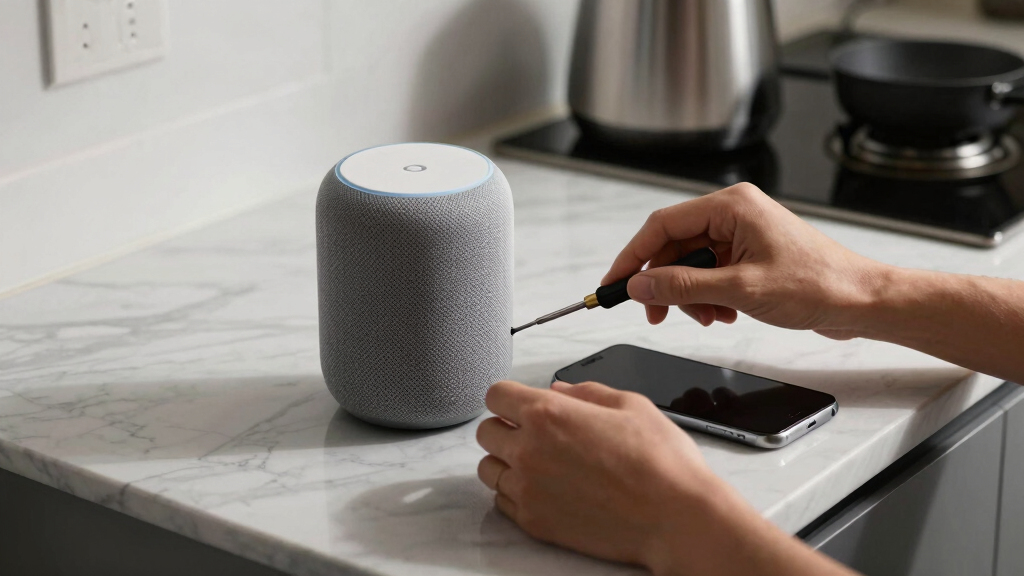
The Google Home Speaker delivers rich, loud sound and has a sleek, colorful design resembling a small, yarn-ball-like sphere. It performs well in voice recognition tests, accurately responding to wake words even at high volumes and over background noise, as confirmed by early testers. The speaker’s audio quality is comparable to or better than similarly sized Bluetooth speakers like the UE Wonderboom, with a slight emphasis on bass and clarity, making it suitable for background music or casual listening.
However, the device’s minimalistic design presents usability challenges. Controls for volume are touch-sensitive and located on the sides of the round device, but they are small and not intuitively marked, leading to difficulty in adjusting volume. The light ring indicator, which shows when the AI is listening or responding, is hidden underneath the speaker, reducing visibility and feedback. Unlike Amazon’s Echo Dot, which has physical buttons, the Home Speaker relies on touch, which some users may find less convenient.
Connectivity options are limited to Google Cast and multi-room grouping, without Bluetooth streaming, although pairing with Google TV for enhanced TV sound is possible. While the device is not expected to replace high-end sound systems, early impressions suggest it outperforms current TV speakers in clarity and volume for its size. The device is priced at $99, making it an attractive option for casual use, provided its usability issues are addressed.
Most importantly, the speaker’s core function as a smart home control hub and AI assistant depends on Gemini, Google’s latest AI platform. Google has not yet fully launched Gemini, and the AI’s responsiveness and capabilities remain under testing, leaving some features and performance aspects uncertain at this stage.
Implications for Smart Home and AI Integration
This device’s success hinges on both its hardware quality and the performance of Google’s Gemini AI. While it offers a compelling audio experience and attractive design, usability issues could hinder widespread adoption. Its performance as a smart home hub and AI assistant will influence Google’s position in the competitive smart speaker market, especially as users increasingly expect seamless, reliable voice interactions and easy-to-use controls.
Products Worth Considering

Sonos One (Gen 2) Voice-Controlled Smart Speaker, White

Sonos Era 100 Wireless Smart Speaker with Alexa, Black

Bose Home Speaker 500 Smart Bluetooth Speaker with Alexa, Black
As an affiliate, we earn on qualifying purchases.
Google’s Smart Speaker Evolution and Expectations
Google has not released a new smart speaker in six years, making this launch significant for the company’s smart home ambitions. Past models like the Nest Audio focused on sound quality but lacked the integrated AI features now promised with Gemini. Industry analysts see this device as a testbed for Google’s next-generation AI, which could reshape user interaction with smart speakers. Early reviews highlight that, despite impressive audio, usability quirks remain a barrier, and the full potential of Gemini is yet to be demonstrated.
“The speaker’s voice recognition is solid, even at high volumes, but the touch controls are less intuitive than physical buttons.”
— an anonymous researcher
Uncertainties Surrounding Gemini AI Performance
It is not yet clear how well Gemini will perform in everyday use, as Google has not yet fully launched or demonstrated the AI’s capabilities in this device. The responsiveness, accuracy, and range of functions remain under testing, and early impressions are based on limited samples. Additionally, the impact of usability issues on overall user satisfaction is still uncertain.
Next Steps for Testing and Full Release
Google is expected to continue testing Gemini AI and improve the user interface of the Home Speaker through updates. A full review of the device’s AI capabilities and user experience is anticipated once Google completes its internal testing and releases more comprehensive software updates. Consumers and industry watchers will be watching to see if usability issues are addressed and how well Gemini integrates into daily life.
Key Questions
Will the Google Home Speaker improve its usability over time?
Google is likely to release firmware updates that could address some usability issues, such as improving touch controls and making feedback more visible. However, specific improvements have not been confirmed.
How does the sound quality compare to other small smart speakers?
Early reviews suggest the Home Speaker offers rich, clear sound with good bass emphasis, outperforming some competitors like the Amazon Echo Dot Max in clarity and volume for its size.
Can the Home Speaker replace my existing Bluetooth speaker?
No, the device does not support Bluetooth streaming; it relies on Google Cast for audio playback and multi-room grouping.
When will Gemini AI be fully available on this device?
Google has not announced an exact release date for Gemini’s full integration; testing and rollout are ongoing.
What are the main usability issues currently reported?
Users report difficulty in adjusting volume due to small, touch-sensitive controls and limited visible feedback, as well as the hidden light ring indicator.
Source: The Verge