For a smart thermostat with voice-guided installation, the Sensi ST55 and Sensi Lite ST25 are two practical DIY options, but they suit different wiring and smart-home needs. I rank the Sensi ST55 Best Overall because its broader platform support and common-wire flexibility give more households room to make it work. The Sensi Lite ST25 is my Best Simple Setup pick for buyers who want app guidance, scheduling, and geofencing without needing as many integrations.

Get home appliances delivered free with Prime
- Fast, free delivery on millions of items
- Prime Video, Amazon Music and more included
- Member-only deals all year
The main tradeoff is straightforward: the ST55 supports Apple HomeKit, SmartThings, and Vera alongside Alexa and Google Assistant, while the ST25 keeps compatibility to Alexa and Google and uses 2.4 GHz Wi-Fi. Wiring can decide the choice before smart features do: the ST25 calls for a C-wire on heat pump and heat/cool-only systems, while the ST55 does not need a common wire in most applications. Neither is a voice-guided thermostat in the sense of a spoken, hands-free installation coach; their setup assistance comes through app instructions, with built-in leveling features for DIY mounting.
Complete the kit


Key Takeaways
- The Sensi ST55 is the stronger fit for mixed smart-home setups because it lists Alexa, Apple HomeKit, Google Assistant, SmartThings, and Vera support.
- The ST25 offers geofencing and app-guided setup, but requires a C-wire for heat pump and heat/cool-only systems.
- Neither product promises spoken installation coaching; both rely on app instructions and a built-in level to help with DIY setup.
- The ST55 does not need a common wire in most applications, which can simplify installation for homes without one, subject to HVAC compatibility.
- Check your system type and existing thermostat wiring before choosing; the ST25’s 2.4 GHz Wi-Fi limit and narrower assistant support may also affect fit.
| Sensi ST55 Wi-Fi Smart Thermostat |  | Best Overall — broader smart-home support and more forgiving common-wire needs | Model: ST55 | Connectivity: Wi-Fi | Compatible platforms: Amazon Alexa, Apple HomeKit, Google Assistant, SmartThings, Vera | VIEW ON AMAZON | See Our Full Breakdown |
| Sensi Lite Smart Wi-Fi Thermostat, ST25 | 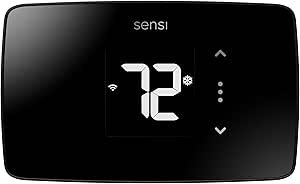 | Best Simple Setup — app-guided DIY with geofencing for compatible systems | Model: ST25 | Connectivity: Wi-Fi, 2.4 GHz | Voice assistants: Amazon Alexa, Google Assistant | VIEW ON AMAZON | See Our Full Breakdown |
| smart thermostat with voiceguided installation | Model | Connectivity | HVAC types listed | Controls |
|---|---|---|---|---|
| Sensi ST55 Wi-Fi Smart Thermos | ST55 | Wi-Fi | Air conditioner, boiler, furnace, heat pump | Button, app, touch, and voice |
| Sensi Lite Smart Wi-Fi Thermos | ST25 | Wi-Fi, 2.4 GHz | Air conditioner, boiler, furnace, heat pump | App, touch, and voice |
More Details on Our Top Picks
Sensi ST55 Wi-Fi Smart Thermostat
The Sensi ST55 ranks first because it balances DIY setup with the broadest integration options in this pair. Its app instructions and built-in level support a homeowner mounting the unit and following the setup process, while button, app, touch, and voice controls offer more than one way to adjust the temperature afterward. The installation aid is not described as spoken coaching, so buyers seeking a thermostat that verbally guides each wiring step should not mistake this for that kind of product.
Its clearest advantage over the Sensi Lite ST25 is smart-home reach: the ST55 lists Alexa, Apple HomeKit, Google Assistant, SmartThings, and Vera. That breadth makes it a more natural choice for households already using HomeKit or SmartThings, or for buyers who want flexibility if their platform preferences change. The ST25 is limited to Alexa and Google Assistant, though it adds geofencing, a feature the supplied ST55 description does not list.
Wiring is another reason I place the ST55 ahead. It does not require a common wire in most applications, whereas the ST25 specifically requires one for heat pump and heat/cool-only systems. That does not mean the ST55 works with every installation: the provided details warn that HVAC compatibility can vary, and buyers should still confirm their system and wiring. Its Wi-Fi-dependent advanced features, including remote access and reports, also make it less appealing where connectivity is unreliable or app use is unwelcome.
For households seeking flexible scheduling, remote access, HVAC alerts, and maintenance reminders, the ST55 is the more capable all-around pick. The tradeoff is that its advantage is mainly breadth, not a promise of more guided installation than the ST25. I would choose it over the Lite when platform compatibility and common-wire flexibility matter more than geofencing or a pared-back setup.
Pros:- App installation instructions and a built-in level support DIY mounting.
- Works with Alexa, Apple HomeKit, Google Assistant, SmartThings, and Vera.
- Does not require a common wire in most applications.
- Offers flexible scheduling, remote access, usage reports, HVAC alerts, and maintenance reminders.
Cons:- Advanced remote features depend on Wi-Fi and the mobile app.
- HVAC compatibility may vary, so system and wiring checks remain necessary.
- Geofencing is not listed among the supplied features.
Best for: Households that want a DIY-oriented thermostat with app instructions, broad smart-home platform support, and a lower likelihood of needing a common wire in typical applications.
Not ideal for: Buyers who require spoken installation coaching, have unreliable Wi-Fi, or want geofencing as a named feature should look elsewhere or compare the ST25’s listed features and check system fit.
- Model:ST55
- Connectivity:Wi-Fi
- Compatible platforms:Amazon Alexa, Apple HomeKit, Google Assistant, SmartThings, Vera
- HVAC types listed:Air conditioner, boiler, furnace, heat pump
- Common wire:Not required in most applications
- Controls:Button, app, touch, and voice
- Display:5-inch LED
- Power details:24 V AC; two AA batteries included
Our verdict“I recommend the ST55 for the broadest smart-home compatibility and more forgiving common-wire requirements, as long as its app-based setup meets your expectations.”
Sensi Lite Smart Wi-Fi Thermostat, ST25
The Sensi Lite ST25 is the more focused choice: it covers app control, voice control, schedules, geofencing, and usage reports without the ST55’s longer list of smart-home platforms. Its built-in level and step-by-step instructions are useful for DIY installation, but, as with the ST55, the supplied information does not describe spoken setup prompts. I would read “voice” here as a control method, not proof that the thermostat talks you through installation.
Where the Lite distinguishes itself is geofencing. For buyers who want the thermostat to respond to location-based routines, that feature is explicitly listed for the ST25, while it is not listed for the ST55. The ST55 still wins for integration breadth, especially if Apple HomeKit, SmartThings, or Vera is part of the household’s setup. The Lite supports Amazon Alexa and Google Assistant, so it remains a sensible match for homes built around those services.
The important limitation is wiring. The ST25 needs a C-wire for heat pump and heat/cool-only systems, although one is not required for most other systems. That makes a compatibility check more central than it is with the ST55, which generally avoids a common-wire requirement in most applications. Its Wi-Fi connection is also limited to 2.4 GHz, so a network setup that does not support that band may rule it out. The ST55’s supplied details do not state a frequency limit.
The ST25 makes most sense when its system requirements line up and the buyer values straightforward app features over a wider integration list. It also has an ENERGY STAR certification and a stated data-use position: personal data and thermostat activity are not used for sale or targeted advertising. Those are meaningful selection points, but they do not erase the C-wire and Wi-Fi constraints. Choose the ST25 over the ST55 for geofencing and a simpler feature brief, not for stronger platform compatibility or more elaborate installation guidance.
Pros:- DIY installation support includes a built-in level and step-by-step instructions.
- Lists scheduling, geofencing, remote app control, and usage reports.
- Works with Amazon Alexa and Google Assistant.
- ENERGY STAR certified; product information states personal data and thermostat activity are not used for sale or targeted advertising.
Cons:- Requires a C-wire for heat pump and heat/cool-only systems.
- Wi-Fi is limited to 2.4 GHz.
- Lists fewer smart-home platforms than the ST55 and does not claim spoken installation guidance.
Best for: Buyers with a compatible HVAC setup who want app-guided DIY installation, geofencing, scheduling, and Alexa or Google Assistant control over a broader integration list.
Not ideal for: Owners of heat pumps or heat/cool-only systems without a C-wire, households relying on Wi-Fi outside 2.4 GHz, or buyers who need HomeKit, SmartThings, or Vera support.
- Model:ST25
- Connectivity:Wi-Fi, 2.4 GHz
- Voice assistants:Amazon Alexa, Google Assistant
- HVAC types listed:Air conditioner, boiler, furnace, heat pump
- C-wire requirement:Required for heat pump and heat/cool-only systems; not required for most others
- Controls:App, touch, and voice
- Display:LCD
- Power details:Battery or C-wire; two AAA batteries included
- Warranty:3 years
Our verdict“I would choose the ST25 for geofencing and app-guided setup when its C-wire and 2.4 GHz requirements fit, but the ST55 is the safer all-around comparison for platform breadth.”

How We Picked
I ranked these thermostats around the specific promise in this search: smart control with DIY installation guidance. The supplied product information describes app instructions and built-in leveling, not spoken prompts that talk someone through wiring. I treat that distinction plainly rather than labeling either model as a voice-led installer.
My comparison gives most weight to wiring requirements and HVAC fit, since a thermostat that cannot connect to a buyer’s system is not a useful smart upgrade. I then compare the installation aids, voice-assistant options, remote controls, and schedule features. The ST55 comes first for broader platform support and fewer common-wire limitations in most applications. The ST25 earns a distinct place for buyers who want a simpler feature set with geofencing, provided its wiring and Wi-Fi requirements fit their home.
I use only the supplied product details here. HVAC compatibility can vary by system and wiring configuration, so I recommend checking the manufacturer’s compatibility guidance before purchase. Features such as remote control and usage reports also rely on Wi-Fi and app access; they are not substitutes for confirming the thermostat’s electrical and system compatibility.
| smart thermostat with voiceguided installation | Model | Connectivity | Controls |
|---|---|---|---|
| Sensi ST55 Wi-Fi Smart Thermos | ST55 | Wi-Fi | Button, app, touch, and voice |
| Sensi Lite Smart Wi-Fi Thermos | ST25 | Wi-Fi, 2.4 GHz | App, touch, and voice |
Factors to Consider When Choosing Smart Thermostat With Voiceguided Installation
I would start with the details that can disqualify a thermostat before comparing app features: HVAC type, wiring, and home Wi-Fi. Then decide whether broader smart-home integration or geofencing better matches the way you control your home.
Check what “voice-guided installation” means
These two Sensi models have voice controls and DIY installation aids, but the supplied descriptions say their setup help comes from app instructions and built-in leveling. They do not state that a voice assistant or the thermostat verbally guides installation. If you need spoken, step-by-step wiring instructions, verify that capability directly before choosing either model. Voice control and voice-led installation are different features, and the product details here only support the former.
Match the thermostat to your wiring
The ST25 requires a C-wire for heat pump and heat/cool-only systems, while most other listed setups do not require one. The ST55 does not need a common wire in most applications, which can make it a more accommodating starting point for older wiring, but it is not a guarantee of compatibility. Check your current thermostat’s wires and the HVAC system type against manufacturer guidance before installation. If you are uncertain, consult a qualified installer rather than guessing at wiring connections.
Choose the smart-home features you will actually use
The ST55 is the clear pick for households that need Apple HomeKit, SmartThings, or Vera, since it also supports Alexa and Google Assistant. The ST25 names Alexa and Google Assistant only, but it lists geofencing, which may matter more to buyers who want location-based routines. Both offer app-based remote management and scheduling; weigh a feature you already use more heavily than a longer list that will sit idle.
Confirm Wi-Fi and app dependence
The ST25 specifically uses 2.4 GHz Wi-Fi. Check that your home network supports that band and that the thermostat’s intended location gets a reliable signal. The ST55 also depends on Wi-Fi for advanced features such as remote access and usage reporting, according to its description. If you want basic local controls to remain your main way of adjusting temperature, both include physical interaction methods, but connected features will depend on the network and app.
Treat compatibility claims as a starting point
Both products list air conditioners, boilers, furnaces, and heat pumps, but a broad list cannot confirm every particular system, wiring configuration, or equipment variation. The ST55 description explicitly notes that compatibility can vary. I would check the manufacturer’s compatibility information with the exact model of HVAC equipment and your wiring before ordering. This step matters more than small interface differences: a compatible thermostat with the right wiring is a better choice than one whose extra features do not fit the installation.
Frequently Asked Questions
Do either of these thermostats provide spoken installation instructions?
The supplied details describe app instructions and a built-in level for DIY installation on both models, plus voice control for thermostat functions. They do not say that either product verbally guides you through wiring or setup. I would treat “voice” as a way to control heating and cooling, not as confirmation of a spoken installation coach.
Which model is more likely to work without a C-wire?
The ST55 does not require a common wire in most applications. The ST25 does not require one for most systems either, but it does require a C-wire for heat pump and heat/cool-only systems. Since wiring and equipment configurations vary, check the precise system requirements before making a final choice.
Which thermostat supports more smart-home platforms?
The Sensi ST55 has the broader listed support: Amazon Alexa, Apple HomeKit, Google Assistant, SmartThings, and Vera. The ST25 lists Amazon Alexa and Google Assistant. If your household depends on HomeKit, SmartThings, or Vera, the ST55 is the more direct fit based on the supplied compatibility information.
Does the Sensi Lite ST25 work with 5 GHz Wi-Fi?
The ST25’s listed Wi-Fi connection is limited to 2.4 GHz. The supplied product details do not say that it connects to 5 GHz, so buyers should check that their network offers a compatible 2.4 GHz connection. The ST55 details provided here do not specify a Wi-Fi frequency.
What should I check before installing either thermostat?
Confirm your HVAC type, inspect the existing thermostat wiring, check the applicable C-wire requirement, and verify Wi-Fi coverage where the thermostat will be mounted. Then use the manufacturer’s compatibility guidance for your specific system. If your wiring is unclear or you are not comfortable handling it, seek qualified installation help rather than relying on a general compatibility list.
Conclusion
My overall recommendation is the Sensi ST55 for buyers who want broader smart-home support and a better chance of avoiding a common-wire requirement in typical applications. Pick the Sensi Lite ST25 if you value geofencing, use Alexa or Google Assistant, and have wiring that meets its C-wire rules—especially if your system is a heat pump or heat/cool-only setup. Both suit app-guided DIY installation, but neither is described as offering spoken installation coaching. For either model, I would confirm HVAC compatibility and wiring before buying; those checks matter more than any feature list.
Halloween Picks
halloween
As an affiliate, we earn on qualifying purchases.