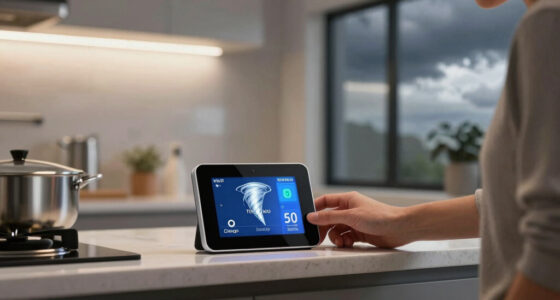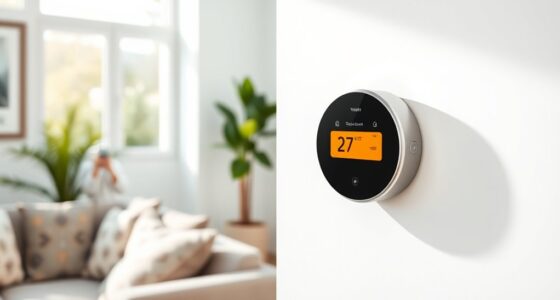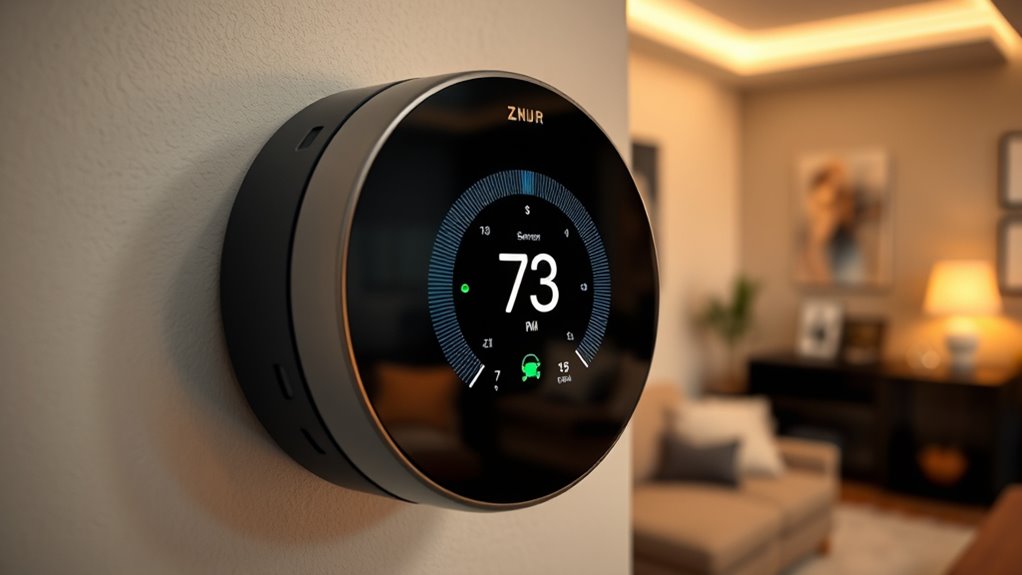

Smart thermostat sensors use advanced science to monitor your home’s temperature, humidity, and occupancy accurately. They rely on precise calibration and sophisticated algorithms to guarantee reliable readings, which helps optimize your comfort and energy use. Continuous improvements in calibration techniques and privacy safeguards also protect your data and build trust. If you’re curious about how these sensors work behind the scenes and ensure your system runs smoothly, keep exploring the science that makes it possible.
Key Takeaways
- Smart thermostat sensors utilize advanced calibration techniques to accurately measure temperature, humidity, and occupancy for optimal climate control.
- Precise calibration ensures reliable data, directly impacting energy efficiency and user comfort in smart home systems.
- Sensor accuracy depends on ongoing adjustments to account for environmental changes, aging, and installation conditions.
- Privacy safeguards, including encryption and secure data protocols, protect sensor data from unauthorized access and hacking.
- Scientific innovations continually improve sensor calibration and privacy measures, enhancing the reliability and security of smart thermostats.

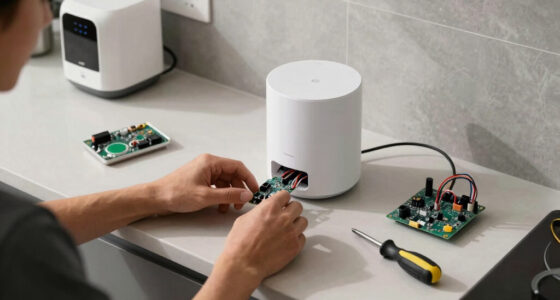
Smart thermostat sensors are the key to efficient climate control, harnessing science to maximize your comfort and energy savings. These sensors continuously monitor temperature, humidity, and sometimes even occupancy, allowing your thermostat to make smarter decisions about heating and cooling. But for these sensors to work effectively, they need to be properly calibrated. Sensor calibration involves fine-tuning the sensor’s readings to match actual environmental conditions, guaranteeing that the data it provides is accurate and reliable. Without proper calibration, the sensor might misjudge the room’s temperature, leading to unnecessary energy consumption or discomfort. Manufacturers often calibrate sensors during production, but they may also include self-calibration features or allow manual adjustments to maintain precision over time. This process is essential because environmental factors, sensor aging, or installation issues can impact accuracy, and regular calibration helps keep your smart thermostat functioning at its best.
While sensors are at the heart of smart climate control, they also raise concerns about data privacy. These devices collect a lot of information about your home environment, occupancy patterns, and sometimes even personal routines. This data is critical for the thermostat to optimize comfort and energy efficiency, but it also needs to be protected from unauthorized access. Reputable smart thermostat manufacturers prioritize data privacy by implementing strong encryption protocols and giving you control over what data is shared and stored. It’s important to understand how your data is used and to review privacy policies carefully. Protecting your data not only safeguards your privacy but also maintains the integrity of your home automation system. When sensors transmit data to cloud servers, secure connections are essential to prevent hacking or interception, which could compromise your home’s security or reveal sensitive information. Additionally, understanding the science behind sensor accuracy can help users appreciate the importance of proper calibration and privacy safeguards. Advances in sensor calibration techniques are continuously improving the precision and reliability of these devices, ensuring better performance over time. Furthermore, implementing privacy safeguards is vital to maintaining user trust and the security of personal information in smart home systems.
The science behind these sensors involves more than just temperature detection; it encompasses advanced algorithms, sensor calibration, and privacy safeguards. Precise calibration ensures the sensor’s measurements remain trustworthy, which directly impacts your comfort and energy costs. Meanwhile, robust data privacy measures build trust and ensure your personal information isn’t misused. As technology evolves, sensor calibration techniques become more sophisticated, and privacy protections become more extensive. By understanding these scientific principles, you can better appreciate how your smart thermostat adapts to your lifestyle, providing ideal comfort while safeguarding your information. Ultimately, the success of a smart thermostat hinges on the seamless integration of accurate sensor data and privacy-conscious design—both rooted in solid scientific principles working behind the scenes to serve your home.

ecobee Smart Sensor 2 Pack – Comfort, Security, Energy Savings, Temperature and Occupancy Detection – Compatible with ecobee Thermostats for Home
Knows when a room is occupied and communicates the temperature to your ecobee smart thermostat from up to…
As an affiliate, we earn on qualifying purchases.
As an affiliate, we earn on qualifying purchases.
Frequently Asked Questions
How Accurate Are Smart Thermostat Sensors in Different Weather Conditions?
You might wonder how accurate smart thermostat sensors are across various weather conditions. Generally, their sensor accuracy remains reliable, but weather variability can impact performance slightly. Extreme cold or heat may cause minor fluctuations, but modern sensors are designed to adapt and maintain precision. Keep in mind that regular calibration and quality sensors help guarantee consistent temperature control, regardless of weather changes.
Do Smart Sensors Require Regular Calibration for Optimal Performance?
You might wonder if smart sensors need regular calibration for peak performance. Generally, they don’t require frequent calibration, but factors like sensor lifespan and environmental conditions can influence calibration frequency. Over time, sensors can drift, so checking and recalibrating occasionally ensures accuracy. Typically, manufacturers recommend calibration every 1-2 years or if you notice inconsistent readings, helping your smart thermostat function efficiently and maintain comfort in your home.
How Do Sensors Detect Occupancy Without Infringing on Privacy?
Imagine sensors as silent guardians, sensing your presence without prying into your privacy. They detect occupancy through subtle signals like motion, temperature shifts, or sound patterns, all designed with high sensor sensitivity that respects your privacy concerns. These sensors work discreetly, ensuring your home stays comfortable while safeguarding your personal space, like a gentle whisper rather than a loud intrusion, giving you peace of mind with smart technology.
Can Sensor Placement Affect the Overall Energy Efficiency?
Sensor placement considerably impacts your smart thermostat’s energy efficiency. When sensors are strategically positioned in high-traffic or central locations, they accurately detect occupancy and temperature variations, optimizing heating and cooling. Poor placement might lead to false readings or energy waste. As a result, you should consider placing sensors where they can best monitor activity and environmental changes, ensuring your system responds efficiently, saving energy, and reducing costs.
Are There Compatibility Issues With Existing HVAC Systems?
You might encounter HVAC integration issues with your existing system, especially if sensor compatibility isn’t considered. Some smart thermostats may not seamlessly work with older or specialized HVAC units, requiring additional adapters or upgrades. To avoid problems, check that your thermostat is compatible with your system’s specifications. Ensuring proper sensor compatibility and HVAC integration helps optimize performance and energy savings, making your smart thermostat a worthwhile investment.

Honeywell Home RCHTSENSOR-1PK, Smart Room Sensor works with T9/T10 WIFI Smart Thermostats
Compatible ONLY with series 3 & Series 4 T9 Smart thermostats. Series number appears after model number on…
As an affiliate, we earn on qualifying purchases.
As an affiliate, we earn on qualifying purchases.
Conclusion
Imagine your smart thermostat as a vigilant gardener, constantly sensing the weather and adjusting for the perfect bloom. Thanks to advanced sensors, it learns your habits and responds in real-time, just like a seasoned gardener tending to delicate plants. Studies show that smart thermostats can cut energy bills by up to 12%. With these sensors working behind the scenes, you’re not just controlling your home—you’re creating a smarter, more efficient sanctuary that adapts seamlessly to your life.

GoveeLife 2.0 WiFi Hygrometer Thermometer 3 Pack, Smart Humidity Temperature Sensor with App Notifications, Temperature Humidity for Bedroom, Wine Cellar, Basements(Only Support 2.4G Wi-Fi)
Smart WiFi Control: Monitor indoor thermometer data anytime, anywhere. The gateway can be connected through WiFi via the…
As an affiliate, we earn on qualifying purchases.
As an affiliate, we earn on qualifying purchases.
ecobee Smart Sensor 2 Pack – Comfort, Security, Energy Savings, Temperature and Occupancy Detection – Compatible with ecobee Thermostats for Home
Knows when a room is occupied and communicates the temperature to your ecobee smart thermostat from up to…
As an affiliate, we earn on qualifying purchases.
As an affiliate, we earn on qualifying purchases.