
The best home air conditioners balance room coverage, installation needs, and everyday noise rather than relying on BTU numbers alone. My best overall pick is the Midea 8,000 BTU Smart Inverter Window Air Conditioner with Heat and Dehumidifier, which pairs window-unit efficiency with added year-round flexibility. For quieter window cooling, the Midea U-Shaped models stand out, while the DREO 318S is a more compact portable choice for bedrooms. The main tradeoffs are window versus portable installation, cooling capacity versus energy use, and convenience features versus simplicity. Read on for how all 14 options compare and which one best fits your home.

Get home appliances delivered free with Prime
- Fast, free delivery on millions of items
- Prime Video, Amazon Music and more included
- Member-only deals all year
Complete the kit


Key Takeaways
- Window models lead for fixed-room cooling: The Midea inverter and U-shaped units offer a quieter, less floor-space-intensive alternative to the large portable models.
- Portable BTU figures need careful interpretation: The DREO 318S lists 8,000 BTU ASHRAE and 5,000 BTU DOE, showing why buyers should compare comparable capacity ratings rather than the largest number on a package.
- Large rooms bring installation tradeoffs: Several portable picks claim coverage up to 700–750 square feet, but they still need a window exhaust route and floor space near the window.
- Small rooms do not need oversized units: The GE 5,000 BTU window AC is a more fitting starting point for a compact space than the 12,000–14,000 BTU portable options.
- Extra modes define the specialized picks: The Midea 8,000 BTU window unit and SereneLife portable model add heat, while several smart portable units prioritize app and voice control.






| home air conditioner | Power | Weight | Noise level | Refrigerant |
|---|---|---|---|---|
| DREO Portable Air Conditioner | 115 volts; 1,040 watts | 55 pounds | 45 dB | R-32 |
| Frigidaire 8,000 BTU Window Ai | 115 volts; 714 watts | 45.4 pounds | 55 dBA | R-32 |
| 14,000 BTU Portable Air Condit | 115 volts; 1,180 watts | 75 pounds | 54 dB | R-32 |
| Midea 8,000 BTU Smart Inverter | 115 volts | — | 45 dBA | — |
| 14,000 BTU Portable Air Condit | 115 volts; 1,200 watts | 66.6 pounds | 44 dB | — |
| 14,000 BTU Portable Air Condit | 115 volts; 1,440 watts | — | — | R-32 |
| Midea 12,000 BTU U-Shaped Wind | 115 volts; 1,140 watts | 56.9 lb. | — | R-32 |
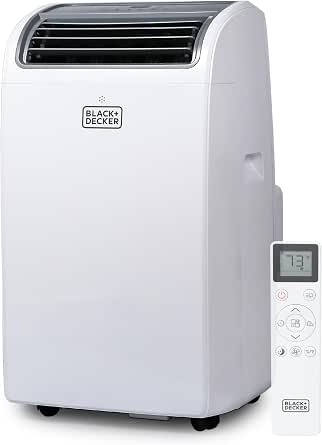
| BLACK+DECKER Portable Air Cond | 115 volts; 1,365 watts | 68.3 lb. | — | R-32 |
| 14,000 BTU Smart WiFi Portable | 115 volts; 1,200 watts | 66 lb. | — | — |
| Shinco 12,000 BTU Portable Air | 115 volts; 3,520 watts listed | — | — | R-410A |
| Midea 10,000 BTU U-Shaped Smar | — | 56.9 pounds | 32 dBA | R-32 |
| GE 5,000 BTU Window Air Condit | — | 36.5 pounds | 56 dBA | — |
| Garvee 3-in-1 Portable Air Con | — | 85.3 pounds | 50 dB | — |
| SereneLife Portable Air Condit | — | — | 51 dBA | R-32 |
More Details on Our Top Picks
DREO Portable Air Conditioner 318S, 8000 BTU ASHRAE (5000 BTU DOE) Smart AC Unit for Bedroom, 3-in-1 Cooling, Fan & Dehumidifier, APP/Voice/Remote Control, Quiet Standing AC
The DREO 318S suits bedrooms where app and voice controls matter as much as cooling. Its listed 45 dB noise level is lower than the Frigidaire 8,000 BTU window unit’s 55 dBA, while the portable design avoids leaving an AC installed in the window year-round. It also adds fan and dehumidifier modes, and drainage-free operation can cut routine maintenance in many conditions. The tradeoff is room coverage: its stated 100-square-foot limit is far below the Frigidaire’s 350 square feet, so this is a focused bedroom pick, not a small-apartment solution. In humid rooms, drainage may still be needed, and the unit lacks inverter technology. I’d choose it for smart, quiet control in a compact space, not for broad coverage or maximum energy efficiency.
Pros:- App, voice, and remote controls offer flexible operation.
- Listed 45 dB noise level is suited to quieter rooms.
- Cooling, fan, and dehumidifier modes cover more than temperature control.
- Drainage-free operation in many environments reduces routine water handling.
Cons:- Specified coverage is limited to 100 square feet.
- May need a drain hose in high humidity.
- No inverter technology for improved energy efficiency.
Best for: People furnishing a bedroom up to 100 square feet who want app, voice, and remote control without a permanent window unit.
Not ideal for: People cooling a large bedroom or living room, or those in humid climates who want to avoid managing a drain hose.
- Cooling capacity:8,000 BTU ASHRAE (5,000 BTU DOE)
- Listed room area:100 sq. ft.
- Noise level:45 dB
- Power:115 volts; 1,040 watts
- Refrigerant:R-32
- Dimensions:15.16 × 13.98 × 24.8 inches
- Weight:55 pounds
- Window fit:17-inch minimum window width and height; 53-inch maximum window width
Our verdict“Choose the DREO 318S for smart, relatively quiet cooling in a small bedroom, but pick the Frigidaire or a higher-capacity unit for more floor space.”
Frigidaire 8,000 BTU Window Air Conditioner with Remote Control, Cools Up to 350 Sq. Ft., Quiet Operation, Eco Mode, 3 Fan Speeds, Auto Restart, White
The Frigidaire is the straightforward choice for buyers who want window-mounted cooling across up to 350 square feet without paying for portable-unit mobility or smart-home extras. Its washable filter and alert system make upkeep less of a guessing game, while Eco and Sleep modes, a remote, and three fan speeds provide useful everyday control. Compared with the DREO 318S, it covers much more space, but it is fixed in the window and has a higher listed noise level of 55 dBA versus the DREO’s 45 dB. It also lacks the Midea’s inverter technology and supplemental heat. That makes this Frigidaire a sensible single-season cooling pick, but a less compelling fit for buyers seeking especially quiet operation or year-round use.
Pros:- Covers up to 350 square feet, substantially more than the DREO 318S.
- Washable dust filter and filter alerts simplify routine maintenance.
- Eco and Sleep modes offer alternatives to continuous full-power operation.
- Remote, three fan speeds, and adjustable airflow add useful control.
Cons:- Window installation limits placement and seasonal flexibility.
- Listed 55 dBA noise level is higher than the DREO 318S and Midea unit.
- Does not offer supplemental heat or inverter technology.
Best for: Renters or homeowners with a suitable window who need uncomplicated cooling for a bedroom or living room up to 350 square feet.
Not ideal for: People who cannot install a window unit, want a portable appliance, or need supplemental heat and inverter operation.
- Cooling capacity:8,000 BTU
- Room coverage:Up to 350 sq. ft.
- Noise level:55 dBA
- Power:115 volts; 714 watts
- Refrigerant:R-32
- Filter:Washable pre-filter
- Dimensions:18.5 × 15.8 × 13.4 inches
- Weight:45.4 pounds
- Window opening:14.4-inch minimum width and height; 36-inch maximum width
Our verdict“Pick the Frigidaire for simple window-based cooling across a medium room; choose the Midea if quieter operation, inverter technology, or supplemental heat matters more.”
14,000 BTU Portable Air Conditioner, 4-in-1 Multi-Functional Unit for Large Rooms up to 750 sq. ft.
For a large open room, this portable model’s stated 14,000 BTU capacity and coverage up to 750 square feet set it apart from the 8,000 BTU Frigidaire and Midea, both listed for rooms up to 350 square feet. Cooling, dehumidifier, and fan modes give it a practical role beyond peak-heat days, while caster wheels and handles help move it between rooms. The greater reach comes with real costs: at 75 pounds, it is heavier than the 66.6-pound WiFi portable unit in this roundup, and its 1,180-watt draw may add to energy use. Window-kit setup is also part of the portable-AC routine, so moving it is easier than carrying it upstairs or reinstalling it. I’d favor this model for space coverage over smart controls or lighter handling.
Pros:- 14,000 BTU capacity and stated coverage up to 750 square feet suit larger spaces.
- Cooling, dehumidifier, and fan modes provide multiple functions.
- Caster wheels and handles help reposition the unit on one floor.
- Remote control and a 24-hour timer support convenient scheduling.
Cons:- At 75 pounds, moving it between floors may require help.
- Window-kit setup is needed for operation.
- Its 1,180-watt draw may be a drawback for energy-conscious buyers.
Best for: Households with a large open-plan living area, up to the stated 750 square feet, that need a portable high-capacity unit.
Not ideal for: People with small rooms, frequent stair moves, or a priority for app and voice controls.
- Cooling capacity:14,000 BTU
- Listed room coverage:Up to 750 sq. ft.
- Noise level:54 dB
- Power:115 volts; 1,180 watts
- Refrigerant:R-32
- Modes:Cooling, dehumidifier, and fan
- Dimensions:17.32 × 13.19 × 27.95 inches
- Weight:75 pounds
- Timer:Up to 24 hours
Our verdict“Choose this model when large-room coverage is the priority, and consider the lighter WiFi portable unit if easier handling and connected controls matter more.”
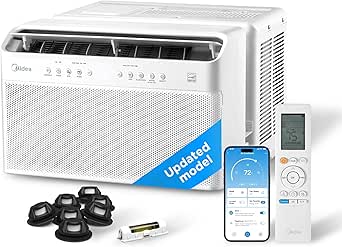
Midea 8,000 BTU Smart Inverter Window Air Conditioner with Heat and Dehumidifier
The Midea offers the most balanced feature set among the smaller-room window choices here: inverter cooling, supplemental heat, dehumidification, and smart controls in a unit rated for up to 350 square feet. Its listed 45 dBA noise level is lower than the Frigidaire’s 55 dBA, and inverter technology is intended to reduce energy use compared with a conventional on-off design. The heat function gives it a longer seasonal role, though it is supplemental rather than a solution for every winter: it will not operate below an outdoor temperature of 41°F. Unlike the DREO portable, the Midea stays installed in a window, and its larger stated dimensions call for careful fit checks. I’d rank it ahead of the Frigidaire for quieter, multi-season use, but not for anyone needing portable placement or dependable heat in colder weather.
Pros:- Inverter technology is designed to reduce energy use compared with conventional operation.
- Cooling, dehumidifying, and supplemental heating extend its usefulness beyond summer.
- Listed 45 dBA noise level is lower than the Frigidaire’s 55 dBA.
- App and voice compatibility add smart control.
Cons:- Heat-pump operation does not work below 41°F outdoors.
- Window installation requires a suitable opening and enough clearance.
- Coverage is limited to rooms up to 350 square feet.
Best for: People with a suitable window who want a quieter, smart-controlled AC for a room up to 350 square feet and supplemental heat in mild weather.
Not ideal for: People who need a portable unit, live where winter temperatures regularly fall below 41°F, or lack a sufficiently large window opening.
- Cooling capacity:8,000 BTU
- Room coverage:Up to 350 sq. ft.
- Noise level:45 dBA
- Power:115 volts
- Technology:Smart inverter
- Functions:Cooling, supplemental heat, and dehumidification
- Dimensions:19.41 × 22.17 × 13.9 inches
- Included components:Remote control and installation kit
- Heat-pump operating limit:Does not operate below 41°F outdoors
Our verdict“Choose the Midea for quiet, smart window cooling with mild-weather heat; choose a portable model if you need to move the AC or a dedicated heater for colder conditions.”
14,000 BTU Portable Air Conditioner with WiFi & Remote Control, Cools Up to 700 Sq.Ft, Auto-Evaporation, Low Noise, White
This portable unit pairs 14,000 BTU cooling with WiFi, app, voice, and remote controls, making it the connected alternative to the large-room portable model rated for 750 square feet. Its stated coverage reaches 700 square feet, slightly less than that rival, while its listed 44 dB noise level is lower than the other portable model’s 54 dB. Auto-evaporation can reduce routine water handling, and cooling, fan, and dehumidifier modes add flexibility. The tradeoffs are a 66.6-pound body that is still awkward to carry and a 1,200-watt draw. Window installation also limits where it can run. I’d pick this over the 750-square-foot model for connected controls and lower listed noise, but reverse that choice if maximum stated coverage is the priority.
Pros:- 14,000 BTU cooling and stated coverage up to 700 square feet suit large rooms.
- WiFi, app, voice, and remote controls provide several ways to operate it.
- Listed 44 dB noise level is lower than the 54 dB large-room portable alternative.
- Auto-evaporation may reduce routine water handling.
Cons:- At 66.6 pounds, it is cumbersome to carry despite its portable format.
- Its 1,200-watt draw may not suit buyers prioritizing lower power use.
- Requires a suitable window for installation.
Best for: People cooling a large room up to 700 square feet who want WiFi or voice control and prefer a portable unit over a fixed window AC.
Not ideal for: People who need the greatest stated coverage, move an AC frequently between floors, or want a lower-wattage appliance.
- Cooling capacity:14,000 BTU
- Listed room coverage:Up to 700 sq. ft.
- Noise level:44 dB
- Power:115 volts; 1,200 watts
- Controls:App, remote, and voice control
- Functions:Cooling, fan, and dehumidifier
- Dimensions:16.7 × 15.7 × 25.5 inches
- Weight:66.6 pounds
- Warranty:1 year
Our verdict“Choose this connected portable AC for large-room cooling with quieter listed operation, but favor the 750-square-foot model if coverage matters more than WiFi controls.”
14,000 BTU Portable Air Conditioner, 4-in-1 Smart AC with WiFi
For a large room where noise and flexible controls matter, this 14,000 BTU portable AC offers a useful mix of capacity and convenience. Its stated coverage reaches 750 square feet, and 41 dB operation is quieter than the BLACK+DECKER BPACT14WT’s listed 54 dB, a meaningful difference for bedrooms or shared living spaces. App, voice, remote, and touch controls also give it more ways to fit into a smart-home routine. Dehumidifier and fan modes add utility when full cooling is unnecessary. The tradeoff is that this is still a portable unit: it needs a window connection, occupies floor space, and draws 1,440 watts. Compared with the Midea U-Shaped Window AC, it avoids a window-mounted compressor installation but gives up that model’s quieter 32 dB rating and inverter design.
Pros:- 14,000 BTU capacity is listed for rooms up to 750 square feet
- 41 dB noise rating is lower than the BLACK+DECKER BPACT14WT’s listed 54 dB
- App, voice, remote, and touch controls
- Cooling, dehumidifier, and fan modes with a 24-hour timer
Cons:- Uses 1,440 watts, which may add up during extended cooling
- Portable design takes up floor space and requires a window exhaust setup
- Full smart controls depend on Wi-Fi
Best for: People cooling a large bedroom or living area who want quiet operation and app or voice control without installing a window AC.
Not ideal for: Buyers prioritizing lower electricity use or a permanent, low-profile setup; its 1,440-watt draw and floor-standing format may be a poor fit.
- Cooling power:14,000 BTU
- Noise:41 dB
- Energy efficiency:7.8 CEER
- Refrigerant:R-32
- Power:115 volts; 1,440 watts
- Modes:Cooling, dehumidifier, fan, 24-hour timer
- Controls:App, remote, touch panel, voice
Our verdict“Choose this model for large-room portable cooling with quieter operation and broad smart controls, but skip it if energy draw or floor space is your main concern.”
Midea 12,000 BTU U-Shaped Window Air Conditioner, Cools up to 550 Sq Ft
The Midea U is the strongest fit here for buyers who can install a window unit and want to keep room noise down. Its 32 dB rating is quieter than every portable model in this batch, including the 41 dB 14,000 BTU Smart AC. The U-shaped chassis also leaves part of the window available to open, so it offers a fresh-air option that portable units with exhaust hoses do not. Its 12,000 BTU capacity is rated for up to 550 square feet, less than the larger portable models’ stated coverage, but the inverter compressor and listed energy savings favor steady use over maximum reach. The compromise is installation: the unit weighs 56.9 pounds and needs a compatible window. Buyers with unusual windows or frequent moves may find a portable AC easier to manage.
Pros:- 32 dB noise rating suits bedrooms and quiet living areas
- Inverter compressor supports more efficient, steady operation
- U-shaped design allows the window to open for fresh air
- Wi-Fi control works with Alexa and Google Assistant
Cons:- Installation can be demanding, and the unit weighs 56.9 pounds
- Window must meet the specified dimensions
- 550-square-foot coverage is less than the larger portable models in this batch
Best for: Apartment residents or homeowners with compatible windows who want quiet cooling for a bedroom or living room and value opening the window for fresh air.
Not ideal for: Renters who cannot install a window unit, people with windows outside the listed size range, or anyone needing portable cooling across rooms.
- Cooling power:12,000 BTU
- Noise:32 dB
- Compressor:Rotary inverter
- Refrigerant:R-32
- Power:115 volts; 1,140 watts
- Window fit:23–36 inches wide; minimum opening height 19.5 inches
- Weight:56.9 lb.
Our verdict“Pick the Midea U for quiet, smart window cooling in a compatible room; choose a portable model instead if installation flexibility matters more.”
BLACK+DECKER Portable Air Conditioner, 14,000 BTU, BPACT14WT, White
The BLACK+DECKER BPACT14WT makes sense for buyers who want 14,000 BTU portable cooling paired with a remote that can use its Follow Me thermostat function. That feature lets temperature control respond to the remote’s location, which can be helpful when a room cools unevenly. It also combines AC, fan, and dehumidifier modes with Wi-Fi and voice control. Against the 14,000 BTU Smart AC with 41 dB operation, however, this model is noticeably louder on paper at 54 dB, and its listed coverage is 700 rather than 750 square feet. Its 68.3-pound weight also makes room-to-room moves a chore. I’d favor it over the Shinco 12,000 BTU Portable AC when the extra stated capacity and smart controls matter, but the Shinco is the simpler choice if you do not need Wi-Fi.
Pros:- 14,000 BTU cooling with listed coverage up to 700 square feet
- Follow Me remote thermostat can help target comfort where the remote is placed
- Wi-Fi and Alexa or Google Assistant voice control
- Cooling, fan, and dehumidifier functions
Cons:- 54 dB noise rating is higher than the quieter smart portable options in this batch
- At 68.3 pounds, it is cumbersome to move between rooms
- Requires a window kit and exhaust-hose setup
Best for: Households with a large room that want a portable AC, voice control, and temperature sensing from the remote’s location.
Not ideal for: Light sleepers, noise-sensitive households, or buyers who need to move the unit often; its 54 dB rating and 68.3-pound weight work against those needs.
- Cooling power:14,000 BTU
- Noise:54 dB
- Power:115 volts; 1,365 watts
- Refrigerant:R-32
- Functions:Air conditioner, dehumidifier, fan
- Controls:Wi-Fi, voice, remote with Follow Me thermostat
- Weight:68.3 lb.
Our verdict“Choose this BLACK+DECKER when Follow Me temperature control and smart features matter more than low noise or easy portability.”
14,000 BTU Smart WiFi Portable Air Conditioner, Cools up to 700 Sq.Ft, Auto-Evaporation, 3-in-1 Modes, Voice & Remote Control, Quiet Operation, White
Auto-evaporation is the practical distinction here: this 14,000 BTU portable AC is designed to reduce the need for manual water draining, a recurring hassle that some portable-unit owners would rather avoid. It also offers Wi-Fi, voice, and remote controls, with a stated 42 dB noise level that sits close to the 41 dB 4-in-1 Smart AC. That other model is rated for up to 750 square feet and lists a broader control set, while this one is rated for 700 square feet and draws 1,200 watts. It may suit buyers who favor auto-evaporation and a simpler remote-and-voice setup. The window kit and exhaust hose still require installation, and auto-evaporation does not remove the need to follow the unit’s drainage instructions in every condition.
Pros:- 14,000 BTU capacity is listed for rooms up to 700 square feet
- Auto-evaporation can reduce manual drainage
- 42 dB noise rating is close to the quieter 41 dB smart portable model
- Wi-Fi, voice, and remote controls
Cons:- Requires a window kit and exhaust hose
- At 66 pounds, it is not easy to move frequently
- Auto-evaporation may not eliminate drainage needs in every operating condition
Best for: People cooling a large room who want smart portable operation and less routine water handling than a unit without auto-evaporation.
Not ideal for: Buyers who want a window-mounted unit, do not have space for a floor-standing appliance, or need a guaranteed no-drain setup in all conditions.
- Cooling power:14,000 BTU
- Noise:42 dB
- Power:115 volts; 1,200 watts
- Functions:Cooling, dehumidifier, fan
- Water handling:Auto-evaporation
- Controls:Wi-Fi, voice, remote
- Weight:66 lb.
- Warranty:1-year limited
Our verdict“Choose this model for large-room portable cooling with auto-evaporation, but pick the 750-square-foot 4-in-1 Smart AC if you need more stated coverage.”
Shinco 12,000 BTU Portable Air Conditioner with Remote, Timer, and Installation Kit
The Shinco is the most straightforward option in this group for medium-sized rooms: it supplies 12,000 BTU ASHRAE capacity, a remote, an included installation kit, and cooling, fan, and dehumidifier modes without leaning on Wi-Fi or voice control. Its stated room size is up to 450 square feet, so it is better matched to a bedroom or modest living area than the 700–750-square-foot claims attached to the 14,000 BTU portables. Compared with the BLACK+DECKER BPACT14WT, it gives up smart control and Follow Me sensing but also avoids making those features part of the buying decision. The listed 52 dB noise level may be audible in a quiet room, and its reported 3,520-watt draw deserves scrutiny for energy-conscious buyers. Check the SACC figure as well: it is 7,500 BTU, below the ASHRAE headline capacity.
Pros:- Rated for rooms up to 450 square feet
- Installation kit is included for window venting
- Cooling, fan, and dehumidifier modes
- Remote control has a listed 23-foot range
Cons:- 52 dB may be noticeable in bedrooms or other quiet spaces
- SACC cooling capacity is 7,500 BTU, below the 12,000 BTU ASHRAE figure
- Listed 3,520-watt draw and 2.6 SEER raise energy-use concerns
Best for: Buyers who want a remote-controlled portable AC for a medium-sized room and prefer basic controls over app or voice features.
Not ideal for: People cooling large open spaces, light sleepers, or energy-conscious buyers who want a lower listed power draw and stronger efficiency data.
- Cooling capacity:12,000 BTU ASHRAE; 7,500 BTU SACC
- Noise:52 dB
- Dehumidification:43.2 L/day
- Refrigerant:R-410A
- Power:115 volts; 3,520 watts listed
- Modes:Cooling, fan, dehumidifier
- Controls and setup:Remote control; installation kit included
- Efficiency:2.6 SEER; 780 kWh annual energy consumption
Our verdict“Pick the Shinco for basic portable cooling in a medium-sized room, but look to a larger 14,000 BTU model for more stated coverage or quieter operation.”
Midea 10,000 BTU U-Shaped Smart Inverter Window AC, Cools 450 Sq Ft, Ultra Quiet, Alexa/Google Compatible, 35% Energy Savings
The Midea 10,000 BTU U-Shaped is the strongest fit here for buyers who want substantial room cooling without giving up a quieter room or app-based control. Its 32 dBA noise level and inverter operation set it apart from the small GE window unit, listed at 56 dBA, while Wi-Fi and Alexa and Google compatibility add convenient scheduling and remote adjustments. The listed coverage is up to 450 square feet, making it a more suitable choice for a larger bedroom or living area than the GE’s 150-square-foot limit. The tradeoff is installation: the U-shaped design requires a compatible window opening, and its 56.9-pound weight may call for help during setup. Choose it over a portable unit when a window AC works for your home; skip it if your window dimensions do not fit.
Pros:- Listed 32 dBA operation is quieter than the GE 5,000 BTU window model’s 56 dBA.
- Inverter technology and ENERGY STAR certification support an efficiency-focused choice.
- Wi-Fi, Alexa, and Google Assistant compatibility allow remote and voice control.
- 10,000 BTU capacity is suited to substantially larger rooms than the GE’s 150-square-foot coverage.
Cons:- U-shaped window installation depends on compatible window dimensions.
- At 56.9 pounds, installation may be difficult for one person.
- Requires a window opening, unlike a cooling approach that does not occupy the window.
Best for: People cooling a bedroom or living space up to 450 square feet who want low listed noise, inverter operation, and voice or app control.
Not ideal for: Renters who cannot install a window unit, or buyers whose windows do not meet the listed opening dimensions.
- Cooling power:10,000 BTU
- Listed room capacity:Up to 450 sq ft
- Noise level:32 dBA
- Inverter:Yes
- Refrigerant:R-32
- Voltage:115 volts
- Weight:56.9 pounds
- Window opening range:22–36 inches wide; 13.75–36 inches high
Our verdict“Choose this Midea for quiet, connected window cooling in a room up to 450 square feet, provided your window fits its installation requirements.”
GE 5,000 BTU Window Air Conditioner for Small Spaces
The GE 5,000 BTU window AC earns its place by matching a modest cooling capacity to rooms up to 150 square feet. That makes it a more sensible small-bedroom or dorm pick than the 10,000 BTU Midea, whose greater capacity and smart controls may be unnecessary in a compact space. GE keeps operation simple with manual controls, a washable filter, and included installation hardware, so there is less setup complexity than with a connected unit. Its listed 440-watt draw is also lower than the Midea’s 890 watts, though those figures alone do not establish comparative efficiency. The compromise is limited reach and no digital or smart features. The listed noise level is 56 dBA, so buyers seeking the quietest bedroom option should compare it with the Midea’s much lower listed 32 dBA.
Pros:- 5,000 BTU capacity is sized for rooms up to 150 square feet.
- Manual controls offer a simple alternative to the smart features on the Midea U-shaped model.
- Washable filter supports routine maintenance.
- Included hardware is described as supporting DIY installation.
Cons:- Cooling coverage is limited to small rooms.
- No digital controls, Wi-Fi, or voice assistant compatibility.
- Listed 56 dBA noise level is much higher than the Midea U-shaped model’s 32 dBA.
Best for: Students, renters, and homeowners cooling a small bedroom, office, or dorm room up to 150 square feet who prefer straightforward controls.
Not ideal for: People cooling larger open rooms or seeking app control and especially quiet operation; the capacity is limited and the listed noise level is 56 dBA.
- Cooling power:5,000 BTU
- Listed room size:Up to 150 sq ft
- Noise level:56 dBA
- Voltage:115 volts
- Wattage:440 watts
- Dimensions:15 × 16.36 × 12.56 inches
- Weight:36.5 pounds
- Window opening range:27.13–36 inches wide; 13.38 inches high
- Warranty:1-year GE limited warranty
Our verdict“Pick the GE for uncomplicated cooling in a small room, but choose the Midea if quieter operation or smart control matters more.”
Garvee 3-in-1 Portable Air Conditioner, 14,000 BTU (9300 BTU SACC) AC Unit
The Garvee 14,000 BTU portable AC is the large-room choice for buyers who need cooling, fan, and dehumidifier modes in a movable unit. Its stated coverage of up to 750 square feet matches the large-room reach of the 14,000 BTU portable options in this roundup, while its casters and side handles make it easier to reposition than a window-mounted AC. That flexibility comes with a substantial footprint and an 85.3-pound weight, so moving it between floors is not a casual task. It also needs a window installation for exhaust, which limits where it can run, and the listed 50 dB noise may stand out in a quiet bedroom. Compared with the SereneLife, Garvee lists greater cooling coverage but does not list a heating mode; buyers needing year-round temperature functions may prefer that alternative.
Pros:- Listed coverage reaches up to 750 square feet.
- Combines air conditioning, fan, and dehumidifier functions.
- Casters and side handles help with repositioning within a home.
- Includes remote control and timer according to the product information.
Cons:- At 85.3 pounds, it is heavy to move frequently.
- Requires window exhaust installation, limiting placement options.
- Listed 50 dB noise may be noticeable in a quiet sleeping space.
Best for: Households cooling a large room up to 750 square feet that need a portable unit with AC, fan, and dehumidifier modes.
Not ideal for: Light sleepers, people who need a heater, or anyone who must frequently carry an 85.3-pound appliance between rooms or floors.
- Cooling power:14,000 BTU (9,300 BTU SACC)
- Listed floor area:Up to 750 sq ft
- Noise level:50 dB
- Modes:Air conditioning, fan, and dehumidifier
- Voltage:115 V
- Wattage:1,155 W
- Dimensions:20.16 × 18.11 × 33.66 inches
- Weight:85.3 pounds
Our verdict“Choose Garvee for portable three-mode cooling across a large room, and choose the SereneLife instead if heating matters more than maximum listed coverage.”
SereneLife Portable Air Conditioner With Heat & Dehumidifier, 12,000 BTU, Room Up to 550 Sq. Ft., Remote & Window Kit Included
The SereneLife portable AC stands apart from Garvee by adding a 10,500 BTU heating mode alongside cooling, dehumidifying, and fan functions. That combination suits a household looking for one movable appliance to handle more than summer heat, with stated cooling coverage of up to 550 square feet. Its included hose, remote, and window mount kit simplify the basic setup, while the 70.3-pound weight is still substantial but lighter than Garvee’s 85.3 pounds. The tradeoff is reduced stated cooling reach: Garvee lists coverage up to 750 square feet and higher cooling capacity. SereneLife also needs window exhaust despite being portable, and the listed 51 dBA noise may bother buyers who prioritize quiet sleeping conditions. Pick it for multi-season versatility, not maximum room coverage.
Pros:- Combines cooling, heating, dehumidifying, and fan functions.
- Listed cooling coverage is up to 550 square feet.
- Includes a hose, remote, and window mount kit.
- Weighs less than the Garvee portable AC, though it remains a heavy unit.
Cons:- Listed coverage and cooling capacity are lower than Garvee’s 750-square-foot, 14,000 BTU offering.
- At 70.3 pounds, it is still cumbersome to move often.
- Requires window exhaust installation and is listed at 51 dBA.
Best for: People who want portable cooling for a room up to 550 square feet plus heating and dehumidifying functions in the same appliance.
Not ideal for: Buyers cooling rooms larger than the listed 550-square-foot coverage, or those who need a quiet unit or do not have a suitable window for exhaust.
- Cooling power:12,000 BTU
- Heating power:10,500 BTU
- Listed room coverage:Up to 550 sq ft
- Dehumidifier capacity:1.5 liters per hour
- Noise level:51 dBA
- Refrigerant:R-32
- Voltage and wattage:120 V; 1,060 W
- Dimensions and weight:14 × 16.5 × 27 inches; 70.3 pounds
- Included components:Hose, remote, and window mount kit
Our verdict“Choose SereneLife if you value portable heating as well as cooling, but pick Garvee for greater listed cooling coverage.”

How We Picked
I compared these 14 air conditioners on the factors that change how well they fit a home: cooling capacity and stated room coverage, installation demands, noise-related design, energy-conscious features, controls, and added functions such as heating or dehumidification. I also gave weight to how clearly a model’s stated capacity and intended room size help a buyer match the unit to a space. A high BTU figure alone did not earn a top position; the unit also needed a practical fit for its intended room and a manageable ownership tradeoff.
The ranking favors adaptable, room-appropriate cooling over sheer output. The Midea 8,000 BTU inverter window model leads because it combines window-unit cooling with heat and dehumidification, while Midea’s U-shaped models earn distinction for buyers prioritizing quieter operation. Portable models rank well when their mobility, smart controls, or larger-room claims answer a clear need, but their exhaust setup and floor footprint count against them. The Frigidaire and GE window units serve straightforward cooling needs, while specialized or less fully specified models are better treated as targeted alternatives than universal picks.
Factors to Consider When Choosing Best Home Air Conditioners
Before choosing among these models, I would start with the room and the installation constraints, then narrow the field by noise, energy use, and controls. The right air conditioner is the one that suits the space you actually need to cool, not the one with the biggest advertised number.
Match Capacity to the Room and Its Conditions
Use the manufacturer’s room-coverage guidance as a starting point, not a guarantee that one BTU rating fits every home. Sun exposure, ceiling height, insulation, nearby kitchens, and the number of occupants all affect cooling demand. A unit that is too small may run for long periods without bringing the room to a comfortable temperature, while an oversized unit can cool quickly without managing humidity as steadily. For portable units, check whether the listing gives ASHRAE and DOE capacity; those figures use different rating methods and should not be compared as if they were identical. If your room sits near a unit’s stated coverage limit, a more efficient room match may matter more than choosing the biggest model available.
Choose Window or Portable Installation Before Comparing Features
A window AC keeps the main appliance out of the living area, but it requires a compatible window and a secure installation. A portable AC avoids placing a heavy unit in the window, yet it still needs an exhaust hose routed outside and room around the appliance for airflow. That makes portable models useful when window access is limited or when you may move cooling between rooms, but they are not installation-free. Check window dimensions, screen and sash design, nearby outlets, and any building restrictions before ordering. Buyers sometimes focus on mobility and overlook that moving a portable unit also means relocating its hose and window panel.
Treat Noise and Placement as a Pair
Noise can be more noticeable in a bedroom or home office than in a shared living space, so look beyond a general claim of quiet operation when detailed sound figures are unavailable. Window units place much of the cooling hardware at the window, while portable models sit inside the room and use an exhaust hose. That difference can shape how the sound carries and how much floor space the unit occupies. A U-shaped window design may appeal to sleepers who want to prioritize quieter operation, while a compact portable model can suit a bedroom where a window unit cannot be installed. Think about where the appliance will sit relative to the bed, desk, and conversation area before treating noise as a minor specification.
Compare Energy Features With Your Cooling Routine
Inverter technology, eco modes, and timers are most useful when they match how you run the AC. If the unit will cool a room for many hours each day, steadier operation and energy-conscious controls may justify choosing a more feature-rich model. For occasional use, a simpler unit may better match your needs than paying attention to smart features you rarely use. Keep doors and windows closed while cooling, and use a timer or schedule to limit operation when the room is empty. Do not assume that an advertised energy-saving percentage translates directly into the same result in every home; room conditions and usage patterns affect the outcome.
Decide Whether Heating and Smart Controls Earn Their Place
Heat, dehumidification, app access, and voice control can make an air conditioner more useful, but each feature should solve a real problem for your household. A heat-capable unit may add shoulder-season flexibility, though it should not automatically be treated as a replacement for a home’s primary heating system. Dehumidification can help in damp conditions, but its presence does not remove the need to size the AC for the room. Smart controls are helpful if you want to set schedules remotely or connect the appliance to a voice assistant; otherwise, a remote and simple controls may be easier to live with. Prioritize features that fit your daily routine over a longer feature list.
Check the Practical Details Before You Commit
Before buying, confirm the installation kit fits your window, that the appliance has a suitable outlet nearby, and that you can route any exhaust hose without sharp bends or obstruction. Review how filters are accessed and cleaned, since neglected airflow can undermine cooling performance. Portable models deserve extra scrutiny for hose placement, drainage or auto-evaporation details, and the space needed around the unit. Also think through seasonal storage: a window unit may need removal or protection, while a portable unit takes up indoor storage space when not in use. These practical checks can matter more to long-term satisfaction than a remote or app feature.
Frequently Asked Questions
Should I choose a window air conditioner or a portable air conditioner?
Choose a window unit if you have a compatible window and want to keep the appliance and most of its bulk out of the room. A portable unit suits spaces where window installation is restricted or where you value the option to move the AC, but it still needs an exhaust hose routed outdoors. That hose and the appliance itself take up indoor space. Compare the installation requirements before comparing cooling capacity, since a unit that cannot be set up correctly will not be a useful match. The Midea U-shaped models, for example, are window picks, while the DREO and larger 14,000 BTU choices are portable.
How should I compare BTU ratings on portable air conditioners?
Check which rating method a listing uses and compare like with like. Some portable ACs show both ASHRAE and DOE figures, which can differ because the standards measure capacity differently. The DREO 318S listing gives 8,000 BTU ASHRAE and 5,000 BTU DOE, a clear example of why one number should not be compared directly with a model using another rating. Room coverage claims are also useful context, but they are not a substitute for considering sun exposure, insulation, and room layout. If specifications are incomplete, avoid assuming that a larger headline number alone means better performance in your space.
Is a 14,000 BTU portable AC a better choice for every large room?
Not automatically. Several portable options in this roundup state coverage of roughly 700–750 square feet, but that claim depends on room conditions and proper exhaust setup. A larger unit can be a sensible match for an open area with a substantial cooling load, yet it may be excessive for a smaller enclosed room. Check the room dimensions and the manufacturer’s coverage guidance, then factor in sunlight, ceiling height, and connected spaces. Also weigh the indoor footprint and hose placement, since a high-capacity portable unit can be harder to position than a window model.
When is it worth choosing an inverter or smart air conditioner?
An inverter model is most compelling when you expect regular, extended cooling and want a unit designed to adjust its operation rather than simply relying on basic on-and-off control. Smart features help when remote scheduling or voice control fits your routine, but they do not fix a poor room-size match or unsuitable installation. The Midea inverter window models are the strongest fit here for buyers who value those features in a window unit. For a room cooled only occasionally, a straightforward model with useful basic controls may be the simpler choice. Consider the feature set against how often you will use it, not just what the appliance can do.
Can a home air conditioner that includes heat replace my main heating system?
Do not assume that a heat mode makes a room air conditioner a complete substitute for your home’s primary heating. The Midea 8,000 BTU window option and the SereneLife portable model add heating, which can be useful for targeted comfort or milder weather. Whether that is sufficient depends on the room, outdoor conditions, and the unit’s heating specifications. Check the product documentation for the intended heating use and capacity before relying on it through cold weather. If you need whole-home or dependable winter heating, keep a dedicated heating system in your plan.
Conclusion
For the strongest all-around fit, I would start with the Midea 8,000 BTU Smart Inverter Window Air Conditioner with Heat and Dehumidifier, especially if you want window installation and added seasonal flexibility. My best value direction is the straightforward Frigidaire 8,000 BTU window AC for buyers who want core cooling without prioritizing smart extras. For a premium, quieter window setup, compare the Midea U-Shaped models, choosing the 10,000 BTU version for its stated 450-square-foot coverage or the 12,000 BTU model for a larger space. Beginners who want a basic fit for a small room can start with the GE 5,000 BTU window unit; those who cannot install a window AC may prefer the compact DREO 318S portable. For specific needs, choose the SereneLife if portable heating matters, or a 14,000 BTU portable model if your room is large and you can accommodate its hose and floor footprint. Match the installation and capacity to your space first, then narrow the list by noise, controls, and extra modes.
Cold & flu season Picks
humidifiers
As an affiliate, we earn on qualifying purchases.